
Last verified: July 2026
In December 2012, a 23-year-old physiotherapy student was gang-raped and fatally assaulted on a moving bus in Delhi. The horror of that night is remembered by a whole country. What fewer people remember is the quieter failure that ran alongside it: for years, ordinary victims who walked into a police station were turned away with three words, “wrong police station, go elsewhere.” A woman attacked in one district, told to travel to another to even file a report. That everyday refusal is the reason a mechanism now called Zero FIR under BNSS exists at all.
Here’s the thing about that period. The public outrage after 2012 did not stop at the courtroom. It forced a hard look at how police stations treated the very first step of any criminal case: recording that a crime had happened. A committee headed by a former Chief Justice of India, the Justice J.S. Verma Committee, was set up in early 2013. Its report drove the Criminal Law (Amendment) Act, 2013, which, among many changes, inserted a penalty (the old Section 166A of the Indian Penal Code) for a public servant who refused to record information about serious offences.
Somewhere in that reform wave, an old practice got a new spotlight. If a crime is serious enough, why should a victim be bounced around over a map line? Let any station record it, number it “0”, and pass it to the station that actually has jurisdiction. Police call it a “Zero FIR.” For a decade it lived mostly in advisories and court judgments. Then it got a statute.

Since 1 July 2024, that practice sits in black-letter law. Section 173(1) of the Bharatiya Nagarik Suraksha Sanhita, 2023 says a police officer must record information about a cognizable offence “irrespective of the area where the offence is committed.” Read those last words again. They are the legal DNA of the Zero FIR. What was once a favour a sympathetic officer might grant is now a right you can insist on, at any police station in India.
So this guide is not a history lesson. It’s a working manual. What a Zero FIR actually is, the section that backs it, how to file one (in person and, now, online), what happens after, and, most importantly, exactly what to do when an officer at the counter still tries the old “wrong jurisdiction” line. Because that line, it turns out, is now a dereliction of duty, and there’s a ladder of remedies stacked against it.
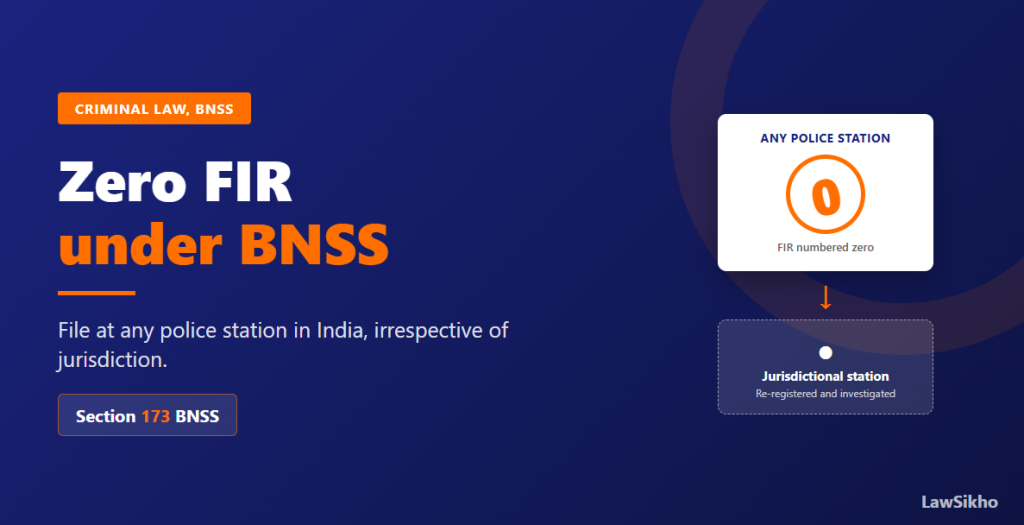
A Zero FIR is a First Information Report that can be registered at any police station in India, regardless of where the crime occurred, under Section 173(1) of the Bharatiya Nagarik Suraksha Sanhita, 2023 (BNSS). It is numbered “0”, then transferred to the police station with territorial jurisdiction, which re-registers it as a regular FIR and investigates.
That is the whole idea in four sentences. The rest of this guide unpacks the Section 173 framework, the difference between a Zero FIR and its lookalikes, the step-by-step filing routes, the escalation path if you’re refused, the case law that backs you, and the 2025 limits every reader should know.
What is a Zero FIR?
A Zero FIR is a First Information Report that any police station can register even when the crime did not happen within that station’s local area. The station records the information, gives it the serial number “0” (which is where the name comes from), and then forwards it to the police station that does have territorial jurisdiction. That second station re-registers it as a regular, numbered FIR and runs the investigation.
The single most important thing to get right? A Zero FIR is a full FIR, not a lesser “complaint” or a soft note in a diary. It sets the machinery of criminal investigation in motion the moment it is recorded. The Delhi High Court, in Kirti Vashisht v. State (Delhi High Court, 2019), explained the point directly: the only real difference between a Zero FIR and an ordinary FIR is that a Zero FIR can be lodged at any police station irrespective of jurisdiction, and is later transferred to the competent station. Same legal weight. Different starting counter.
People trip over the “0” and assume it signals something provisional. It doesn’t. The zero is a numbering convention, nothing more. When the file reaches the right station, that station allots a real FIR number and the investigation continues seamlessly. Think of the “0” as a placeholder that says “recorded here, belongs there,” not as a downgrade in status.
Zero FIR meaning and full form
Let’s clear up a common search. “Zero FIR” has no grand full form. FIR itself stands for First Information Report, and “Zero” is simply the serial number “0” assigned at registration. So the “full form” is really just “a First Information Report numbered zero.” It is a practitioner’s term of art, not a defined statutory phrase, which is why you’ll find the concept in Section 173 without the words “Zero FIR” appearing in the section itself.
In Hindi, people often ask for the meaning as well: a Zero FIR is a FIR that can be lodged at any thana (police station) regardless of where the offence occurred, and is then transferred to the concerned thana for investigation. The word “zero” (शून्य) refers to that placeholder number, not to any weakness in the report.
Why it is called “Zero” FIR: origin and history
Why “zero” and not “one” or “A”? Because when a station records a crime it cannot itself investigate (usually for want of jurisdiction), it needs a way to log the report without slotting it into its own running FIR register. Marking it “0” keeps the station’s own numbered series clean while still creating an official, time-stamped record that the crime was reported. The number travels with the file until the right station takes over and gives it a proper number.
The concept was never a sudden invention. For years it lived as an administrative practice, encouraged by the police manual and by good sense, so that a victim standing in the wrong station at 2 a.m. would not be sent away. But practice is fragile. An officer who wanted to avoid work could always fall back on “not my area.” That gap between what should happen and what did happen is exactly what the reforms after 2012 tried to close.
From the 2012 Verma Committee to statutory recognition
The arc from an ad-hoc favour to a codified right runs through a decade of reform. It’s worth walking through it, because knowing the history tells you how strong your position actually is at the counter today.
It began with the December 2012 Delhi gang-rape case and the national reckoning that followed. In January 2013, the Justice J.S. Verma Committee submitted its report on amendments to criminal law, recommending, among sweeping reforms, that police must not refuse to register cases and that failure to do so should carry consequences. That fed into the Criminal Law (Amendment) Act, 2013, which inserted the old Section 166A into the Indian Penal Code: a public servant who failed to record information about specified offences could face imprisonment.
Then came the judicial anchor. In Lalita Kumari v. Government of U.P., (2014) 2 SCC 1, a five-judge Constitution Bench of the Supreme Court held in 2013 that registration of an FIR is mandatory under the old Section 154 of the Code of Criminal Procedure if the information discloses a cognizable offence, with only narrow room for a preliminary enquiry. Read together, the amendment and the ruling meant a station could no longer treat FIR registration as optional. The Ministry of Home Affairs reinforced this with advisories in 2013 and 2015 directing police not to refuse registration on jurisdiction grounds, and specifically endorsing Zero FIRs.
The final step was statutory. When the Bharatiya Nagarik Suraksha Sanhita, 2023 came into force on 1 July 2024, it wrote the “irrespective of the area” language directly into Section 173(1). The Ministry of Home Affairs and the Bureau of Police Research and Development also issued standard operating procedures around Zero FIR and e-FIR in mid-2024 to guide stations on the ground. So the Zero FIR you can demand today is not a courtesy. It is the product of a 2012 tragedy, a committee, an amendment, a Constitution Bench, and finally a fresh criminal code.
Section 173 BNSS: the legal framework for Zero FIR
If you remember only one section from this entire guide, make it this one. Section 173 of the Bharatiya Nagarik Suraksha Sanhita, 2023 is the statutory home of both the ordinary FIR and the Zero FIR. It replaces the old Section 154 of the Code of Criminal Procedure, and it is the provision you cite when you want a station to record your information and stop hiding behind a map.
Section 173(1): information in cognizable cases, “irrespective of the area”
Section 173(1) of the BNSS deals with information relating to a cognizable offence. The operative phrase, and the one that matters most for Zero FIR, is that the information shall be recorded “irrespective of the area where the offence is committed.” That clause is the whole point. It tells every police station that the location of the crime is not a valid reason to turn you away at the stage of recording.
Why does that clause carry so much weight? Because the Supreme Court had already said, in Satvinder Kaur v. State (Govt. of NCT of Delhi), AIR 1999 SC 3596, that an investigation cannot be thwarted merely because of a question of territorial jurisdiction. The officer in charge must record the information; whether that station ultimately has jurisdiction to investigate is a separate question to be sorted out later, not a gate to keep the victim out. Section 173(1) now puts that principle in the statute itself, which is why you can be confident insisting on registration wherever you are.
A cognizable offence, in plain terms, is one serious enough that police can register an FIR and start investigating without first getting a magistrate’s permission (murder, rape, kidnapping, robbery, and the like). Zero FIR belongs to this world of cognizable offences. That distinction matters when we get to what a Zero FIR is not.
Section 173(2), (3) and (4): free copy, preliminary enquiry, and refusal path
The rest of Section 173 gives you three practical tools, and most people have never heard of two of them.
First, Section 173(2). Once the information is recorded, a copy of the FIR must be given to the informant or victim, free of cost. This is not a favour you request; it is your entitlement. Always collect it, because that copy carries the “0” number and the record that you reported the crime on a particular date and time.
Second, Section 173(3). For a narrow band of offences, those punishable with three years or more but less than seven years, the officer may, with the prior permission of an officer not below the rank of Deputy Superintendent of Police, first conduct a preliminary enquiry within fourteen days to check whether a prima facie case exists, instead of registering an FIR immediately. This is a limited window, not a general escape hatch. For the most serious offences, registration remains immediate.
Third, Section 173(4). If the officer in charge refuses to record the information, the aggrieved person can send the substance of that information, in writing and by post, to the Superintendent of Police. If the SP is satisfied that it discloses a cognizable offence, the SP either investigates or directs a subordinate to do so. Keep this route in mind; it is the first formal rung of the refusal ladder we build later.
How BNSS Section 173 differs from the old CrPC Section 154
Readers who studied criminal procedure a few years ago learned all of this under the Code of Criminal Procedure, 1973. The BNSS reshuffled the numbers, and getting the mapping right matters when you cite the law. If you want the full comparison, we’ve covered how FIR registration changed from Section 154 CrPC to Section 173 BNSS in a dedicated piece.
The short version: the old Section 154 CrPC (FIR in cognizable cases) is now Section 173 BNSS; the old Section 156(3) CrPC (a magistrate directing registration and investigation) is now Section 175(3) BNSS; and the old Section 166A IPC (penalty on a public servant who fails to record information) is now Section 199 of the Bharatiya Nyaya Sanhita, 2023. The substance is broadly continuous, but two things are genuinely new. The “irrespective of the area” language is now express, and the preliminary-enquiry window in Section 173(3) is written into the statute with a defined bracket and timeline. Under the old code, Zero FIR itself was judge-made and administrative; under the BNSS, its foundation is statutory.
Zero FIR vs regular FIR vs e-FIR vs cross FIR: how they differ
Half the confusion around Zero FIR comes from four similar-sounding terms getting mixed up. A Zero FIR, a regular FIR, an e-FIR, a cross FIR, and an NCR entry aren’t five words for the same thing. Here’s a clean comparison, then the distinctions in plain prose.
| Parameter | Regular FIR | Zero FIR | e-FIR | Cross FIR |
|---|---|---|---|---|
| Jurisdiction | Station where the offence occurred | Any station, irrespective of area | Depends on the portal or state rules | Same incident, opposite party’s version |
| Serial number | Regular running number | Numbered “0” until transferred | Regular number once confirmed | Its own regular number |
| Mode of filing | In person, at the counter | In person or online | Online or via a portal | In person or online |
| What happens next | Investigated by that station | Transferred to the jurisdictional station, then investigated | May need in-person signature within a set window | Investigated alongside the first FIR |
| When it is used | Crime within local area | Crime outside the local area, or victim elsewhere | Convenience, cyber and property offences | Two sides accusing each other over one event |
Zero FIR vs regular FIR
A regular FIR is registered by the police station that has territorial jurisdiction over the place where the crime happened, and it carries a running serial number from that station’s register. A Zero FIR is registered by any station regardless of jurisdiction, carries the number “0”, and is then transferred to the correct station, which re-registers it with a real number. So the difference is not legal quality; both are First Information Reports with identical status. The difference is where you can file it and what number it starts with.
Zero FIR vs e-FIR, cross FIR, and an NCR entry
An e-FIR is not a different kind of FIR at all. It is a mode of filing: lodging the report online through a state police portal or the national cybercrime portal, instead of walking up to a counter. An e-FIR can itself be a Zero FIR if it is filed online for a crime outside that jurisdiction. So the two categories overlap rather than compete. (More on the online route, and the important signature rule, in the filing section below.)
A cross FIR is something else entirely. It is a counter-FIR: when two parties to the same incident each accuse the other, and each lodges a separate FIR, those competing FIRs are called cross FIRs or cross cases. They can be investigated together, but they are distinct reports arising from opposite versions of one event. A Zero FIR, by contrast, is about location, not about a rival version.
Then there is the NCR, or non-cognizable report. When the offence is non-cognizable (a minor offence where police cannot investigate without a magistrate’s order), the station records an NCR entry, not an FIR, and typically advises the complainant to approach a magistrate. An NCR is not a Zero FIR and does not start a police investigation on its own. Finally, a “complaint” in the strict sense is an allegation made to a magistrate, which is a separate track from an FIR made to the police. Keep these four apart and most of the online confusion dissolves.
Parameter
Regular FIR
Zero FIR
e-FIR
Cross FIR
Jurisdiction
Station where the offence occurred
Any station, irrespective of area
Depends on the portal or state rules
Same incident, opposite party’s version
Serial number
Regular running number
Numbered “0” until transferred
Regular number once confirmed
Its own regular number
Mode of filing
In person, at the counter
In person or online
Online or via a portal
In person or online
What happens next
Investigated by that station
Transferred to the jurisdictional station, then investigated
May need in-person signature within a set window
Investigated alongside the first FIR
When it is used
Crime within local area
Crime outside the local area, or victim elsewhere
Convenience, cyber and property offences
Two sides accusing each other over one event
How to file a Zero FIR under BNSS
Enough theory. If you or someone you know needs to file a Zero FIR right now, here’s exactly how to do it, first the walk-in route, then the online route. This section is the practical core, so read it as a checklist rather than an essay.
Filing a Zero FIR in person (walk-in), step by step
- Go to any police station. It does not have to be the station where the crime happened; the nearest or most convenient one will do.
- Give the information about the cognizable offence, orally or in writing. If you speak it, the officer must reduce it to writing.
- Say clearly that you want it recorded under Section 173 of the BNSS as a Zero FIR, since the offence falls outside this station’s area.
- Have the recorded information read over to you, and check it for accuracy before you sign it.
- Collect your free copy of the FIR under Section 173(2). Do not leave without it.
- Note the “0” FIR number and ask which station the file is being transferred to, so you can follow up there.
Before you go, a quick “what to carry and what to say” checklist helps. Carry any government photo ID (Aadhaar, voter ID, passport, driving licence), whatever documents relate to the incident (medical papers, screenshots, receipts, damaged items, threatening messages), and a written note of the who, what, when and where while it is fresh. And if the officer starts with “wrong jurisdiction,” the sentence to use is simple: “I am giving information about a cognizable offence. Please register it as a Zero FIR under Section 173 and give me a copy.” You are not asking for a favour. You are stating the law.
Filing an e-FIR or e-Zero FIR online
Online registration has grown fast, especially for cyber and financial offences. For cybercrime and online fraud, the national channel is the National Cybercrime Reporting Portal (cybercrime.gov.in) and the 1930 helpline; many states also run their own police portals for e-FIRs. If you are outside the jurisdiction of the crime, an online report can operate as an e-Zero FIR, filed anywhere, routed to the right station. We’ve walked through the mechanics of filing a cybercrime FIR under BNS Section 111 separately for readers who need that specific route.
Two practical points decide whether your online report actually becomes a live FIR. First, the signature step: for e-FIRs, you are generally required to visit the police station and sign the report within three days for it to be treated as a validly registered FIR. Skip that step and the report may lapse. Second, tracking: once registered, keep the acknowledgement or reference number, which lets you track the status of your complaint or FIR online through the same portal. (The dedicated e-Zero FIR cyber-fraud initiative, and its automatic-conversion rule, is covered in the recent-changes section further down.)
Is there a fee, and can you file in another city or state?
No, there’s no fee. Registering an FIR, Zero or regular, costs nothing. Any officer who demands money to register your report is acting illegally, and that itself is misconduct you can report.
And yes, you can file in a different city or state from where the crime happened. That is precisely what the Zero FIR exists for. A person robbed in Mumbai can walk into a station in Delhi, and a woman assaulted while travelling can report at the nearest station wherever she is. The station records the Zero FIR and transfers it. Location is a routing problem for the police to solve, not a barrier for you to overcome.
It does not have to be the station where the crime happened. The nearest or most convenient one will do. Orally or in writing. If you speak it, the officer must reduce it to writing. Say clearly you want it recorded under Section 173 of the BNSS as a Zero FIR, since the offence falls outside this station’s area. Have the recorded information read over to you, and check it for accuracy before you sign it. This copy is free of cost and your entitlement. Do not leave without it. Ask which station the file is being transferred to, so you can follow up there.Go to any police station
Give the information about the cognizable offence
Insist it be recorded as a Zero FIR
Read it over and sign
Collect your free copy under Section 173(2)
Note the “0” number and the transferee station
What happens after a Zero FIR is filed: transfer and preliminary enquiry
Filing is the start, not the finish. Once a Zero FIR is recorded, two things can happen next: it gets transferred to the right station, and in a narrow set of cases, a short preliminary enquiry may run first. Knowing this sequence keeps you from panicking when the FIR number changes or the file seems to move.
Transfer to the jurisdictional station and re-registration
After a Zero FIR is registered, the station forwards it to the police station that holds territorial jurisdiction over the place of the offence. That receiving station registers a regular, numbered FIR based on the same information and takes over the investigation. So yes, the FIR number changes on transfer: the “0” gives way to that station’s running number. This is normal and does not weaken your case; it is the same information, now docketed where it belongs.
Who investigates after transfer? The jurisdictional station. The station where you first filed does not usually run the full investigation; its job was to record the report and route it correctly.
How fast does the transfer happen? Here, be careful with the numbers you’ll see online. Many sources quote a “24-hour” transfer figure, and administrative SOPs and good practice do push stations to move quickly, often within a day. But treat that as the operational expectation rather than a hard statutory deadline carved into Section 173. If the transfer stalls for days with no movement, that delay is something you can escalate.
Preliminary enquiry under Section 173(3): scope and 14-day window
In a limited category of cases, the officer may run a preliminary enquiry before registering the FIR, and it helps to know when this is legitimate. Under Section 173(3) of the BNSS, for offences punishable with three years or more but less than seven years, an officer, with the prior permission of an officer not below the rank of Deputy Superintendent of Police, may conduct a preliminary enquiry within fourteen days to see whether a prima facie case exists.
The point of the enquiry is to filter out cases in that middle bracket where a quick check is sensible, not to delay serious matters. For the gravest cognizable offences, there is no such enquiry; registration is immediate, in line with what the Constitution Bench laid down. If an officer tells you a preliminary enquiry is needed for a clearly serious offence, that is a misreading of the provision, and you are within your rights to press for immediate registration.
If the police refuse: the remedy ladder
Here’s the section to bookmark. Despite a clear statute and decades of case law, refusal at the counter still happens. The good news is that the law gives you an ordered escalation path, and each rung is stronger than the last. Treat it as a ladder: you climb only as high as you need to.
The legal ground under your feet is solid. In State of A.P. v. Punati Ramulu, AIR 1993 SC 2644, the Supreme Court held that a police officer’s refusal to record information on the ground that the offence occurred outside the station’s jurisdiction is a dereliction of duty. And in Satvinder Kaur, the Court made clear that jurisdiction is no reason to thwart registration and investigation. So when you escalate, you are not being difficult; you are enforcing a duty the officer owes you.
Step 1 to 2: escalate within the police and the Section 199 BNS penalty
Step 1: escalate within the police force. If the officer in charge refuses to register your Zero FIR, send the substance of the information in writing to the Superintendent of Police under Section 173(4) of the BNSS. If the SP is satisfied a cognizable offence is disclosed, the SP must investigate or direct an investigation. A written, dated communication (kept with proof of dispatch) is far harder to ignore than an oral request at a counter. If you need a model to work from, see how a written criminal complaint is drafted.
Step 2: know the penalty that hangs over the refusing officer. Section 199 of the Bharatiya Nyaya Sanhita, 2023 (the successor to the old Section 166A IPC) makes it an offence for a public servant to fail to record information about specified cognizable offences. In other words, refusing to register certain FIRs is not just bad service; it can be a crime by the officer. Mentioning this provision, calmly, often changes the temperature at the counter, because the officer knows the exposure is personal.
Step 3 to 4: Magistrate under Section 175(3) BNSS, then an Article 226 writ
Step 3: go to the Magistrate. If the police still will not act, you can apply to the jurisdictional Magistrate under Section 175(3) of the BNSS, which empowers the Magistrate to direct registration and investigation (this is the successor to the old Section 156(3) CrPC route). Note the newer pre-conditions: the BNSS expects you to have first approached the SP under Section 173(4) and to support your application with an affidavit. So your earlier written complaint to the SP is not a throwaway step; it is the foundation the Magistrate application is built on.
Step 4: the writ. As the last rung, you can approach the High Court under Article 226 of the Constitution for a writ (typically mandamus) directing the police to perform their statutory duty and register the FIR. This is the constitutional backstop when the ordinary machinery fails. It is heavier artillery, and in most cases you will not need to reach it, but it exists precisely so that a determined refusal cannot leave a victim without a remedy. Climb the ladder in order, keep every piece of paper, and each step becomes evidence for the next.
Refusal on the ground of “wrong jurisdiction” is a dereliction of duty. The law gives you an ordered escalation path, and each rung is stronger than the last. Insist the report be recorded as a Zero FIR under Section 173, wherever you are. If refused, ask for the refusal in writing and note the officer’s name. Send the substance of the information in writing to the SP under Section 173(4) BNSS. If satisfied a cognizable offence is disclosed, the SP must investigate or direct an investigation. Apply to the Magistrate under Section 175(3) BNSS to direct registration and investigation, backed by the Section 199 BNS penalty on the refusing officer. Approach the High Court under Article 226 for a writ (typically mandamus) directing the police to perform their statutory duty and register the FIR.Register at any station
Written complaint to the Superintendent of Police
Application to the Magistrate
Writ under Article 226
Scope, limits and eligibility: when a Zero FIR is (and isn’t) right
A Zero FIR is powerful, but it isn’t a universal key. Knowing its limits protects you from two opposite mistakes: trying to use it where it doesn’t apply, and accepting it where you should have insisted on a regular FIR. Both matter.
Which offences, which complainants
Start with the offences. A Zero FIR is for cognizable offences, the serious category where police can register and investigate without a magistrate’s prior order. For non-cognizable offences, the station records an NCR entry and points you to a magistrate; a Zero FIR is not the right vehicle there. If you are unsure which side of the line your situation falls on, we’ve mapped the line between cognizable and non-cognizable offences in detail.
Who can file? Not only the victim. A Zero FIR can be lodged by anyone who has information about a cognizable offence, including a witness, a relative, or a bystander.
For women and sexual offences, the protection is stronger still: the law allows information about specified offences against women to be recorded at any police station, and the BNSS carries provisions (including the Section 176 investigation framework) tailored to such cases, so a survivor is never trapped by geography. Cybercrime and online fraud are squarely covered too, and the online channels make a Zero FIR practical even when the offender is in another state. On timing, there is no rigid statutory cut-off for reporting a cognizable offence, though delay can invite questions about the evidence, so report as early as you reasonably can.
The 2025 Delhi High Court limit: a Zero FIR is not a shortcut to offload a case
Now the nuance that almost no guide covers, and the one that can protect your case. A Zero FIR is meant for situations where the crime lies outside the station’s jurisdiction. It isn’t a device for a station to dump a case that actually belongs to it.
In a 2025 ruling, X v. State (NCT of Delhi), 2025 SCC OnLine Del 2918 (decided by Narula J. on an anonymised cause-title; reported here), the Delhi High Court addressed exactly this misuse. Where part of the alleged offence had occurred within the local station’s own jurisdiction, the Court held that the station should have registered a regular FIR rather than a Zero FIR and transferred the matter to another State. In the Court’s words, that mechanical transfer “undermines the gravity of the allegations,” and it risked delaying investigation and compromising evidence. The direction was clear: register a regular FIR and investigate locally.
The lesson runs in the opposite direction from the usual advice. Usually we tell you to insist on a Zero FIR when a station stalls on jurisdiction. But if any part of the offence happened within the station’s own area, insist on a regular FIR instead, because a Zero-FIR-and-transfer there can quietly push your case out of reach and slow everything down. The tool is right for the wrong-jurisdiction case, and wrong for the local case dressed up as one.
Landmark case law on Zero FIR and FIR registration
You do not need to be a lawyer to benefit from knowing the cases, because naming the right judgment at the right moment tells an officer you know exactly where you stand. Five decisions carry most of the weight for Zero FIR, and each does a specific job.
The foundation is Lalita Kumari v. Government of U.P., (2014) 2 SCC 1. A five-judge Constitution Bench held that registering an FIR is mandatory when information discloses a cognizable offence, with only a narrow space for preliminary enquiry in specified categories. This is the duty a Zero FIR operationalises; without the mandatory-registration principle, the whole structure would collapse.
Next, Satvinder Kaur v. State (Govt. of NCT of Delhi), AIR 1999 SC 3596. The Supreme Court held that an investigation cannot be thwarted for want of territorial jurisdiction, and that the station must register the information first and sort out jurisdiction later. This is the legal engine behind the “irrespective of the area” language now in Section 173(1).
Then State of A.P. v. Punati Ramulu, AIR 1993 SC 2644. The Court treated a police officer’s refusal to record information on jurisdiction grounds as a dereliction of duty. This is the case that turns “not my area” from an excuse into misconduct, and it sits at the heart of the refusal-remedy ladder.
For the definition itself, Kirti Vashisht v. State (Delhi High Court, 2019) is the go-to. The Delhi High Court expressly explained “Zero FIR,” clarifying that the only difference from a regular FIR is that it can be lodged at any police station irrespective of jurisdiction and is later transferred. Judgments that use the phrase by name are rare, which is what makes this one useful.
Finally, the freshest authority, X v. State (NCT of Delhi), 2025 SCC OnLine Del 2918. Decided in 2025, per Narula J. on an anonymised cause-title, it marks the boundary: where the offence falls within the local station’s jurisdiction, a regular FIR must be registered, and a mechanical Zero-FIR transfer is improper. Together these five cases give you both the sword (register it, wherever I am) and the shield (do not offload my local case).
Common mistakes people make with Zero FIR
Even people who know their rights slip up on the details. A few recurring errors do real damage, so here’s what to avoid.
- Treating a Zero FIR as a “lesser” complaint. It is a full FIR with identical legal status. Do not let anyone, including yourself, downgrade it in your mind.
- Walking away without the free copy or the “0” number. That copy is your proof of what you reported and when; under Section 173(2) it is your right, so collect it every time.
- Accepting a “wrong jurisdiction” refusal at face value. As the case law shows, jurisdiction is no ground to refuse recording. Insist, then escalate if needed.
- Letting two stations ping-pong the file. If the receiving station and the filing station keep passing your case back and forth, break the loop with a written complaint to the SP under Section 173(4) and, if needed, a Section 175(3) application to the Magistrate.
- Assuming a Zero FIR is inadmissible or worthless as evidence. It is a valid FIR; its evidentiary value is the same as any FIR, and transfer does not dilute it.
- Assuming an online report is automatically a registered FIR. For e-FIRs you usually must complete the in-person signature step (commonly within three days) for it to count. And remember, filing and transfer do not mean your case has been dismissed; a transfer is routing, not rejection.
Recent changes: the e-Zero FIR initiative and what comes next
The Zero FIR isn’t a settled relic; it’s actively evolving, and 2025 brought its biggest upgrade yet. The direction of travel is clear: from paper to portal, from favour to automatic entitlement, from “when did you report?” arguments to machine time-stamps. Here’s where things stand and where they are heading.
The 19 May 2025 e-Zero FIR initiative for cyber fraud
On 19 May 2025, according to the Ministry of Home Affairs, its Indian Cyber Crime Coordination Centre (I4C) rolled out an e-Zero FIR initiative aimed squarely at cyber fraud. The mechanism is genuinely new: cyber-financial-fraud complaints made on the National Cybercrime Reporting Portal or the 1930 helpline, where the loss crosses a high-value threshold reported as ₹10 lakh, are automatically converted into a Zero FIR, registered with the e-Crime police station in Delhi. The system stitches together the I4C’s NCRP, Delhi Police’s e-FIR system, and the National Crime Records Bureau’s Crime and Criminal Tracking Network and Systems (CCTNS). The complainant then has three days to visit the cybercrime police station and have the Zero FIR converted into a regular FIR.
Two caveats worth stating plainly. This launched as a Delhi pilot, with national rollout announced as the plan rather than an accomplished fact, so its reach beyond Delhi is still expanding. And the ₹10 lakh figure and rollout status are drawn from official and concordant secondary reporting around the launch; anyone acting on the exact number should confirm the current threshold, since a pilot like this can be recalibrated. What is not in doubt is the design: for the first time, a serious cyber fraud can trigger a Zero FIR without a human at a counter deciding whether to record it.
Where Zero FIR is heading: digitisation, CCTNS auto-routing, and accountability
Look a little further out and the trajectory sharpens. Full e-FIR digitisation and a wider e-Zero FIR rollout would make portal-based registration the default for cyber and property-fraud complaints, not the exception. As CCTNS and the wider Inter-operable Criminal Justice System mature, auto-routing of Zero FIRs to the correct jurisdictional station should shrink the transfer window, in principle toward something close to real time, easing the very ping-pong problem victims complain about today.
The most interesting second-order effect is about accountability, and it is easy to miss. Every e-Zero FIR creates a machine log of when the complaint was made against when it was registered. That timestamp is a quiet revolution: it makes police refusal or delay provable in a way paper diary entries never did, which in turn strengthens the Section 199 BNS penalty and the Article 226 writ remedy, because now there is data, not just an aggrieved person’s word. Expect, over time, compliance dashboards, and quite possibly a lowering of the ₹10 lakh cyber threshold as the pilot proves out and pressure grows to cover smaller frauds. The Zero FIR that began as a response to a 2012 tragedy is becoming the backbone of India’s digital-era crime reporting.
The December 2012 Delhi gang-rape case and the national reckoning that followed forced a hard look at how police recorded crimes. The Justice J.S. Verma Committee reported on criminal-law amendments, recommending that police must not refuse to register cases. It fed the Criminal Law (Amendment) Act, 2013. A five-judge Constitution Bench held that registering an FIR is mandatory when the information discloses a cognizable offence. Section 173(1) wrote the “irrespective of the area” language directly into statute, giving the Zero FIR its black-letter foundation. The I4C rolled out an e-Zero FIR initiative for cyber fraud, auto-converting high-value complaints into a Zero FIR without a human at the counter.The Delhi case
Justice Verma Committee
Lalita Kumari: mandatory registration
BNSS in force
e-Zero FIR
Frequently asked questions about Zero FIR under BNSS
What exactly is a Zero FIR? A Zero FIR is a First Information Report that any police station can register even if the crime happened outside its area. It is numbered “0”, then transferred to the police station with territorial jurisdiction, which re-registers it as a regular FIR and investigates. It is a full FIR, not a lesser complaint, and it exists so a victim is never turned away over jurisdiction.
Does “Zero FIR” have a full form, and what does it mean? There is no special full form. FIR stands for First Information Report, and “Zero” simply refers to the serial number “0” given at registration. So a Zero FIR is just a First Information Report numbered zero, recorded at any station and later moved to the one with jurisdiction. The phrase is a practitioner’s term; the underlying provision is Section 173 of the BNSS.
Under which section of the BNSS is a Zero FIR provided? The statutory basis is Section 173 of the Bharatiya Nagarik Suraksha Sanhita, 2023. Section 173(1) requires police to record information about a cognizable offence “irrespective of the area where the offence is committed,” which is the exact language that supports a Zero FIR. Section 173(2) gives you a free copy, and Section 173(4) sets out what to do if an officer refuses.
How is a Zero FIR different from a regular FIR? Legally, they are the same instrument: both are First Information Reports with identical status. The difference is practical. A regular FIR is registered by the station with jurisdiction and carries that station’s running number. A Zero FIR is registered by any station, numbered “0”, and then transferred to the jurisdictional station, which allots a real number and investigates.
How do I file a Zero FIR? Walk into any police station and give information about the cognizable offence, orally or in writing. Ask that it be recorded under Section 173 as a Zero FIR, have it read over to you, sign it, and collect your free copy under Section 173(2). Note the “0” number and the station it is being transferred to. There is no fee at any stage.
Can I file a Zero FIR online? Yes, in effect, through e-FIR channels. For cybercrime and online fraud, use the National Cybercrime Reporting Portal (cybercrime.gov.in) or the 1930 helpline; many states also have their own police portals. An online report for an out-of-area crime works as an e-Zero FIR. For most e-FIRs you must still visit the station and sign within about three days for it to count as a registered FIR.
Can a Zero FIR be filed at any police station? Yes. That is the entire purpose of a Zero FIR. Section 173(1) of the BNSS requires information about a cognizable offence to be recorded irrespective of where the offence took place. So the nearest or most convenient station must record your report and then transfer it to the station with jurisdiction. Location is the police’s routing task, not a barrier for you.
Can I file a Zero FIR in a different city or state from where the crime happened? Absolutely. A person robbed in one city can report at a station in another; a traveller assaulted mid-journey can report wherever they are. The station records the Zero FIR and forwards it to the jurisdictional station for investigation. This cross-city, cross-state flexibility is exactly why the Zero FIR mechanism was created and later codified in the BNSS.
What is the e-Zero FIR initiative and how do I use it for cyber fraud? Announced on 19 May 2025 by the Ministry of Home Affairs through the I4C, the e-Zero FIR initiative automatically converts high-value cyber-fraud complaints (reported threshold around ₹10 lakh) made on the NCRP or 1930 helpline into a Zero FIR. You report the fraud on the portal or helpline; if it qualifies, a Zero FIR is generated, and you then have three days to visit the cybercrime station to convert it into a regular FIR. It launched as a Delhi pilot.
Is there any fee to file a Zero FIR? No. Registering an FIR, whether a regular FIR or a Zero FIR, is completely free. No police officer may charge you to record your information. If anyone demands money to register your report, that itself is misconduct, and you can report it up the chain to the Superintendent of Police.
How soon is a Zero FIR transferred to the jurisdictional station? The expectation, under administrative practice and standard operating procedures, is that the transfer happens quickly, often within about a day. Treat the widely quoted “24 hours” as an operational target, not a hard statutory deadline written into Section 173. If the file stalls for several days with no movement, that delay is something you can escalate to the Superintendent of Police.
What can I do if the police refuse to register my Zero FIR? Climb the remedy ladder. First, send the information in writing to the Superintendent of Police under Section 173(4). If refusal continues, apply to the Magistrate under Section 175(3) of the BNSS to direct registration and investigation. As a final step, approach the High Court under Article 226 for a writ. Keep every document, since each step supports the next.
What is the remedy under Section 175(3) of the BNSS? Section 175(3) lets you ask a Magistrate to direct the police to register an FIR and investigate a cognizable offence when they have failed to act. It is the successor to the old Section 156(3) CrPC route. Under the BNSS, you are generally expected to have first approached the Superintendent of Police under Section 173(4) and to file an affidavit supporting your application to the Magistrate.
What punishment does a police officer face for not registering an FIR? Section 199 of the Bharatiya Nyaya Sanhita, 2023 (the successor to the old Section 166A IPC) makes it an offence for a public servant to fail to record information about specified cognizable offences. So refusing to register certain FIRs is not just poor service; it can be a criminal offence by the officer, carrying imprisonment. This personal exposure is often enough to change an officer’s response at the counter.
Can a Zero FIR be filed for any offence, or only cognizable ones? Only for cognizable offences, the serious category where police can register and investigate without a magistrate’s prior order. For non-cognizable offences, the station records a non-cognizable report (NCR) and directs you to a magistrate; a Zero FIR is not the right route there. So before insisting on a Zero FIR, check that the offence is cognizable.
Can a woman file a Zero FIR for a sexual offence at any police station? Yes, and the protection here is deliberately strong. The law allows information about specified offences against women, including sexual offences, to be recorded at any police station regardless of where the offence occurred, and the BNSS carries a tailored investigation framework for such cases. A survivor should never be turned away over jurisdiction; the station must record the Zero FIR and transfer it to the competent station.
Can a Zero FIR be quashed? Yes. A Zero FIR, being a full FIR, can be challenged and quashed like any other, typically by approaching the High Court under its inherent powers. For how that works in detail, see our guide on whether and how a Zero FIR can be quashed under Section 528 BNSS. Quashing depends on the facts, such as whether the allegations disclose an offence or the proceedings are an abuse of process.
Has the e-Zero FIR system been rolled out across India yet? As of the latest information, the e-Zero FIR initiative launched on 19 May 2025 as a pilot in Delhi, with a national rollout announced as the plan rather than a completed step. Its reach beyond Delhi is still expanding, so availability and the exact threshold may vary by the time you read this. Confirm the current status for your state before relying on automatic conversion.
References
Case Law
- Kirti Vashisht v. State (Delhi High Court, 2019), decided 29 November 2019.
- Lalita Kumari v. Government of U.P., (2014) 2 SCC 1, Supreme Court, Constitution Bench (five judges), 12 November 2013.
- Satvinder Kaur v. State (Govt. of NCT of Delhi), AIR 1999 SC 3596, Supreme Court, 5 October 1999.
- State of Andhra Pradesh v. Punati Ramulu, AIR 1993 SC 2644, Supreme Court, 19 February 1993.
- X v. State (NCT of Delhi), 2025 SCC OnLine Del 2918, Delhi High Court, Narula J., 2 May 2025 (anonymised cause-title; not yet indexed on Indian Kanoon; news report).
Statutes
- Bharatiya Nagarik Suraksha Sanhita, 2023; sections cited: 173, 175 and 176.
- Bharatiya Nyaya Sanhita, 2023; section cited: 199.
Secondary sources (optional)
- Press Information Bureau release on the e-Zero FIR initiative (PRID 2129715, 19 May 2025).
- Bureau of Police Research and Development standard operating procedure on Zero FIR and e-FIR.
Legal disclaimer
This article is for informational and educational purposes only and does not constitute legal advice. Laws, procedures, and thresholds change, and their application depends on the facts of each case. For advice on a specific situation, consult a qualified advocate before acting.





 Allow notifications