
Last verified: 2026-07-03
An arbitrator sat on a domestic dispute for years, then delivered the award roughly three months after the tribunal’s mandate had already lapsed. To the losing side, that lateness was a gift. Under Section 29A of the Arbitration and Conciliation Act, 1996, the time limit for making the award had blown past, so the party resisting the award argued the whole thing was a dead letter, a nullity, worth nothing.
Years of hearings, thousands of pages of pleadings, and the award arrived stillborn. Or so the argument went. The tribunal had taken up the reference, the pleadings had closed, and the statutory window to make the award had opened and then quietly shut before the signed award appeared.
A single judge of the High Court agreed. In an order dated 24 January 2025, the court held the late award was a nullity and declined to extend the arbitrator’s mandate. Once the mandate had lapsed, the reasoning ran, the arbitrator was spent, and no application could revive a completed but out-of-time award. On that reading, the arbitration was simply over.

The claimant had run the full course, won on paper, and lost everything to a calendar. Nothing about the merits had changed; the delay alone was doing the work of a defence. It is the kind of outcome that makes commercial parties wonder why they chose arbitration at all, and why a private process meant to save time had handed the other side an escape hatch.
Then the Supreme Court took a different view. On 3 February 2026, in C. Velusamy v. K. Indhera, 2026 INSC 112, the Court held that a Sec. 29A(5) application to extend the mandate is maintainable even after an award has been rendered post-expiry. Yes, the late award is ineffective and unenforceable as it stands. But the court’s power to extend the mandate is not defeated by the arbitrator’s lapse.
The tribunal can resume from the stage where the mandate ended and deliver a fresh, valid award. The lateness was a wound, not a death.
Read that sequence again, because it captures what is actually at stake in the “12 plus 6” clock that most practitioners quote from memory. What happens when the deadline is blown? Who can rescue the arbitration, and where do they go to do it? Is a late award void forever, or just paused?
These are not academic questions. They decide whether a client walks away with an enforceable award or with nothing after years of cost. This guide maps the whole clock, current through 2026, and it starts by fixing the one thing everyone quotes and few get exactly right.
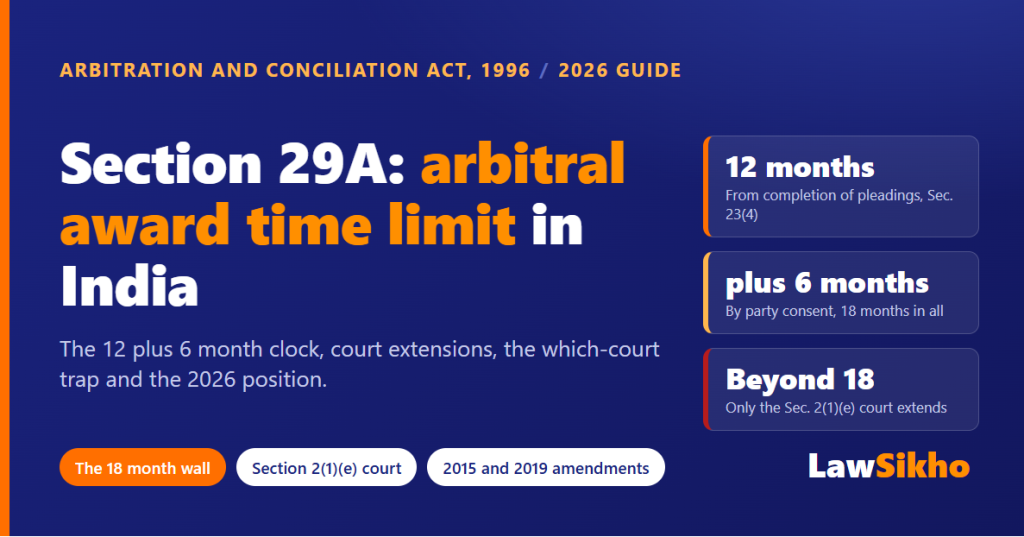
Section 29A of the Arbitration and Conciliation Act, 1996 requires an arbitral tribunal in a domestic arbitration to make its award within 12 months from the completion of pleadings under Section 23(4). Parties may extend this by up to 6 months by mutual consent. Beyond 18 months, only a court can extend the arbitrator’s mandate, and only for sufficient cause.
That definition holds the four things that decide most Sec. 29A disputes: when the clock starts, how far consent stretches it, where the 18-month wall sits, and who alone can move it. Each section below opens one of these up, and one section breaks cleanly into a step-by-step guide to filing the extension application itself.
What is Section 29A of the Arbitration and Conciliation Act?
You chose arbitration to get a faster answer than a civil court would give you. So why does the statute now impose a hard deadline on your own arbitrator? Because for two decades it did not, and that was the problem. Sec. 29A is the provision that put a clock on the tribunal, and understanding what it is (and what it is not) is the foundation for everything else in this guide.
The rule in one line
At its core, Section 29A of the Arbitration and Conciliation Act, 1996 is a statutory deadline for making an arbitral award, backed by real consequences. In a domestic arbitration, the tribunal must make its award within 12 months, extendable by 6 months if the parties agree. Miss that combined 18-month window, and the arbitrator’s mandate does not just wobble; it terminates, unless a court steps in and extends it.
The section also arms the court to cut the arbitrator’s fees for delay the tribunal caused, and to substitute the arbitrator where needed.
That is the whole architecture in one breath: a clock, a consent extension, a court gate beyond it, and teeth. Everything else is detail about how each piece works.
Why the section exists
Here’s the thing about Indian arbitration before 2015. The 1996 Act, as originally enacted, carried no statutory time limit for making an award at all. Arbitrations routinely dragged on for five, seven, even ten years, which quietly defeated the entire promise of the process.
Parties who had opted out of the court system to save time found themselves in a private process that moved no faster, and sometimes slower. Sec. 29A was inserted by the 2015 amendment to cure precisely that reputation for glacial delay.
So the section is not a neutral piece of housekeeping. It is a deliberate legislative response to a specific failure, and courts read it with that purpose in mind. When a judge weighs whether to extend a lapsed mandate, the pull toward finishing the arbitration (rather than letting delay kill it) traces straight back to why the section exists.
What Sec. 29A does not do
Just as important is what this section is not. Sec. 29A is not a limitation period for filing a claim. It does not tell you how long you have to commence an arbitration; that is governed by the Limitation Act, 1963, running from when the cause of action arose. Confusing the two is a common beginner error, and it leads to bad advice about whether a claim is time-barred.
And post-2019, Sec. 29A does not bind an international commercial arbitration to a mandatory clock either. The mandatory 12-month deadline applies to domestic arbitration. For international commercial arbitration, the timeline became directory, a matter we unpack fully further down.
Flag it now, because readers routinely assume the 18-month wall binds every India-seated arbitration. It does not.
When does the 12-month clock start? Completion of pleadings under Sec. 23(4)
Ask ten practitioners when the Sec. 29A clock starts and you will get answers that are years apart, because the trigger changed in 2019 and the old version still circulates. This is not a trivia question. Get the start date wrong and every downstream calculation, the 12-month point, the 18-month wall, the day you must file for an extension, is wrong too. So when does the clock actually begin?
The 2019 trigger: completion of pleadings
Under the current text, the 12 months runs from the date on which the pleadings are completed. That trigger comes from Section 23 of the Arbitration and Conciliation Act, 1996, which was amended in 2019 to add sub-section (4). Pleadings here means the statement of claim and the statement of defence. And there is a nested deadline inside it: the pleadings themselves are to be completed within 6 months from the date the arbitrator, or all the arbitrators, received written notice of appointment.
So the sequence runs like this. Notice of appointment goes to the tribunal, and within 6 months, pleadings should close. From the date pleadings close, the 12-month award clock starts ticking. Two linked deadlines, one feeding the other.
In practice, the completion-of-pleadings date is the single most important date in the whole calculation, and it is the one parties most often fail to pin down in writing.
The old 2015 trigger, and why it still gets quoted
Now, here’s where the confusion comes from. Under the original 2015 text, the clock did not run from completion of pleadings at all. It ran from the date the tribunal “entered upon the reference,” a phrase meaning, broadly, the date the arbitrator received notice in writing of the appointment and agreed to act. That earlier trigger is the one you will still see quoted in older articles, older judgments, and the memory of practitioners who learned the section before 2019.
Treat the “enters upon the reference” phrase as history for a post-2019 domestic arbitration. It matters for arbitrations governed by the pre-2019 text, and it explains a great deal of the older case law, but the operative trigger today is completion of pleadings. What does “enters upon the reference” mean, and does it still matter? It means the tribunal took up the reference after notice, and it matters mainly for the transition question of which version of the clock governs your particular arbitration.
Does a surrejoinder or additional pleadings reset the clock?
A recurring practical question: if the tribunal allows a surrejoinder, a rejoinder, or additional pleadings, does the completion date shift, and with it the whole clock? The short answer is that the clock starts when pleadings are actually marked complete, so a genuinely permitted further pleading can move the completion date. Some High Courts have taken this view where the surrejoinder was a real part of the pleadings, not an afterthought. The line reflected in Buoyant Technology Constellations Pvt. Ltd. v. Manyata Infrastructure Developments Pvt. Ltd., 2024 SCC OnLine Kar 82 (affirmed by the Supreme Court) confirms the principle that the 12-month period begins when the pleadings are marked complete on the record, and that a surrejoinder taken on record with permission counts as part of the pleadings.
But do not treat this as a loophole. A party cannot manufacture delay by seeking pointless additional pleadings and then claim a later start date. The completion date is fixed by what the tribunal actually orders, on the record, not by a party’s tactical wish to reset the clock.
The pitfall: assuming the clock runs from the first hearing
Here is the mistake that quietly ruins the calculation. Many parties assume the 12 months runs from the first hearing, or from the date the arbitrator was appointed. It does not. Under the 2019 text, it runs from completion of pleadings, which can be many months after appointment (up to the 6-month pleadings cap, and sometimes the subject of dispute itself).
The practical reality is that experienced counsel fix the completion-of-pleadings date in writing at the moment it happens, on the record, rather than reconstructing it later from correspondence when an extension is already in play. Docket the completion date. Calendar the 12-month and 18-month points from day one. A party that leaves the start date vague is a party that will argue about it, expensively, at exactly the wrong moment.
The Section 29A time limit stages: 12 months, 18 months, court extension
The “12 plus 6” shorthand hides a three-stage structure, and the stages behave very differently from one another. One is automatic. One needs the parties to agree. One needs a judge.
Confuse which is which and you will either ask a court for something you could have arranged privately, or try to arrange privately something only a court can give. So what are the three stages, and what happens at each wall?
Stage 1: 12 months from completion of pleadings
The first stage is the mandatory 12-month period. In a domestic arbitration, the tribunal must make the award within 12 months from the date pleadings are completed under Sec. 23(4). No court and no consent is needed for this period; it is the baseline the statute grants automatically.
“Make the award” here means a signed, final award, not merely one that has been reserved or orally announced. An award that is reserved on the last day but signed weeks later is not “made” within the period.
That distinction bites. Practitioners occasionally assume that concluding the hearing, or reserving the award, stops the clock. It does not. The relevant act is the making of the award itself, which in practice means the signed instrument that disposes of the reference.
Stage 2: plus 6 months by mutual consent under Sec. 29A(3)
If 12 months is not enough, the parties can buy 6 more, and they can do it entirely on their own. Under Sec. 29A(3), the parties may, by consent, extend the period for making the award by a further time not exceeding 6 months. No court application is required. The consent should be recorded clearly, ideally in a written agreement, joint memo, or a consent order before the tribunal, so there is no later dispute about whether an extension was actually granted or how long it ran.
This takes the outer boundary of the “private” timeline to 18 months. Within that 18 months, the arbitration proceeds under the parties’ own control. Consent is the lever, and it is cheaper and faster than any court route, which is exactly why sophisticated parties reach for it before the 12-month point rather than after.
Stage 3: beyond 18 months, only a court can extend
Here is the wall. Once the 18-month window (12 plus the 6-month consent extension) is exhausted, the parties cannot extend further on their own. Beyond 18 months, only a court can extend the mandate, under Sec. 29A(4) read with Sec. 29A(5), and only for sufficient cause.
At the 18-month mark, the mandate of the arbitrator terminates, unless the court has extended it. That word “unless” is doing enormous work, and we return to it in detail below.
The court’s extension is not a rubber stamp. It comes for sufficient cause, on terms the court thinks fit, and it may carry consequences for the tribunal: the court can reduce the arbitrator’s fees by up to 5% for each month of delay attributable to the tribunal, and it can substitute the arbitrator. So Stage 3 is qualitatively different from the first two. It is discretionary, it is public, and it can be costly.
The at-a-glance table
For a party trying to see the whole clock at once, here is the structure in one view.
| Stage | Duration | Trigger | Who can extend | Consequence if not met |
|---|---|---|---|---|
| Stage 1 | 12 months | From completion of pleadings (Sec. 23(4)) | No one; statutory baseline | Move to Stage 2 or the mandate is at risk |
| Stage 2 | Plus 6 months (18 total) | Mutual consent under Sec. 29A(3) | The parties, by agreement | Move to Stage 3 or the mandate is at risk |
| Stage 3 | Beyond 18 months | Court order for sufficient cause | The Sec. 2(1)(e) court | Mandate terminates unless the court extends |
A common question practitioners raise is whether the arbitrator can earn extra fees for finishing early. Under the 2015 scheme, the section did carry an incentive: where the award is made within 6 months, the tribunal may be entitled to additional fees as the parties agree. It is the mirror image of the fee-cut for delay, a carrot alongside the stick, and it survives in the current text as a nudge toward speed.
What changed: Section 29A in 2015 vs 2019 (and is it retrospective?)
If you are reading a judgment or an older article on Sec. 29A, the first question to ask is which version of the section it is applying, because there are two, and they differ in ways that change the answer. The section was born in 2015 and substantially reworked in 2019. Knowing what moved between the two, and whether the changes reach back to older arbitrations, is essential to citing the right rule. So what actually changed?
The 2015 insertion
Sec. 29A did not exist in the 1996 Act as originally passed. It was inserted by the Arbitration and Conciliation (Amendment) Act, 2015, drawing on the Law Commission’s recommendations, notably the 246th Report. The 2015 version set a hard 12-month clock running from the date the tribunal “enters upon the reference,” allowed a 6-month extension by consent, provided for court extension beyond that, introduced the power to reduce the arbitrator’s fees by up to 5% per month for tribunal-caused delay, and gave courts the power to substitute an arbitrator while extending time.
That was a genuine structural change to Indian arbitration. For the first time, the statute imposed a deadline on the tribunal and gave courts tools to enforce it. The design goal was blunt: force arbitrations to finish and make delay expensive for the party or arbitrator causing it.
The 2019 changes
The Arbitration and Conciliation (Amendment) Act, 2019 then made two changes that matter here. First, it moved the clock trigger. Instead of running from when the tribunal “enters upon the reference,” the 12 months now runs from completion of pleadings under Sec. 23(4), with pleadings capped at 6 months from notice of appointment. Second, it carved international commercial arbitration out of the mandatory clock, converting the timeline for such arbitrations into a directory “endeavour” rather than a hard deadline.
Both changes were practitioner-driven fixes. The pleadings trigger acknowledged that the clock should not start biting before the parties have even framed their cases. The international commercial arbitration carve-out recognised that foreign parties and institutions were wary of a rigid domestic-style deadline. The direction of travel, in short, was toward a more workable, less mechanical clock.
Is the timeline retrospective?
This is where litigation clusters. Does the timeline apply to arbitrations that commenced before the relevant amendment? The honest answer is that it depends, and courts have approached it through the lens of when the arbitration commenced under Section 21 of the Arbitration and Conciliation Act, 1996 (the date the request for the dispute to be referred is received by the respondent) versus the date the amendment came into force. The safest working position is that the version of Sec. 29A in force when the arbitration commenced generally governs, but the point has produced conflicting orders and turns on the specific dates.
The better approach, in our view, is to plead the commencement date precisely and address both versions of the section rather than assume one applies. A litigant who simply cites the current text to a tribunal constituted years earlier may be citing the wrong rule. Frankly, this gets overlooked, and it is a soft spot the other side can exploit.
The 2015-vs-2019 comparison
| Feature | 2015 version | 2019 version |
|---|---|---|
| Clock trigger | “Enters upon the reference” | Completion of pleadings under Sec. 23(4) |
| International commercial arbitration | Bound by the mandatory clock | Carved out; timeline is directory (“endeavour”) |
| Pleadings cap | Not specified | 6 months from notice of appointment |
| Fee reduction and substitution | Introduced in 2015 | Retained |
| Point | 2015 (as inserted) | 2019 (current) |
|---|---|---|
| When the clock starts | 2015 12 months from the date the tribunal “enters upon the reference”. |
2019 12 months from completion of pleadings under Sec. 23(4). |
| Time for pleadings | Not separately capped. | 2019 Pleadings to be completed within 6 months. |
| Fee reduction for delay | 2015 Court may cut arbitrator fees for tribunal-attributable delay. |
Retained, carried forward unchanged. |
| Substitution of arbitrators | 2015 Court may substitute one or all arbitrators on extension. |
Retained, proceedings continue from the stage reached. |
| Point | Domestic arbitration | International commercial arbitration |
|---|---|---|
| The time limit | Bound by the mandatory 12 plus 6 clock under Sec. 29A(1) and (3). | Carved out of the mandatory clock by the 2019 amendment. |
| Nature of the timeline | Binding, the mandate ends unless extended. | Directory, the proviso asks the tribunal to “endeavour” to finish within 12 months. |
Does the 12-month limit apply to international commercial arbitration? The ICA carve-out
Cross-border parties negotiating an India-seated arbitration often ask the same worried question: are we locked into a rigid 18-month deadline that could blow up a complex, multi-jurisdictional dispute? The answer, since 2019, is reassuring, and it is one that a surprising number of guides get wrong. So does the mandatory clock bind an international commercial arbitration?
The carve-out
No, it does not, at least not as a mandatory deadline. Post-2019, Section 29A excludes international commercial arbitration from the mandatory 12-month clock. The proviso instead asks the tribunal to make the award “as expeditiously as possible” and to “endeavour” to dispose of the matter within 12 months from completion of pleadings.
That is directory language, not a hard cap. The tribunal is encouraged to move within a year, but the 18-month wall and the automatic termination of mandate do not apply the same way they do to a purely domestic arbitration.
The Supreme Court settled this in Tata Sons Pvt. Ltd. v. Siva Industries and Holdings Ltd., 2023 LiveLaw (SC) 39, holding that the amended Sec. 29A does not bind an international commercial arbitration to the mandatory 12/18-month timeline; the tribunal retains jurisdiction to manage its own timeline. For a complex international dispute, that flexibility is the difference between a workable arbitration and a procedural minefield.
Domestic vs international commercial arbitration at a glance
The two regimes now run on different tracks. The comparison table in the section above lays out the 2015-to-2019 shift, and the domestic-versus-international contrast is the sharpest part of it. A domestic arbitration lives under the mandatory 12 plus 6 clock with a court gate beyond 18 months. An international commercial arbitration lives under a directory “endeavour” to finish within 12 months, with the tribunal retaining control rather than the mandate terminating by operation of law.
Worth flagging: “directory” does not mean “ignore the clock.” A tribunal in an international commercial arbitration that lets the matter drift for years invites its own problems, including challenges and cost consequences. It just means the specific machinery of mandatory termination and court extension is not triggered the way it is domestically.
Why it matters for cross-border deals
When does a dispute even qualify as an international commercial arbitration? Broadly, when at least one party is habitually resident in, or is a body corporate incorporated in, or is a company whose central management is in, a country other than India. That definition, in Sec. 2(1)(f), decides whether the mandatory clock applies at all. For a joint venture or supply contract with a foreign counterparty, that single classification changes the entire timeline analysis.
The practical consequence is scheduling freedom. A cross-border tribunal can set a realistic procedural calendar for document production, witness evidence, and expert reports without racing a domestic-style deadline. Once an international award is made, the reader’s natural next question is enforcement, which is why understanding the enforcement of foreign arbitral awards in India matters as the very next step after the timeline question.
The pitfall here is the mirror image of the domestic one. Just as domestic parties wrongly assume they can extend past 18 months on their own, cross-border parties sometimes assume the 18-month wall binds their India-seated international commercial arbitration and panic-file an extension application they never needed. Classify the arbitration first. The clock analysis flows entirely from that classification.
Which court extends the arbitrator’s mandate? Sec. 2(1)(e) vs Sec. 11
Suppose your arbitration has run past time and you need a court to extend the mandate. Simple enough, until you ask which court, and discover that filing in the wrong one can cost you months you do not have. This was for years one of the genuinely contested corners of Sec. 29A practice, and although the Supreme Court has now settled the core question, filing in the wrong forum still burns time you cannot recover. So which court has the power to extend?
The leading view: the Sec. 2(1)(e) court
On the prevailing view, the “Court” competent to extend the mandate under Sec. 29A(4) is the court identified in Section 2 of the Arbitration and Conciliation Act, 1996, specifically Sec. 2(1)(e). That means the principal civil court of original jurisdiction in a district, and a High Court only where it has ordinary original civil jurisdiction. It is not, on this view, the High Court that appointed the arbitrator under Section 11 of the Arbitration and Conciliation Act, 1996.
The distinction was drawn out in Chief Engineer (NH) PWD (Roads) v. M/s BSC&C and C JV, 2024:MLHC:309, where the High Court held that the court competent to extend under Sec. 29A is the Sec. 2(1)(e) court, not the Sec. 11 appointing court, and the Supreme Court declined to interfere, dismissing the special leave petition on 13 May 2024. The reasoning is that Sec. 29A(4) uses the defined term “Court,” which the Act ties to Sec. 2(1)(e), and the power to substitute an arbitrator under Sec. 29A(6) is merely consequential to the extension power, not a separate route back to the Sec. 11 forum. Understanding this fully means understanding how arbitrators are appointed under Section 11, because the whole forum debate turns on separating the appointment power from the extension power.
The counter-line, and how the Supreme Court closed it
For a time this was genuinely contested. A competing line of reasoning held that where a High Court appointed the arbitrator under Sec. 11, that same court should be able to extend the mandate, since substitution of the arbitrator (part of the Sec. 29A machinery) touches the appointment power the High Court exercised. A Division Bench of the Bombay High Court took that view, holding that a Sec. 29A(4) application would lie before the High Court where it had appointed the arbitrator under Sec. 11(6). For a while the split ran across High Courts.
The Supreme Court has now resolved it. In Jagdeep Chowgule v. Sheela Chowgule, 2026 INSC 92, the Court held that, irrespective of whether the tribunal was constituted by the High Court under Sec. 11(6) or by the parties, the extension application must be filed before the “Court” as defined in Sec. 2(1)(e), and not before the Sec. 11 appointing forum. Extension or substitution under Sec. 29A does not partake of the character of an “appointment” under Sec. 11, so the appointing court does not become the Sec. 29A “Court.” That reasoning aligns with the earlier Chief Engineer position and the dismissal of the special leave petition in that matter.
So the honest position is this: the Sec. 2(1)(e) view is now the settled and safer one, endorsed by the Supreme Court, and the older pro-Sec. 11 line has been superseded. A litigant should know the debate existed and still surfaces in older orders, but the weight of authority, now including a Supreme Court ruling, points firmly to the Sec. 2(1)(e) court.
The practical takeaway
Where should a litigant file today to avoid the jurisdiction trap? On the current weight of authority, file in the principal civil court of original jurisdiction under Sec. 2(1)(e) (or the commercial court exercising that jurisdiction for a specified-value commercial dispute), not in the Sec. 11 appointing High Court. That is the forum least likely to send you away on a preliminary objection.
The cost of guessing wrong is not just a dismissal; it is time. An extension application bounced for want of jurisdiction can burn weeks or months while the mandate sits lapsed, and in a contested matter the other side will happily raise the objection precisely to run down the clock. This is where most applicants go wrong, filing on instinct in the “arbitration court” they know, the Sec. 11 High Court, rather than the Sec. 2(1)(e) court the section actually points to.
How to file a Section 29A extension application: step-by-step
Enough doctrine. If your arbitration is heading toward the wall (or has already hit it) and you need a court to extend the mandate, here is the actual workflow, in sequence. Several of these steps are order-sensitive, and skipping one can hand the other side an easy objection. Follow them in order.
- Diarise the deadline and decide before or after. Confirm the completion-of-pleadings date, then compute the 12-month and 18-month points. Decide whether you are filing before expiry or after expiry, because both are maintainable (covered in the next section), but the framing of your application differs. File early where you can; do not treat the wall as a soft target.
- Identify the correct forum. File in the Sec. 2(1)(e) principal civil court or the commercial court exercising that jurisdiction, not (on the leading view) the Sec. 11 appointing High Court. Confirm both pecuniary and territorial jurisdiction before you file, because the wrong forum costs time you cannot recover.
- Draft the application and plead sufficient cause. Set out the specific, bona fide reasons for the delay, state the stage the tribunal has reached, and specify the further time sought. Do not file a bare “the arbitration is running slow” application; plead the cause with particulars (the sufficient-cause checklist below shows what a court looks for).
- Serve the other side and the tribunal. Give notice of the application to the opposite party and to the tribunal, and annex the arbitration agreement, the record showing when pleadings were completed, and the procedural history that explains the delay.
- Address fees and terms. Be ready for the court to impose terms and, where delay is attributable to the tribunal, to reduce the arbitrator’s fees by up to 5% for each month of such delay. Anticipate the costs conversation rather than being surprised by it at the hearing.
- Ask for consequential directions if needed. Where the delay is the arbitrator’s and a fresh start is warranted, you can seek substitution of the arbitrator under Sec. 29A(6), with the proceedings to continue from the stage already reached rather than starting over.
- Move promptly on disposal. The court is to endeavour to dispose of the application within 60 days from the date of service of notice on the opposite party, under Sec. 29A(9). Push for that timeline, but plan realistically, since 60 days is a target, not a guarantee.
What counts as “sufficient cause”
“Sufficient cause” is the hinge on which every court extension turns, and it is not defined in the statute, so it is worth knowing what actually persuades a judge. In practice, three things carry the day: a bona fide, specific reason for the delay rather than a generic complaint; the absence of mala fide or dilatory conduct by the party seeking time; and demonstrable progress, with a clear statement of the stage the tribunal has reached and the further time genuinely needed. A checklist that ticks all three reads very differently from one that asserts none.
The position in Wadia Techno-Engineering Services Ltd. v. Director General of Married Accommodation Project, 2023:DHC:3457 is useful here: a court may extend the mandate on sufficient cause even without the consent of the objecting party, so a respondent’s refusal to agree is not a veto on a genuine extension. What the court weighs is the cause, not the other side’s willingness.
Who can apply and what the court can order
Either party can move the application, and in appropriate cases the tribunal’s position feeds into it. On such an application, the court’s toolkit is broad: it can extend the time, impose terms, reduce the arbitrator’s fees for tribunal-attributable delay, and substitute the arbitrator while directing that proceedings continue from the stage reached. Can the court replace the arbitrator while extending? Yes, under Sec. 29A(6), and the substitution is treated as consequential, so the arbitration does not restart from scratch.
Timeline for the court to decide
How long does the court take? The statute sets a 60-day endeavour under Sec. 29A(9), running from service of notice on the opposite party. Set expectations accordingly with a client: the section signals urgency, and a well-prepared, uncontested application can move quickly, but a contested one in a busy commercial court can take longer. The realistic plan is to file early and not rely on a fast disposal to rescue a mandate filed at the last minute.
Can you extend after the mandate expires, or after the award?
Here is the question that keeps award-holders awake: the deadline passed, the mandate lapsed, and maybe a late award has already been signed, so is the arbitration simply dead? For years the answer was genuinely uncertain, with High Courts pulling in opposite directions. Two recent Supreme Court decisions have now brought clarity. So can you still extend after expiry, and even after the award?
Extension after expiry is allowed
Take the first situation: the 12 or 18-month period has lapsed, but no award has been made yet. Can you still apply to extend? Yes. An application under Sec. 29A(4) read with Sec. 29A(5) is maintainable even after the period has expired.
The key textual point is that Sec. 29A(4) says the mandate “shall terminate” unless the court has extended it, and that word “unless” makes the termination conditional rather than absolute. The ruling in Rohan Builders (India) Pvt. Ltd. v. Berger Paints India Ltd., 2024 INSC 686 settled this at the Supreme Court, holding that the extension application is maintainable even after expiry, and that “terminate” is qualified, not final. Earlier High Court reasoning had pointed the same way, as in ATC Telecom Infrastructure Pvt. Ltd. v. Bharat Sanchar Nigam Ltd. (Delhi HC, O.M.P.(MISC.)(COMM.) 466/2023), which rejected the notion that a party must file strictly before expiry.
So a lapsed mandate is not a closed door. It is a door that a court can reopen for sufficient cause, provided you actually walk up and ask.
The old contrary view
It was not always this clear, and knowing the contrary view helps you read older judgments correctly. Before the position settled, some High Courts held that once the mandate had ended, or once the award had been delivered, the tribunal was functus officio and no extension petition could be entertained. That strict line appears in Power Grid Corporation of India Ltd. v. SPML Infra Ltd. (Delhi HC, O.M.P.(MISC.)(COMM.) 621/2023), where the Delhi High Court took the view that a Sec. 29A petition was not maintainable once the award was delivered. Present this as the doctrinal journey, not the current law: it is the position the Supreme Court has since moved past, and citing it as good law today would be an error.
Post-award extension after Velusamy (2026)
The hardest version of the question is the one from our opening story: what if a late award has already been made after the mandate expired? For a long time that looked fatal. On 3 February 2026, the Supreme Court in C. Velusamy v. K. Indhera, 2026 INSC 112 held otherwise. The Court ruled that a Sec. 29A(5) extension application is maintainable even after an award has been rendered following expiry of the mandate.
The mechanics matter. Such a late award is ineffective and unenforceable as it stands, but the court’s power to extend the mandate is not impaired by the arbitrator having jumped the gun. On extension, the tribunal resumes from the stage where the mandate lapsed and delivers a fresh, valid award. This is a second-order shift worth naming: the battleground moves from “can you file at all?” to “will the court grant it, and on what terms?”, because maintainability is now largely settled while discretion is not.
Before-expiry vs after-expiry, and the pending-application question
Is the legal position different depending on whether you file before or after expiry? Substantively, both are maintainable after Rohan Builders, but the optics and the pleading differ: a before-expiry application is a routine request for more time, while an after-expiry one must squarely address why the delay in even applying is excusable.
A common question is whether filing a Sec. 29A application stops the mandate from terminating while the application is pending. The prudent working assumption, consistent with the conditional reading of “terminate,” is that a timely application preserves the position, and the Wadia Techno-Engineering point reinforces that a court can extend on sufficient cause without the objecting party’s consent, so a respondent cannot force termination merely by refusing to agree.
When do you use consent under Sec. 29A(3) versus a court extension under Sec. 29A(4)/(5)? Use consent while you are still inside the 18-month window and the other side agrees; go to court once you are past it or consent is refused.
Is a late award valid? The Sec. 34 challenge-window problem
So the award arrived late, after the mandate had lapsed. Is it valid, void, or something in between? And if you are the party who wants to attack it (or the one who wants to save it) when does the clock to challenge it start running?
This is where Sec. 29A collides with the setting-aside regime, and the interaction is murkier than most guides admit. Let’s untangle it.
Status of an award made after the mandate lapsed
Start with the award’s status. An award made after the mandate has lapsed is not automatically a permanent nullity, at least not after the 2026 position. On the current view, such an award is ineffective and unenforceable until and unless the court extends the mandate.
If the court extends and the tribunal delivers a fresh award, that fresh award is valid. If no extension is sought or granted, the late award remains unenforceable. So “void forever” is the wrong frame; “ineffective unless cured” is closer to the truth.
That is a meaningful change from the old functus officio thinking, and it is why the party resisting a late award can no longer simply point to the lateness and declare victory. The other side may still rescue the arbitration through an extension.
Is the timeline mandatory, or has it become directory in practice?
Here is the uncomfortable tension. Sec. 29A was sold as a hard cap to end delay, yet Rohan Builders and Velusamy allow extensions after expiry and even after a late award, which prompts a fair question: is the 18-month limit really mandatory, or has it quietly become directory? The honest answer is that the deadline remains mandatory in form, the mandate does terminate unless extended, but the liberal availability of extensions means the practical bite is softer than the text suggests. The discretionary battleground has shifted from maintainability to whether the court will say yes.
Why do so many Indian arbitrations still breach the 18-month limit despite the statutory clock? Partly volume and complexity, partly the very availability of extensions, which reduces the pressure to finish on time. The clock disciplines, but it does not compel, and everyone in the system knows the court gate exists.
The Sec. 34 challenge-window murkiness
Now the genuinely hard part, and the one that catches careful practitioners. If a post-mandate award is “ineffective until extended,” when does the clock to challenge it under Sec. 34 start? Section 34 of the Arbitration and Conciliation Act, 1996 gives a party three months (extendable by 30 days for sufficient cause, but not thereafter) from receipt of the award to apply to set it aside. But if the award is currently ineffective pending an extension ruling, is the challenger supposed to file now against an ineffective award, or wait for the extension decision and risk the three months running out?
There is no crisp statutory answer, and that uncertainty is itself the trap. This is precisely where the interplay with challenging an arbitral award under Section 34 becomes a sequencing problem, not just a doctrinal one.
My arbitrator delivered the award late, so can the other side use that to escape it? Not automatically, given Velusamy, but the safer course for a challenger is to protect the Sec. 34 window rather than assume the lateness alone kills the award. The pitfall is obvious once stated: waiting for the 29A extension ruling and letting the Sec. 34 clock lapse in the meantime, losing the right to set aside on any ground.
What’s changing: the Draft Arbitration and Conciliation (Amendment) Bill, 2024
If you are planning arbitration strategy that has to hold up over the next few years, you should know what may be coming, while being clear that none of it is law yet. There is a draft on the table that would reshape how Sec. 29A extensions work. Could the rules you have just read change? Possibly, and the direction is worth tracking, so long as nobody mistakes a proposal for the statute.
Status: a consultation draft, not in force
Let’s be precise, because several competitors get this wrong. An Expert Committee submitted its report in February 2024, and the Government released a Draft Arbitration and Conciliation (Amendment) Bill, 2024 for public comment on 18 October 2024. As of mid-2026, that draft remains a consultation document only.
It has not been introduced in Parliament, it has not been passed, and it is not in force. There has been no notified amendment to Sec. 29A since the 2019 Act. Treat everything in it as a signal of where reform may head, not as current law.
Getting this status right is itself a trust signal. A guide that implies the 2024 draft is enacted is not just careless; it is giving readers a wrong picture of the live legal position.
What it proposes for Sec. 29A
The direction of the draft is a shift of power away from the courts. On the Sec. 29A front, the proposal would let arbitral institutions, rather than only courts, grant time extensions, reduce arbitrator fees, and substitute arbitrators. The stated aim is to speed up the extension process and reduce dependence on an already-busy court system. In an institutional arbitration, the institution administering the case would handle the timeline machinery that today requires a court application.
That is a structural idea, not a tweak. It would move the “who extends” question, the very forum debate we walked through above, out of the courtroom for institutionally administered arbitrations.
Why it matters
Why care about a draft that is not law? Because the direction of travel shapes how a forward-looking party plans today. Early signals suggest the reform agenda favours institutional arbitration administering timelines, which, if enacted, would make Sec. 29A extensions faster and less court-dependent.
That is a second-order consequence worth internalising: a party that chooses an institutional arbitration now, with clear extension mechanics baked into the rules, is positioning itself for exactly the regime the draft envisages. Practitioners expect movement in this direction, but the prudent course is to plan around the law as it stands and watch the Bill rather than bank on it.
Section 29A vs Section 34: two different clocks
Readers conflate these two sections constantly, and the confusion has consequences: a party that treats the award deadline and the challenge deadline as one clock will mismanage both. They govern different moments, different actors, and different risks. So what is the clean division between Sec. 29A and Sec. 34?
Different jobs
Sec. 29A is the deadline to make the award. It faces the tribunal, runs during the arbitration, and asks: has the award been delivered in time? Section 34 of the Arbitration and Conciliation Act, 1996, by contrast, is the window to set aside the award. It faces the court, runs after the award, and asks: should this completed award be vacated on limited grounds?
One clock governs the production of the award; the other governs the attack on it.
Put simply, Sec. 29A is about whether the arbitrator finished on time, while Sec. 34 is about whether the losing party can undo what the arbitrator produced. They never overlap in function, even though they both involve deadlines.
How they interact
The two clocks meet at exactly one point: the late award. A tribunal that misses the Sec. 29A deadline produces an award that, once effective, can still be challenged on Sec. 34 grounds like any other, and the Sec. 34 clock (three months plus a possible 30 days) is entirely separate from the 29A clock. As the section above explained, the hard part is timing the Sec. 34 challenge when the award’s effectiveness is itself contingent on a 29A extension.
A common reader error is to assume a late award cannot be challenged, or conversely that a Sec. 34 challenge somehow revives a lapsed 29A mandate. Neither is right; they are separate mechanisms that happen to share a subject.
Common mistakes with the Section 29A time limit
Most Sec. 29A problems are not caused by the law being harsh. They are caused by avoidable errors of understanding, made by parties who half-remember the rule. Which mistakes recur most, and how do you stay clear of them?
Treating 18 months as an absolute death sentence
The first mistake is panic. Parties hear “the mandate terminates at 18 months” and assume that a missed deadline is the end of the arbitration, full stop. It is not. As the extension sections explained, an application to extend is maintainable even after expiry, and even after a late award under the 2026 position.
Give up at the 18-month wall and you may be surrendering an arbitration a court would have let you finish.
Filing the extension in the wrong court
The second is forum. Filing the extension application in the Sec. 11 appointing High Court, rather than the Sec. 2(1)(e) principal civil court, invites a jurisdiction objection and can cost you months. The fix is the one from the which-court section: the Supreme Court has now settled that the Sec. 2(1)(e) court is the right forum even where a High Court appointed the arbitrator, so file there (or in the commercial court exercising that jurisdiction).
Assuming international commercial arbitration is bound by the mandatory clock
The third is misclassification. Treating an India-seated international commercial arbitration as if the mandatory 12/18-month clock applies leads parties to file extension applications they never needed, and to schedule the arbitration around a deadline that does not bind them. Classify the arbitration under Sec. 2(1)(f) first; the whole timeline analysis depends on it.
Filing a bare application, and ignoring the Sec. 34 window
The fourth is a double error that often travels together. Filing a court extension with no real sufficient cause, just “arbitration is slow,” invites a fee cut rather than an extension, and separately, letting the Sec. 34 challenge window lapse while a post-award 29A application is pending can forfeit the right to set aside. Plead sufficient cause with particulars, and protect the Sec. 34 clock in parallel.
If you miss the 18-month deadline, have you lost the arbitration entirely? No, but only if you act, promptly and in the right forum, rather than assuming the worst.
Key takeaways
- The clock is 12 months from completion of pleadings under Sec. 23(4), plus 6 months by mutual consent, for a total of 18 months in a domestic arbitration; beyond 18 months, only a court can extend.
- International commercial arbitration is carved out of the mandatory clock; the timeline is directory (the tribunal must “endeavour” to finish within 12 months), so the 18-month wall does not bind it.
- The court that extends the mandate is the Sec. 2(1)(e) principal civil court, not the Sec. 11 appointing High Court; the Supreme Court settled this in 2026, so file in the Sec. 2(1)(e) court (or the commercial court exercising that jurisdiction).
- An extension is available even after the mandate expires, and even after a late award has been made: the late award is ineffective until the court extends, after which the tribunal delivers a fresh, valid award (the 2026 Supreme Court position).
- The Draft Arbitration and Conciliation (Amendment) Bill, 2024 is a consultation draft only: not introduced in Parliament, not passed, not in force as of mid-2026.
- Sequence Sec. 29A and Sec. 34 carefully: protect the three-month setting-aside window from receipt of the award rather than waiting on the extension ruling, or you risk losing the right to challenge.
Frequently asked questions
1. What is Section 29A of the Arbitration and Conciliation Act, 1996? Sec. 29A is the provision that puts a statutory time limit on making an arbitral award. In a domestic arbitration, the tribunal must make the award within 12 months of completing pleadings, extendable by 6 months by consent. Beyond 18 months, only a court can extend the mandate, for sufficient cause. It was inserted in 2015 to cure chronic delay.
2. What is the time limit for making an arbitral award in India? For a domestic arbitration, the award must be made within 12 months from the date the pleadings are completed under Sec. 23(4). Parties can add 6 months by mutual consent, taking the outer private limit to 18 months. Beyond that, a court extension is required. International commercial arbitration is not bound by this as a mandatory deadline.
3. Is the arbitration time limit 12 months or 18 months? Both figures are correct, but they mean different things. The base period is 12 months from completion of pleadings. The parties can extend it by a further 6 months by consent, making 18 months the maximum they can reach without a court. Anything beyond 18 months needs a court order for sufficient cause.
4. Does the arbitrator’s mandate terminate automatically after 18 months? The mandate terminates at 18 months unless a court has extended it, so termination is conditional, not absolute. The word “unless” in Sec. 29A(4) means a court extension keeps the mandate alive. An application to extend is maintainable even after the 18-month period has lapsed, so a missed deadline does not automatically end the arbitration.
5. How much extra time can parties agree to without going to court? Up to 6 months. Under Sec. 29A(3), the parties may extend the 12-month period by mutual consent by a further period not exceeding 6 months. That brings the maximum they can reach on their own to 18 months. Any extension beyond 18 months cannot be done by consent and requires a court order.
6. Who can extend the arbitral award deadline beyond 18 months? Only a court. Once the 12-month period and the 6-month consent extension are exhausted, the parties can no longer extend on their own. Beyond 18 months, a court extends the mandate under Sec. 29A(4) read with (5), for sufficient cause and on such terms as it thinks fit. On the leading view, that court is the Sec. 2(1)(e) principal civil court.
7. Can the court reduce the arbitrator’s fees for delay, and by how much? Yes. Where the court extends the mandate and finds the delay attributable to the tribunal, it may reduce the arbitrator’s fees by up to 5% for each month of such delay. This is a deliberate incentive built into Sec. 29A to discourage tribunal-caused delay. The reduction applies to delay the arbitrator caused, not delay caused by the parties.
8. Do I need the other side’s consent to extend beyond 12 months? For the 6-month extension under Sec. 29A(3), yes, that extension runs on mutual consent. But for a court extension under Sec. 29A(4)/(5), no. A court can extend the mandate on sufficient cause even without the objecting party’s consent, so a refusal to agree does not block a genuine court extension. Consent controls the private 6 months; the court controls the rest.
9. What is the procedure to file a Section 29A extension application? Confirm the completion-of-pleadings date and compute the deadlines, then file in the Sec. 2(1)(e) court (not the Sec. 11 High Court, on the leading view). Plead sufficient cause with particulars, serve the other side and the tribunal, and annex the arbitration agreement and record. Be ready on terms, fees, and, if needed, substitution of the arbitrator.
10. Is there a time limit for the court to decide a Section 29A application? Yes, as an endeavour rather than a hard cap. Under Sec. 29A(9), the court is to endeavour to dispose of the application within 60 days from the date on which notice is served on the opposite party. The 60 days signals urgency, but a contested application in a busy court can take longer, so file early rather than relying on a fast disposal.
11. Can a Section 29A extension application be filed after the mandate has expired? Yes. The Supreme Court has held that an application under Sec. 29A(4)/(5) is maintainable even after the 12-month or extended 18-month period has expired. The reasoning is that “terminate” in Sec. 29A(4) is qualified by “unless the Court has extended,” making it conditional. So a lapsed mandate can still be extended for sufficient cause.
12. Can the mandate be extended after the arbitrator has already passed the award? Yes, under the 2026 Supreme Court position. Even where a late award has been rendered after the mandate expired, a Sec. 29A(5) extension application is maintainable. The late award is ineffective and unenforceable as it stands, but on extension the tribunal resumes from where the mandate lapsed and delivers a fresh, valid award. The lateness is curable, not automatically fatal.
13. Does the 12-month time limit apply to international commercial arbitration? Not as a mandatory deadline. Since the 2019 amendment, international commercial arbitration is carved out of the mandatory 12-month clock. The tribunal is asked to “endeavour” to finish within 12 months of completing pleadings, but the timeline is directory. The 18-month wall and automatic termination do not apply the way they do to a purely domestic arbitration.
14. What is the difference between Section 29A and Section 34? Sec. 29A is the deadline to make the award; it faces the tribunal and runs during the arbitration. Sec. 34 is the window to set the award aside; it faces the court and runs after the award, on limited grounds, within three months (plus up to 30 days). One governs producing the award, the other governs challenging it. The two clocks are separate.
15. Will the 2024 Amendment Bill change who can extend the deadline, and is it in force yet? The Draft Arbitration and Conciliation (Amendment) Bill, 2024 proposes letting arbitral institutions, not just courts, extend time, cut fees, and substitute arbitrators. But it is not in force. As of mid-2026 it remains a consultation draft: released for public comment on 18 October 2024, not introduced in Parliament, and not passed. Current law is still the 2019 position.
16. What happens to the arbitration if the award is not made in time? The mandate terminates unless a court extends it, but that is not the end of the road. A party can apply for an extension even after expiry, and a late award can be salvaged through a court extension under the 2026 position. If no extension is sought or granted, the mandate stays lapsed and a late award remains unenforceable. Acting promptly is what preserves the arbitration.
17. What did the Supreme Court decide in the 2026 post-award extension ruling? It held that a Sec. 29A(5) extension application is maintainable even after an award is made following expiry of the mandate. Such a late award is ineffective and unenforceable as it stands, but the court’s power to extend is not defeated by the arbitrator’s lapse. On extension, the tribunal resumes from the stage the mandate ended and delivers a fresh, valid award.
References
Case Law
- ATC Telecom Infrastructure Pvt. Ltd. v. Bharat Sanchar Nigam Ltd. (Delhi HC, O.M.P.(MISC.)(COMM.) 466/2023), decided 6 November 2023.
- Buoyant Technology Constellations Pvt. Ltd. v. Manyata Infrastructure Developments Pvt. Ltd., 2024 SCC OnLine Kar 82, Karnataka High Court, 5 April 2024 (affirmed by the Supreme Court in SLP).
- Chief Engineer (NH) PWD (Roads) v. M/s BSC&C and C JV, 2024:MLHC:309, Meghalaya High Court, 22 April 2024; SLP (C) No. 10544/2024 dismissed by the Supreme Court on 13 May 2024.
- Jagdeep Chowgule v. Sheela Chowgule, 2026 INSC 92, Supreme Court of India, 29 January 2026; parallel citation 2026 LiveLaw (SC) 89.
- Power Grid Corporation of India Ltd. v. SPML Infra Ltd. (Delhi HC, O.M.P.(MISC.)(COMM.) 621/2023), decided 1 December 2023.
- Rohan Builders (India) Pvt. Ltd. v. Berger Paints India Ltd., 2024 INSC 686, Supreme Court of India, 12 September 2024; parallel citations (2025) 10 SCC 802, 2024 SCC OnLine SC 2494; SC judgment PDF.
- Tata Sons Pvt. Ltd. v. Siva Industries and Holdings Ltd., 2023 LiveLaw (SC) 39, Supreme Court of India, 5 January 2023 (MA 2680 of 2019 in Arbitration Case (Civil) No. 38 of 2017).
- C. Velusamy v. K. Indhera, 2026 INSC 112, Supreme Court of India, 3 February 2026; parallel citation 2026 LiveLaw (SC) 105; judgment PDF.
- Wadia Techno-Engineering Services Ltd. v. Director General of Married Accommodation Project, 2023:DHC:3457, Delhi High Court, 16 May 2023.
Statutes
- The Limitation Act, 1963, referenced for the period to commence a claim (distinguished from the Sec. 29A award-making deadline).
- The Arbitration and Conciliation Act, 1996, sections cited: 2(1)(e), 2(1)(f), 11, 21, 23(4), 29A, 29A(1), 29A(3), 29A(4), 29A(5), 29A(6), 29A(9), 34. Section 29A deep link: Section 29A, Time limit for arbitral award.
- The Arbitration and Conciliation (Amendment) Act, 2015, which inserted Section 29A (the original 12-month clock from when the tribunal “enters upon the reference”).
- The Arbitration and Conciliation (Amendment) Act, 2019, effective 30 August 2019, which moved the Sec. 29A trigger to completion of pleadings under Sec. 23(4) and carved international commercial arbitration out of the mandatory clock.
This article is for informational purposes only and does not constitute legal advice. For specific legal guidance, consult a qualified legal professional.




 Allow notifications