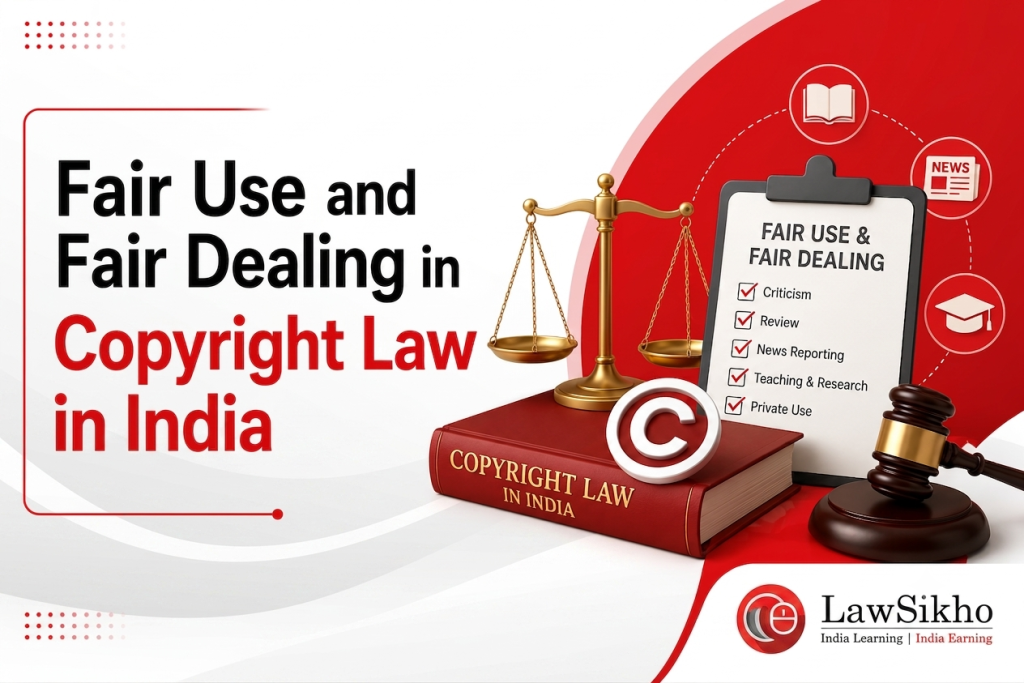

Fair use and fair dealing in copyright law in India describe the situations where a person may use a copyrighted work without the owner’s permission, and in India the operative doctrine is fair dealing under Section 52 of the Copyright Act, 1957. Fair dealing is a closed list of permitted purposes, chiefly private or personal use including research, criticism or review, and reporting current events, rather than the open-ended balancing test that the United States calls fair use. A use is protected only if it first falls inside one of the listed purposes and is then, on the facts, genuinely fair. The distinction decides real disputes over course packs, news clips, memes and parody, and it is where most confident-sounding claims about “fair use in India” go wrong.
This article sets out what fair dealing covers under Indian law, how it differs from American fair use, the statutory scheme in Section 52, the tests courts apply to decide what is fair, and where the doctrine stands for education, memes, news and artificial intelligence.
Copyright gives an owner a bundle of exclusive rights, but those rights were never meant to be absolute. A student photocopying a chapter, a critic quoting a novel, a news channel showing a clip of a speech: each uses someone else’s work, and the law has always accepted that some of this is legitimate. Fair dealing is the statutory space where that ordinary, socially useful copying is allowed to happen.
The trouble is that “fair” has no fixed definition in the Act, and Indian creators routinely borrow the American phrase “fair use” as if it were the same thing. It is not. Understanding the difference, and the narrow gateway Section 52 actually opens, is what separates a safe use from an infringement claim.

Fair dealing under Section 52 of the Copyright Act, 1957 permits limited use of a copyrighted work without the owner’s consent for private or personal use including research, criticism or review, and reporting current events and current affairs. Unlike the open-ended American fair use test, Indian fair dealing is confined to these enumerated purposes; a use must fall within a listed purpose and also be fair on its facts. Courts weigh the quantity and value of what was taken, the purpose of the use, and whether it competes with the original.
Fair use and fair dealing: what India actually follows
India follows fair dealing, not the American doctrine of fair use, and the difference is structural rather than a matter of wording. Fair dealing works from a fixed list of permitted purposes written into the statute, while fair use asks a court to weigh any use against a set of open factors. In practice this means an Indian court first asks whether your use fits a purpose the Act recognises, and only then whether the use was fair. Miss the first step and the fairness of what you did never gets considered.
The confusion is understandable. Both doctrines pursue the same balance, letting the public make reasonable use of protected works without destroying the incentive to create them. But they get there by opposite routes, and importing the wrong one leads people to overestimate what Indian law allows. A useful companion overview of the statutory scheme is iPleaders’ explainer on fair use law in India under the Copyright Act, which tracks the same Section 52 provisions discussed here.
Two different models: a closed list versus an open test
Fair dealing is a closed or enumerated model. The statute names the purposes for which unauthorised use is permitted, and a use outside those categories cannot be saved simply by being reasonable or non-commercial. India inherited this design from the United Kingdom, and it remains the framework across much of the Commonwealth.
Fair use, by contrast, is an open standard. Under Section 107 of the US Copyright Act, a court weighs four factors: the purpose and character of the use, the nature of the work, the amount taken, and the effect on the market for the original. Any purpose can qualify, which is why American courts have extended fair use to parody, search engines and, in some cases, software. The Indian model does not offer that elasticity, and that is the single most important thing to grasp before relying on any exception.
Why “fair use” is the wrong label for Indian law
Calling the Indian exception “fair use” is a small slip with real consequences. The phrase carries American assumptions, above all the idea that a sufficiently “transformative” use is presumptively lawful whatever its purpose. Indian law contains no general transformative-use doctrine and no free-standing parody exception; those uses must be argued home through an existing category such as criticism or review.
Because search behaviour drives so much of this, the label persists online. People type “fair use in India” and expect the four-factor test to apply. It does not. The correct question is always whether the use is a fair dealing for one of the statutory purposes in Section 52, and the sooner a creator reframes the question that way, the more accurate their risk assessment becomes.
A user’s right, not merely a defence
Fair dealing is best understood as a user’s right rather than a grudging excuse raised after the fact. The Delhi High Court took exactly this view in the course-packs litigation, treating the exceptions in Section 52 as an integral part of the copyright bargain and not as a mere defence to be narrowly construed. On that approach, uses falling within Section 52 are simply not infringements at all, so the question of a defence never arises.
The framing matters for how a court reads the provision. If Section 52 is a limitation built into the scope of copyright, it is interpreted purposively to serve the public interest in access, education and free expression. If it were a bare defence, it would be read grudgingly against the user. Indian courts have leaned towards the first, more generous, reading, which shapes every dispute that follows.
Section 52 of the Copyright Act, 1957: the statutory foundation
Section 52 of the Copyright Act, 1957 lists the acts that do not constitute an infringement of copyright, and it is the entire statutory basis for fair dealing in India. The provision runs to a long series of clauses covering fair dealing for specified purposes, educational and library uses, incidental inclusion, certain performances, and more. Everything a lawyer says about permitted use in India ultimately traces back to a clause of this section. The full text sits in Section 52 of the Copyright Act, 1957 on the India Code portal.
The section fits inside the larger architecture of the Act, which grants owners exclusive economic and moral rights and then carves out these public-interest exceptions. Readers who want that wider structure, from what copyright protects to how long it lasts, will find it in our detailed guide to the Copyright Act, 1957 and the rights it creates. Fair dealing is the counterweight to those rights, the space the legislature deliberately left open.
What Section 52 does, and what it costs
Section 52 does one clean thing: it declares that the listed uses are simply not infringements. A use that fits a clause needs no licence, no prior permission, and no royalty. This is what separates a fair dealing exception from a statutory or compulsory licence, where the user must still pay a fixed fee. Under Section 52 there is nothing to pay and no one to ask.
That zero-cost quality is also why the categories are policed carefully. If the boundaries were loose, the exception would swallow the owner’s rights, and licensing markets for education, quotation and news footage would collapse. The provision therefore reads narrowly at the level of purpose even as courts read it generously in aid of access. Knowing what copyright itself protects sharpens the analysis, and our primer on what copyright protects and how to register a work sets out that subject matter.
The 2012 amendment and the reach of fair dealing
The Copyright (Amendment) Act, 2012 widened fair dealing significantly. Before 2012, the fair dealing purposes in Section 52(1)(a) applied to literary, dramatic, musical and artistic works but not to cinematograph films or sound recordings. The amendment extended the same fair dealing purposes to all works except computer programmes, so a film clip or a sound recording can now be used for criticism, review or news reporting on the same footing as a book.
The change brought Indian law closer to its international commitments under the Berne Convention and the TRIPS Agreement, both of which permit exceptions that meet the three-step test of special cases that do not conflict with normal exploitation or unreasonably prejudice the author. The amendment also added or sharpened specific exceptions, including access for persons with disabilities. For anything involving audiovisual content after 2012, the starting assumption is that fair dealing can apply, subject to the usual fairness analysis.
Ideas, expression, and what fair dealing sits on
Fair dealing operates on top of a more basic rule: copyright protects the expression of an idea, not the idea itself. Facts, information, concepts and methods are free for anyone to use, because copyright never reached them in the first place. A great deal of everyday copying is lawful not because it is fair dealing but because no protected expression was taken at all.
This matters because the two questions are often confused. If you restate a statistic, summarise a news development in your own words, or use an unprotectable fact, you are not relying on Section 52; you are outside copyright entirely. Fair dealing becomes relevant only when you have actually reproduced protected expression, and the question is whether that reproduction is nonetheless permitted. Keeping the idea-expression line separate from the fair dealing analysis prevents a lot of muddled thinking.
The three core fair dealing purposes
Section 52(1)(a) recognises three core fair dealing purposes, and they carry most of the weight in day-to-day practice. They are private or personal use including research; criticism or review, whether of that work or of another work; and reporting current events and current affairs, including reporting a lecture delivered in public. A use that cannot be tied to one of these, or to one of the more specific clauses discussed later, does not qualify as fair dealing at all.
Each purpose has its own contours, built up through decades of case law drawn partly from English authority. The categories are not watertight, and a single use can sometimes sit in more than one, but the analysis always begins by naming the purpose.
Private and personal use, including research
Private or personal use, including research, is the first fair dealing purpose under Section 52(1)(a)(i). It covers a person making limited use of a work for their own study, reference or scholarship rather than for public distribution or commercial gain. A researcher copying a passage to analyse it, or a student making notes from a text, sits comfortably inside this category.
The word “private” does real work here. The exception is aimed at individual, non-public use, so reproducing a work and circulating it widely, or building a commercial product on the back of the copying, falls outside it. The 2012 amendment added “personal use” alongside “private use”, confirming that ordinary individual consumption is covered, but the exception has never been a licence to distribute. Scale and audience are what turn private study into something the owner can object to.
Criticism and review
Criticism or review is the second fair dealing purpose, and it is the most powerful for creators, journalists and academics. Section 52(1)(a)(ii) permits fair dealing for the purpose of criticism or review of that work or of any other work. This is the category that shelters book reviews, film criticism, academic commentary, and, as later sections explain, most parody and satire.
The reach of the phrase “or any other work” is significant. It means you can use extracts of one work to criticise a different work, or to comment on a broader subject, not only to review the very work you quote. Courts insist, however, that the use genuinely serve criticism or review rather than dress up wholesale copying as commentary. A review that reproduces so much of the original that it substitutes for it, or that adds no critical content, will not qualify however it is labelled.
Reporting current events and current affairs
Reporting current events and current affairs is the third fair dealing purpose, set out in Section 52(1)(a)(iii). It allows the use of a copyrighted work in the course of reporting news, including in a newspaper, magazine, broadcast or film, and it expressly covers reporting a lecture delivered in public. This is the exception news channels and publishers rely on when they show a clip, a photograph or a document as part of covering an event.
The limiting principle is that the use must be for reporting the event, not for exploiting the work for its own sake. Showing a brief extract of a film to report on its release is reporting; running the whole song because it is entertaining is not. The line between covering a matter of public interest and free-riding on protected content is exactly where the litigation clusters, as the next section shows.
Section 52(1)(a), Copyright Act 1957
Private and personal use, including research Section 52(1)(a)(i): individual study, reference or scholarship, not public distribution. Criticism or review Section 52(1)(a)(ii): of that work or any other work; shelters commentary, and most parody. Reporting current events and current affairs Section 52(1)(a)(iii): including a public lecture; the report must cover the event, not exploit the work. Note: A use must first fit one of these purposes, then be fair on its facts. Since 2012, these apply to all works except computer programmes.The three core fair dealing purposes
How Indian courts decide what is “fair”
Indian courts treat fairness as a question of fact, decided case by case, because the Act deliberately leaves “fair” undefined. There is no formula and no fixed percentage that is safe to copy. Instead, a court examines the whole dealing and asks whether an honest, fair-minded person would regard it as fair in the circumstances, drawing on a set of factors developed in Indian and English case law.
The leading Indian statements come from a handful of High Court decisions that have distilled the inquiry into workable factors. They repeatedly stress that quantity matters less than quality and purpose, and that the effect on the market for the original is often decisive.
The factors: quantum, purpose, intent, competition
The core factors were laid out in Civic Chandran v. C. Ammini Amma, 1996 (16) PTC 670, a decision of the Kerala High Court concerning a counter-drama that reproduced scenes from an earlier play to critique it. The court held that even substantial copying could be fair dealing where the purpose was genuine criticism, and it identified the questions a court should ask: the quantity and value of the matter taken in relation to the comment or criticism; the purpose for which it was taken; and the likelihood of competition between the two works.
Two further ideas run through the case law. The first is intent, sometimes described by the Latin animus furandi, meaning whether the user acted to save their own labour and cash in on the owner’s work, or for a legitimate independent purpose. The second is market substitution: if the new use competes with, and displaces demand for, the original, it is very hard to call it fair. Where the works do not compete and the borrowing serves a real critical or informational purpose, fairness is far easier to establish.
An older but still-cited authority, Blackwood and Sons Ltd. v. A.N. Parasuraman, AIR 1959 Mad 410, framed the same instinct in two elements: there must be no intention to compete with the copyright owner and to derive profit from that competition, and no improper or oblique motive in the use of the original beyond what the purpose requires. The vocabulary has evolved, but the underlying test has been remarkably stable.
The Hamar Television guidelines
The most systematic modern treatment came in Super Cassettes Industries Ltd. v. Hamar Television Network Pvt. Ltd., 2011 (45) PTC 70 (Del), where the Delhi High Court set out a detailed set of guiding principles for fair dealing, particularly in the context of news and current-events reporting. The court began from the position that it is neither possible nor advisable to define fair dealing exhaustively, because it is a question of fact and degree in each case.
From there the court drew several practical propositions. The degree and purpose of the use matter, as does whether the work was already published; the motive behind the use is relevant, so a use dressed up as news but really aimed at commercial exploitation will not pass; and the extent of the use must be proportionate to the purpose. The judgment remains the reference point whenever a broadcaster or publisher claims that its use of protected footage was fair reporting rather than infringement. Because fair dealing is a defence to an infringement claim, understanding it also means understanding the claim it answers, which begins with a legal notice for copyright infringement.
When a little is not too much: de minimis
A related principle is de minimis, the idea that the law does not concern itself with trifling uses. The Delhi High Court applied it in India TV Independent News Service Pvt. Ltd. v. Yashraj Films Pvt. Ltd., 2013 (53) PTC 586 (Del), where a television programme featured singers performing their own songs with brief clips and snippets in the background, and a film song appeared for a few seconds in an advertisement. The Division Bench treated such fleeting, incidental uses as too trivial to amount to infringement, setting aside an over-broad injunction that a single judge had granted.
De minimis is not the same as fair dealing, though the two often travel together. Fair dealing asks whether a real use fits a permitted purpose and is fair; de minimis asks whether the use is so slight that the law should ignore it altogether. For short quotations, incidental background music, or a passing glimpse of a work, de minimis can dispose of the matter before the fair dealing analysis even begins. The court in the India TV case weighed factors such as the size and value of the extract and whether the audience would notice it at all.
Education, libraries, and the other statutory exceptions
Beyond the three fair dealing purposes, Section 52 of the Copyright Act, 1957 carves out a series of specific exceptions for education, libraries, judicial use and more. These clauses are not part of the “fair dealing” language of Section 52(1)(a); they are standalone permissions with their own conditions. In practice they matter enormously, because education and library use account for a large share of everyday copying.
The specific clauses tend to be more precise than the open fair dealing purposes, which cuts both ways. They give clearer protection where they apply, but they also stop at their stated limits. A use just outside the wording of an educational clause cannot always be rescued by calling it fair dealing.
Education and the course-packs question
The educational exception permits the reproduction of a work by a teacher or a pupil in the course of instruction, and its scope was tested in the best-known Indian fair dealing dispute of the last decade. In The Chancellor, Masters and Scholars of the University of Oxford v. Rameshwari Photocopy Services (2016), three academic publishers sued a photocopy shop operating from Delhi University premises for compiling course packs, anthologies of extracts from prescribed books, and selling them to students. The publishers argued this was large-scale infringement; the shop and the university argued it was permitted educational use.
Justice Rajiv Sahai Endlaw dismissed the suit, reading the phrase “in the course of instruction” broadly to cover the preparation and distribution of course packs that reproduced only the portions actually taught. The court treated the exception as a purposive limitation on copyright designed to serve education, not a narrow escape hatch. On appeal, a Division Bench of the Delhi High Court in the December 2016 ruling largely agreed on the principle but held that whether a particular course pack was justified by the instructional purpose was a question of fact to be tried, while notably declining to reinstate any injunction. The publishers ultimately withdrew the suit, leaving the pro-access reasoning intact.
The case is important beyond its facts. It confirmed that Indian copyright law reads its educational exception generously, that reproduction for teaching is not measured by a rigid page limit, and that the exception belongs to the structure of copyright rather than being a mere defence.
Libraries, judicial proceedings, and incidental use
Several further clauses of Section 52 permit uses that keep public institutions and the justice system working. A non-commercial public library may make and supply copies of works within defined limits, which allows libraries to preserve and share materials without a licence. Reproduction of a work for the purpose of a judicial proceeding, or for a report of a judicial proceeding, is also exempt, so pleadings, evidence and judgments can quote protected material freely.
The section also covers incidental inclusion, where a copyrighted work appears in the background of a film, broadcast or photograph without being the focus. A poster on a wall caught in a news shot, or music playing incidentally in a documentary scene, does not infringe simply by being visible or audible. These exceptions reflect a practical judgment that some copying is unavoidable and harmless, and that enforcing copyright against it would serve no one.
Software back-ups and access for persons with disabilities
Computer programmes have their own tailored exceptions, because the three fair dealing purposes in Section 52(1)(a) do not extend to them. Section 52(1)(aa) allows the lawful possessor of a copy of a computer programme to make back-up copies purely as a temporary protection against loss, destruction or damage, and to make copies necessary to use the programme for the purpose for which it was supplied. This is why keeping a back-up of licensed software you own is lawful, while distributing copies is not.
The 2012 amendment added a significant access exception in Section 52(1)(zb), which permits the reproduction of a work in any accessible format for the benefit of persons with disabilities, including by organisations working for them, on a non-profit basis. It reflects India’s commitments under the Marrakesh Treaty, which India was the first country in the world to ratify, in 2014. The clause allows, for example, the conversion of books into Braille, audio or other accessible formats without the owner’s permission, provided the use stays within the non-commercial limits the section sets.
Fair dealing in the digital world: memes, news, OTT, and AI
The same Section 52 principles now decide memes, reaction videos, streaming clips and artificial-intelligence disputes, even though none of these existed when the framework was written. There is no separate “internet exception” in Indian copyright law. A meme, a YouTube review or an AI training dataset is judged by the identical questions: does the use fit a statutory purpose, and is it fair on the facts.
What changes online is scale and visibility, not the legal test. A borrowing that would be trivial in print can reach millions of viewers in a day, which sharpens the questions of market harm and commercial purpose. The digital context makes the analysis harder, not different.
Parody, satire, and memes
Parody and satire have no standalone exception in India, so they must be argued through criticism or review under Section 52(1)(a)(ii). The Civic Chandran decision is the anchor: it accepted that a work which copies from an original in order to critique or comment on it can be fair dealing, even where the copying is substantial, provided the dominant purpose is genuine criticism rather than substitution. A parody that comments on the original, or uses it to make a wider social point, has a real claim to protection.
Memes occupy the same uncertain ground. A meme that transforms an image or clip to comment on it, shared without commercial motive, has a plausible fair dealing argument as criticism or review, reinforced by de minimis where only a small part is used. The argument weakens fast when the meme is used to advertise a product, reproduces a whole protected image, or targets a work purely for entertainment with no critical content. Indian law offers memes no automatic shelter; each one turns on purpose, amount and market effect.
Reviews, reaction videos, and user-generated content
Reviews and reaction videos rely on the criticism-or-review purpose, and their fate depends on how much they add and how much they take. A film or book review that quotes limited extracts to support genuine critical commentary is close to the paradigm case for fair dealing. A reaction video that plays long, continuous stretches of a film or song, adding only sporadic remarks, looks far more like a substitute for the original and far less like criticism.
User-generated content on social platforms raises the market-harm question directly. Where the content competes with the owner’s own exploitation, for instance by letting viewers consume the substance of a work without paying for it, the fair dealing claim suffers. The commercial dimension of modern content creation, from monetised channels to sponsored posts, also cuts against fairness, because courts weigh whether the user is profiting from the borrowed material. The ownership questions that arise when such content lives on streaming services are explored in our discussion of intellectual property and ownership on OTT platforms.
News clips, aggregation, and the current-events line
News reporting online is governed by the current-events purpose and the Hamar Television guidelines, applied to a faster and more commercial environment. A news outlet may use a clip, image or document to report on a genuine event of public interest, provided the use is proportionate and the report is about the event rather than a repackaging of the work for its own sake. Running an entire song, film scene or photo-essay under a thin veneer of “news” falls outside the exception.
News aggregation sharpens the tension. Reproducing headlines and short factual summaries generally stays clear of copyright, because facts and short expressions attract thin or no protection. Systematically copying substantial portions of others’ articles, or the creative expression within them, is a different matter and has drawn infringement claims. The safe zone is reporting the news, in your own expression, using only so much of any protected work as the report genuinely needs.
AI training and the unsettled question
Whether training an artificial-intelligence model on copyrighted works is fair dealing is unsettled in India, and no statutory clause squarely addresses it. The enumerated purposes in Section 52 were not written with machine learning in mind, and it is far from clear that ingesting millions of works to train a model fits “private or personal use, including research” or any other listed purpose. This is the crucial structural point: unlike the open American fair use test, which has been the battleground for AI-training disputes in the United States, India’s closed list gives an AI developer no obvious category to claim.
The question is now live in litigation. News agency ANI has sued OpenAI in the Delhi High Court over the use of its content to train ChatGPT, and the proceedings raise directly whether such use infringes Indian copyright or is saved as fair dealing under Section 52. The High Court has heard the arguments and reserved its judgment, so a decision is awaited and the outcome is genuinely open; the Commerce Ministry has separately convened an expert panel to review whether the Copyright Act is equipped for AI. Until the court or the legislature settles the point, any confident claim that AI training is, or is not, fair dealing in India runs ahead of the law.
Fair dealing compared: India, the United States and the United Kingdom
Fair dealing in India differs sharply from United States fair use and sits close to, but not identical with, the fair dealing of the United Kingdom. All three balance owners’ rights against public access, but the mechanism differs, and using the wrong country’s reasoning is a common and costly error. The table below sets out the core differences before the discussion that follows.
| Feature | India (fair dealing) | United States (fair use) | United Kingdom (fair dealing) |
|---|---|---|---|
| Basic model | Closed list of permitted purposes | Open, flexible standard | Closed list of permitted purposes |
| Governing provision | Section 52, Copyright Act, 1957 | Section 107, US Copyright Act | Copyright, Designs and Patents Act 1988 |
| Core purposes | Private/personal use and research, criticism or review, reporting current events | Any purpose, assessed on the facts | Research and private study, criticism or review, news reporting, quotation, parody, caricature and pastiche |
| Transformative use | No general doctrine; use must fit a listed purpose | Central to the analysis | Not a general doctrine, but a dedicated parody exception exists |
| Test for fairness | Judicially developed factors: quantum, purpose, competition | Four statutory factors | “Fair dealing” judged on comparable factors |
| Standalone parody exception | No | Not needed; covered by fair use | Yes, since 2014 |
India versus the United States
The India-United States gap is the widest and the most misunderstood. American fair use under Section 107 is a single open standard: any use, for any purpose, can qualify if the four factors favour it, and “transformative” purpose has become the dominant consideration. This is why US courts have brought search engines, thumbnail images and certain software uses within fair use, outcomes that have no automatic equivalent in India.
Indian fair dealing offers no such general test. A use must first fit a purpose the statute names, and transformation alone does not create a new category. An Indian creator who copies content believing that “adding value” or “making it their own” is enough, in the American sense, is relying on a doctrine that does not exist here. The gateway of purpose comes first, every time.
India versus the United Kingdom
India and the United Kingdom share the closed-list model, but the United Kingdom has moved ahead in one respect. Both systems require a use to fit an enumerated purpose and then to be fair, and Indian courts have long drawn on English authority in defining fairness. The structures are close cousins, which is why English cases still influence Indian fair dealing reasoning.
The difference is that the United Kingdom, following a 2014 reform, added express exceptions for quotation and for caricature, parody and pastiche, alongside its older categories. India has not enacted a dedicated parody or quotation exception, so Indian parody continues to depend on the criticism-or-review purpose. A use that would fit the United Kingdom’s parody exception directly must, in India, be argued the longer way round.
When relying on American fair use goes wrong
Relying on American fair use in India is the single most common mistake creators make, and it usually surfaces only when a claim arrives. The pattern is familiar: a channel or brand copies footage, an image or a track, reasoning that the use is transformative, non-commercial, or accompanied by credit, all of which are American fair use talking points. None of them, on their own, establishes fair dealing under Section 52.
When a use falls outside every fair dealing purpose and every specific exception, the lawful route is not a better fairness argument; it is a licence. Obtaining permission, whether through a direct licence, a collecting society, or a content agreement, converts an infringing use into an authorised one. Anyone working with third-party content regularly should understand how to draft a licensing agreement, because licensing, not fair dealing, is what covers most commercial uses of protected work.
Fair dealing compared
Note: Importing the US “fair use” reasoning into India is the most common and costly mistake.Fair dealing (India) vs fair use (US) vs fair dealing (UK)
Feature
India
United States
United Kingdom
Model Closed list of purposes Open, flexible standard Closed list of purposes Provision Section 52, Copyright Act 1957 Section 107, US Copyright Act CDPA 1988 Transformative use No general doctrine Central to the test No general doctrine Standalone parody exception No (use criticism/review) Not needed (covered by fair use) Yes (since 2014) Fairness test Quantum, purpose, competition Four statutory factors Comparable factors
Frequently asked questions
1. Is fair use the same as fair dealing in India? No. India follows fair dealing under Section 52 of the Copyright Act, 1957, which permits use only for enumerated purposes such as private use and research, criticism or review, and reporting current events. Fair use is the American doctrine, an open test under which any purpose can qualify. Indian creators often use “fair use” loosely, but the operative law here is fair dealing.
2. What does Section 52 of the Copyright Act cover? Section 52 lists the acts that do not amount to copyright infringement. It includes fair dealing for private or personal use and research, criticism or review, and reporting current events, together with specific exceptions for education, libraries, judicial proceedings, incidental inclusion, certain performances, software back-ups, and access for persons with disabilities. A use that fits a clause needs no permission and no royalty.
3. Is fair dealing a defence or a right? Indian courts have treated fair dealing as an integral limitation on copyright rather than a mere defence. On that view, a use falling within Section 52 is simply not an infringement at all. The Delhi High Court took this approach in the Rameshwari course-packs case, reading the exceptions purposively to serve public access.
4. Can I use copyrighted material for education? Yes, within limits. Section 52 permits reproduction of a work by a teacher or pupil in the course of instruction, and the Delhi High Court in the Rameshwari case read this to cover course packs containing portions actually taught. The use must genuinely serve instruction; it is not a licence to copy entire books or to sell compilations commercially beyond the teaching purpose.
5. How much of a work can I copy under fair dealing? There is no fixed percentage or word limit. Indian courts assess fairness on the facts, weighing the quantity and value of what was taken against the purpose, and whether the use competes with the original. Copying a small but essential part can be unfair, while copying more for genuine criticism can still be fair. Quality and purpose matter more than quantity.
6. Are memes legal under Indian copyright law? It depends on the meme. A meme that transforms an image or clip to comment on or criticise it, shared without commercial motive, has a fair dealing argument under criticism or review, often supported by de minimis. A meme used to advertise a product, or that reproduces a whole protected work with no critical content, is far more exposed. There is no blanket exemption for memes in India.
7. Is parody allowed in India? Parody is allowed only if it fits the criticism-or-review purpose, because India has no standalone parody exception. The Kerala High Court in Civic Chandran accepted that a work copying from an original to critique it can be fair dealing, even with substantial copying, where the dominant purpose is genuine criticism. Parody that merely borrows a work for entertainment, without commenting on it, is weaker.
8. Can I use a film or song clip in a news report? Yes, if the use is for genuinely reporting current events and is proportionate to that purpose. The Delhi High Court in the Hamar Television and India TV cases allowed brief, incidental uses of protected content in reporting and programming, while rejecting uses that merely exploited the work. Running an entire song or scene under the label of news falls outside the exception.
9. Does fair dealing apply to software? The three fair dealing purposes in Section 52(1)(a) do not extend to computer programmes. Software has its own exceptions: the lawful possessor may make back-up copies to guard against loss and copies necessary to use the programme as supplied. Distributing copies of software, or copying it beyond these limits, is not covered.
10. Can AI companies claim fair dealing for training on copyrighted works? This is unsettled in India. The enumerated purposes in Section 52 were not written for machine learning, and it is unclear that training a model on large volumes of copyrighted works fits any listed purpose. The question is being litigated in ANI’s suit against OpenAI in the Delhi High Court, where judgment has been reserved and a decision is awaited. No confident answer exists until a court or Parliament settles it.
11. Does giving credit make a use fair? No. Attribution or a “no copyright intended” tag has no independent legal effect in India and does not convert an infringing use into a fair dealing. Credit may be relevant to moral rights and to good faith, but the use must still fit a Section 52 purpose and be fair on its facts. Many creators wrongly assume that crediting the source is enough; it is not.
12. What should I do if my use falls outside fair dealing? Obtain a licence. When a use does not fit any fair dealing purpose or specific exception, the lawful route is permission from the owner, whether by a direct licence, through a collecting society, or via a content agreement. Licensing, not a stretched fairness argument, is what covers most commercial uses of third-party content.
References
Case Law
- Blackwood and Sons Ltd. v. A.N. Parasuraman, AIR 1959 Mad 410
- Civic Chandran v. C. Ammini Amma, 1996 (16) PTC 670 (Ker); MANU/KE/0675/1996
- India TV Independent News Service Pvt. Ltd. v. Yashraj Films Pvt. Ltd., 2013 (53) PTC 586 (Del)
- Super Cassettes Industries Ltd. v. Hamar Television Network Pvt. Ltd., 2011 (45) PTC 70 (Del)
- University of Oxford v. Rameshwari Photocopy Services (The Chancellor, Masters and Scholars of the University of Oxford v. Rameshwari Photocopy Services), single judge, 16 September 2016
- University of Oxford v. Rameshwari Photocopy Services (Division Bench, 9 December 2016)
Statutes
- Copyright Act, 1957: Section 52 (fair dealing and specific exceptions); sub-clauses cited: 52(1)(a)(i), (ii), (iii), 52(1)(i), 52(1)(aa), 52(1)(zb)
- Copyright (Amendment) Act, 2012 (extension of fair dealing to all works except computer programmes; disability-access exception)
- Berne Convention for the Protection of Literary and Artistic Works; TRIPS Agreement; Marrakesh Treaty (international framework for exceptions)
This article is for informational purposes only and does not constitute legal advice. For specific legal guidance, consult a qualified legal professional.




 Allow notifications