
Last verified: 2026-06-24
A contractor won. After a years-long arbitration over a stalled infrastructure project, the tribunal handed down an award in its favour. Then the award-debtor moved to challenge it under Section 34, and that is where the story turns on the difference between seat vs venue of arbitration. The award-debtor’s counsel filed the setting-aside petition in the High Court of the city where the contract had been performed and where every single hearing had physically taken place. It felt obvious. The hearings happened there, the witnesses were examined there, the files sat there.
Months passed. Then a single-judge bench returned the petition. That court, it held, never had jurisdiction to hear the challenge at all. The juridical seat of the arbitration was a different city entirely, and only the courts at the seat could supervise this award. By the time the petition was returned, the limitation window under Section 34 had nearly run out. A procedural misreading of two words in the contract had come within days of extinguishing a party’s entire right to challenge an award.
This is not a clerical slip you can fix with a fresh filing and an apology. Filing at the venue instead of the seat can cost a party its challenge altogether. Across the 2024 and 2025 line of rulings, the Supreme Court and several High Courts have repeatedly returned or set aside Section 34 petitions filed in the wrong forum, because the petitioner confused where the hearings happened with where the arbitration legally lived. In one matter the Supreme Court had to restore a petition that a High Court had wrongly returned, reiterating that the seat (not the venue) anchors supervisory jurisdiction and stays fixed unless the parties agree in writing to move it.

Here’s the thing about that distinction: it is decided long before any dispute arises. It is decided the moment the contract is signed. Two words sitting quietly in a dispute-resolution clause, drafted in five minutes by someone who treated “seat” and “venue” as interchangeable, can determine whether a multi-crore award stands or falls years later. So if two words carry that much weight, every law student, every junior litigator, and every in-house counsel needs to get seat vs venue of arbitration right before the ink dries, not after the award lands.
And the encouraging part? This is a learnable, masterable skill. The lawyers who genuinely understand the seat doctrine, who can draft a clause that survives a Section 34 challenge and explain to a client exactly which court will hear a future dispute, are the ones commercial teams call first. They turned a confusing, heavily litigated distinction into a professional edge. You can do the same. So what exactly is the difference, and why does it carry this much weight? Start with the one-line distinction every drafter should memorise.
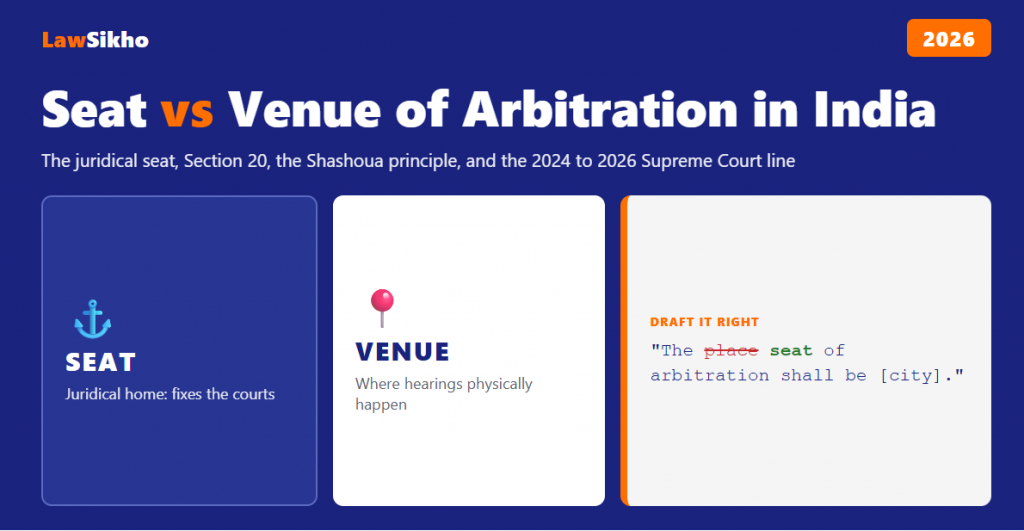
The seat of arbitration is the juridical home of the arbitration: it fixes which court has supervisory jurisdiction (under Sections 9, 11 and 34) and the curial law governing the proceedings. The venue is only the physical location where hearings are held and carries no jurisdictional effect, unless a venue is named with no contrary indicia, in which case it becomes the seat.
That single sentence resolves most of the confusion, but it also opens up a dozen follow-up questions about statutory text, landmark cases, and drafting. The sections below work through each one, from Section 20 of the Act to the 2024-2026 Supreme Court line and a model clause you can adapt.
Seat vs venue of arbitration: the key differences at a glance
Most people meet this distinction the hard way, usually in the middle of a jurisdiction objection they did not see coming. A clause that says hearings will be held in one city, with no separate statement of the seat, sends one party to one High Court and the other party arguing that a different court has the real power. The confusion is structural, not careless: the Arbitration and Conciliation Act, 1996 uses the single word “place” to mean two different things, and the everyday word “venue” has a precise legal meaning that almost no contract spells out.
So here is the clean version. The seat is the legal anchor of the arbitration. It decides which country’s (and within India, which High Court’s) supervisory regime governs the arbitration, and it travels with the arbitration even if not a single hearing is ever held there. The venue is just geography. It is where people physically gather to argue, examine witnesses, and hear the tribunal, chosen for convenience, cost, or neutrality, and it can shift from one session to the next without changing anything legal.
The table below is the version worth memorising. Read it once and the rest of this guide becomes a series of footnotes to it.
| Aspect | Seat | Venue | “Place” under Section 20 |
|---|---|---|---|
| What it is | The juridical home of the arbitration | The physical location of hearings | The statutory word that means seat in 20(1)-(2) and venue in 20(3) |
| Decides jurisdiction? | Yes: fixes the supervisory court (Sections 9, 11, 34) | No jurisdictional effect on its own | Depends on which sub-section: 20(1)-(2) yes, 20(3) no |
| Governs the curial law? | Yes: the seat fixes the lex arbitri | No | 20(1)-(2) yes (as seat); 20(3) no (as venue) |
| Can it change mid-arbitration? | No, unless parties agree in writing | Yes: hearings can move freely | The 20(3) hearing-place can move; the 20(1)-(2) seat cannot |
| Tied to cause of action? | No: applies even if nothing happened there | Not relevant | No |
| Drafting label to use | “The seat of arbitration shall be [city]” | “The venue of hearings may be [city]” | Avoid the bare word “place”; say seat or venue |
| Consequence if wrong | A Section 34 petition can be filed in the wrong court | None, by itself | Litigation over which the clause meant |
What jumps out from that table is that only one row of it actually decides where you can sue. Get the seat right and everything else is logistics. Get it wrong and you can lose the right to challenge an award without ever arguing the merits.
In practice, the most experienced drafters treat the seat as the very first decision in any dispute-resolution clause, before they even think about institution, number of arbitrators, or language. They know that the seat is doing quiet, load-bearing work that the client will never thank them for until something goes wrong. A common question juniors raise is whether the seat and venue have to be in the same city. They don’t. A clause can name Mumbai as the seat and hold hearings in Delhi or Singapore, and that is often the smart structure (more on that in the drafting section below).
So which one actually decides which court hears your dispute, the seat or the venue? The seat, every time. The venue can be anywhere on earth and it changes nothing about supervisory jurisdiction.
What “seat of arbitration” means (the juridical seat)
The seat is best understood as the arbitration’s legal address. It is the jurisdiction whose arbitration law the proceedings are tethered to, and whose courts hold the supervisory powers over the arbitration. When you fix the seat as, say, New Delhi, you are saying that Indian arbitration law governs the procedure and that the Delhi courts (subject to pecuniary and subject-matter rules) supervise interim relief, arbitrator appointment, and any challenge to the award.
Crucially, the seat is a legal concept, not a physical one. A tribunal seated in Mumbai can sit for hearings in London, take evidence over video, and never set foot in Maharashtra, and Mumbai remains the seat. That is why the better term, used by courts and practitioners, is the “juridical seat.” The word juridical is doing real work here: it signals that we are talking about a legal home, not a meeting room.
What “venue of arbitration” means (the physical hearings)
The venue, by contrast, is exactly what the ordinary meaning suggests: the place where the hearing physically happens. Parties pick a venue for practical reasons, proximity to witnesses, availability of hearing centres, neutrality between two sides from different cities, or simply cost. A single arbitration can use several venues across its life: one city for the preliminary meeting, another for cross-examination, a third for final arguments.
None of that movement carries any jurisdictional weight, provided the clause has clearly fixed a seat elsewhere. Think of it this way: the venue is the conference room, the seat is the registered office. You can hold a board meeting in any hotel you like, but the company’s legal home stays put. The danger, and the entire subject of a later section, arises when a contract names only a venue and says nothing about the seat. Then a court may read that venue as the seat, and the conference room quietly becomes the registered office.
Seat vs venue of arbitration: at a glance
Why the seat matters: jurisdiction, curial law, and the three laws of arbitration
If the seat were just a drafting nicety, nobody would litigate over it. The reason it generates Supreme Court benches and returned petitions is that the seat decides two enormously consequential things at once: which courts can touch the arbitration, and which procedural law runs it. Misread either and you can be in the wrong court, under the wrong law, at the worst possible moment.
Start with the practical stakes for a litigator. Every supervisory power a court holds over an arbitration is mapped to the seat. Want interim protection before the tribunal is constituted? You go to the court at the seat under Section 9. Need a court to appoint an arbitrator because the other side is stonewalling? That is the seat’s court under Section 11. Want to challenge the award? Section 34, again at the seat. The seat is the thread that all of these powers hang from.
There is a deeper layer too, the three laws that govern any arbitration, and the seat sits at the centre of the puzzle. The table below separates them, because conflating them is the single most common conceptual error in this area.
| Law | What it governs | How the seat fixes it |
|---|---|---|
| Lex contractus (substantive law) | The rights and obligations under the contract, the merits of the dispute | Chosen separately by the parties; NOT fixed by the seat |
| Lex arbitri (curial law / law of the arbitration) | The conduct of the arbitration: powers of the tribunal, court supervision, challenge grounds | Fixed by the seat: the seat’s arbitration law is the curial law |
| Lex fori (law of the forum) | The procedural law of whichever court is approached | Follows the seat for supervisory matters |
Notice what that table does. It shows that a contract can be governed by Indian law on the merits while being seated abroad, in which case Indian substantive law decides who breached but a foreign court supervises the arbitration. That exact mismatch reached the Supreme Court in 2025, and we’ll come back to it in the foreign-seat section.
The seat fixes supervisory jurisdiction: Sections 9, 11, 17 and 34 follow the seat
This is the rule that the story hook turned on. Under Section 2(2) of the Arbitration and Conciliation Act, 1996, Part I of the Act applies where the place of arbitration is in India, and the courts at that place hold the supervisory powers. The Supreme Court settled the jurisdictional point firmly in Indus Mobile Distribution (P) Ltd. v. Datawind Innovations (P) Ltd., (2017) 7 SCC 678, holding that a designated seat operates as an exclusive jurisdiction clause: the courts at the seat have jurisdiction even where no part of the cause of action arose there.
That last point is the one juniors find counter-intuitive. We are trained, from the first year of civil procedure, to chase the place where the cause of action arose. Arbitration inverts that instinct. The Court reinforced the same idea in Brahmani River Pellets Ltd. v. Kamachi Industries Ltd., (2020) 5 SCC 462, holding that naming a place for the arbitration confers exclusive jurisdiction on that place’s courts, to the exclusion of every other court that might otherwise have had territorial jurisdiction. So if the seat is Kolkata, you cannot file your Section 34 challenge in Chennai just because the goods were delivered there.
A practical knock-on: interim measures follow the seat too. If you need urgent court protection before the tribunal exists, Section 9 takes you to the seat’s court, and once the tribunal is constituted, you seek interim measures from the tribunal under Section 17 (interim-measure jurisdiction tracks the seat in the same way). The mistake we see most often is a party racing to its home court for a Section 9 injunction when the seat is elsewhere, only to have the application questioned on jurisdiction.
In practice, what experienced counsel know is that the seat clause should be the first thing they read in any opponent’s contract during a dispute, because it tells them where the entire fight will be supervised. A common question practitioners raise is how the earlier line of cases like Swastik Gases sits alongside the Indus Mobile ruling. The short answer: the seat-as-exclusive-jurisdiction reading has hardened over time, and the modern position treats the designated seat as conclusive on supervisory jurisdiction. What can go wrong here is filing in the wrong forum and discovering it only when the limitation clock has almost expired, exactly the trap that opens this guide. The bridge to that point is concrete: a misread seat is not a merits problem, it is a jurisdiction problem, and jurisdiction problems can be fatal. For the full mechanics of how that challenge works, see our guide to filing a Section 34 petition to set aside the award.
The seat fixes the curial law (lex arbitri) versus the substantive law of the contract
The curial law, also called the lex arbitri, is the law that governs how the arbitration is conducted: the tribunal’s powers, the extent of court intervention, the grounds on which an award can be set aside. And here is the rule that resolves Q15 and Q16 in one line: the seat fixes the curial law. Seat the arbitration in India and the Arbitration and Conciliation Act, 1996 supplies the curial law, with its specific Section 34 challenge grounds. Seat it in Singapore and the Singapore International Arbitration Act applies instead.
The substantive law of the contract is a separate choice entirely. Parties might write that the contract is “governed by the laws of India” while seating the arbitration in London. In that situation, Indian contract law decides whether a party breached, but English arbitration law governs the conduct of the arbitration and an English court supervises it. The two questions, what are my rights and how is this arbitration run, have two different answers and two different sources.
Why does this matter to a drafter rather than just an academic? Because the curial law determines the menu of challenge grounds. A party that wanted the narrow, pro-enforcement grounds of one jurisdiction but accidentally seated the arbitration in another has handed its opponent a different (sometimes wider) set of tools to attack the award. The practical reality is that most commercial parties never consciously decide their curial law; they decide it by accident, through where they put the seat.
Seat law vs curial law vs substantive law, untangled
Let’s make the three-way distinction concrete with a single hypothetical. An Indian company and a Dutch supplier sign a contract that says: governing law is Indian law, seat of arbitration is Singapore, hearings to be held in Mumbai for convenience. What governs what?
The substantive law (lex contractus) is Indian, so Indian contract law decides the merits. The curial law (lex arbitri) is Singaporean, because the seat is Singapore, so Singapore’s arbitration statute and its courts supervise the proceedings. The venue is Mumbai, which means people physically meet in Mumbai but Mumbai’s courts have no supervisory role at all. Three cities, three different legal functions, and only one of them, the seat, controls jurisdiction.
This is the second-order shift worth flagging for anyone entering disputes practice now. As the seat-equals-exclusive-jurisdiction rule has hardened, the old forum-shopping tactic, file your Section 9 or Section 34 wherever is convenient, has quietly collapsed. Junior litigators trained to reason from the cause of action have to re-learn jurisdiction analysis around the seat instead. That re-skilling is not optional; it is the difference between a petition that survives and one that gets returned.
Section 20 of the Arbitration and Conciliation Act, 1996 explained
If one provision deserves the blame for 25 years of confusion, it is Section 20. The reason is almost comic: the section is titled “Place of arbitration,” and it uses the word “place” three times to mean two completely different things. Untangling those three sub-sections is the single most valuable clarity fix in this entire subject, and it is the gap that most competing explainers skip.
Here is the text-level reality. Section 20 of the Arbitration and Conciliation Act, 1996 has three sub-sections. The first two deal with the parties’ freedom to choose, and the courts read the “place” they choose as the seat. The third deals with the tribunal’s freedom to meet wherever is convenient, and the courts read that “place” as the venue. Same word, two meanings, one section. Once you internalise that split, every case in this guide clicks into place.
So why does the difference matter at the drafting stage? Because the award-content provision requires the award to state the place of arbitration, and that stated place is treated as the seat. Under Section 31(4) of the Arbitration and Conciliation Act, 1996, the award must state its date and the place of arbitration as determined under Section 20, and the award is deemed to have been made at that place, so a sloppy clause that only ever named a “venue” can lead the tribunal (and later a court) to treat that venue as the seat by default. The clause you draft today decides what the award says tomorrow.
Section 20(1) and 20(2): the party-chosen “place” is the seat
Sub-section 20(1) gives the parties the freedom to agree on the “place of arbitration.” Sub-section 20(2) says that failing such agreement, the tribunal shall determine the place. In both, the “place” being decided is the juridical seat: the legal home that fixes supervisory jurisdiction and curial law. This is the reading the Supreme Court adopted, and it is the reason a clause that says “the place of arbitration shall be Chennai” is generally read as fixing Chennai as the seat.
What experienced drafters do is avoid the bare statutory word altogether. Rather than echo “place,” they write “seat” expressly, precisely because the statute’s own vocabulary is the source of the ambiguity. If you mean the seat, say seat. The statute will not punish you for being clearer than it is.
Section 20(3): the tribunal’s “place” for hearings is the venue
Sub-section 20(3) is the venue provision, even though it never uses the word “venue.” It permits the tribunal, unless otherwise agreed, to meet at any place it considers appropriate for consultation, hearing witnesses, experts, or the parties, or for inspecting documents, goods, or property. This is pure logistics. The “place” here is the hearing location, and it carries no jurisdictional consequence.
The constitution bench in Bharat Aluminium Co. v. Kaiser Aluminium Technical Services Inc., (2012) 9 SCC 552 performed exactly this statutory reading: it held that “place” in 20(1) and 20(2) means the seat, while “place” in 20(3) means the venue. That single act of interpretation is what makes Section 20 workable. Before it, courts and counsel had been reading one undifferentiated “place,” and the results were chaos. After BALCO, the section has an internal logic: the parties choose the seat (20(1)-(2)), and the tribunal chooses where to actually meet (20(3)).
Why one word (“place”) created 25 years of confusion
The historical arc is worth tracing, because it explains why even good lawyers still trip on this. When the Act came into force in 1996, drawing on the UNCITRAL Model Law, the drafters used “place of arbitration” as a single term without distinguishing the legal seat from the physical hearing location. For the first decade and a half, Indian courts read “place” loosely, and the high-water mark of confusion was the Bhatia International era, when Part I was applied even to foreign-seated arbitrations.
The fix arrived in 2012 with the constitution bench in BALCO, which separated the two meanings of “place” and rooted the seat concept in Section 20. Even so, the everyday habit of saying “venue” when one means “seat” has outlived the doctrinal clarity. A common question on practitioner forums is simply, why do people keep confusing these? The honest answer: because the statute confused them first, and habits formed over 25 years die slowly. The drafter’s job is to write around the statute’s ambiguity, not to reproduce it.
The landmark cases: from BALCO to BGS Soma
You cannot understand the seat doctrine in India by reading the statute alone, because the statute is the problem the cases were sent to solve. The judicial line, from the 2012 constitution bench to the recency cluster of 2024 and 2025, is what actually tells you how courts decide seat questions. The table below maps the eleven landmark rulings this guide relies on to the sections they anchor, so you can see the architecture before we walk through the highlights.
| Case | Year | One-line holding | Anchor section |
|---|---|---|---|
| Bharat Aluminium Co. v. Kaiser Aluminium | 2012 | Seat = centre of gravity; Part I excluded for foreign-seated arbitration; “place” split across Section 20 | Section 20 and this section |
| Enercon (India) v. Enercon GmbH | 2014 | London = venue, India = seat; seat determined by closest connection | This section |
| Indus Mobile v. Datawind | 2017 | Designated seat = exclusive jurisdiction even where no cause of action arose | Why the seat matters |
| Roger Shashoua v. Mukesh Sharma | 2017 | Venue + supranational rules + no contrary indicia = seat (the Shashoua principle) | When venue becomes seat |
| Union of India v. Hardy Exploration | 2018 | Venue is not the seat without a positive determination (later doubted) | When venue becomes seat |
| BGS SGS Soma JV v. NHPC | 2019 | Venue + “arbitration proceedings” + no contrary indicia = seat; Hardy per incuriam | When venue becomes seat |
| Brahmani River Pellets v. Kamachi | 2019 | Naming a place confers exclusive jurisdiction on that place’s courts | Why the seat matters |
| Mankastu Impex v. Airvisual | 2020 | “Place shall be Hong Kong” + HK law = HK seat; the label alone is not decisive | Seat vs EJ clause |
| Arif Azim v. Micromax | 2024 | Express designation governs; rejects concurrent jurisdiction where designation is express | 2024-2026 line |
| Disortho v. Meril | 2025 | Indian governing law + foreign seat: lex arbitri follows the seat | Foreign seat |
| Activitas v. Mind Plus | 2025 | An exclusive jurisdiction clause can supply the seat where none is expressly stated | 2024-2026 line |
Read down that column and you can see the doctrine maturing: first the seat is created (2012), then it is given exclusive jurisdiction (2017), then the venue-becomes-seat mechanism is settled (2019), and finally the 2024-2025 cases refine how a seat is found when the clause is silent or ambiguous. Each case below is summarised once at its anchor and cross-referenced elsewhere, so nothing is repeated.
BALCO (2012): the constitution bench that created the seat doctrine
Bharat Aluminium Co. v. Kaiser Aluminium Technical Services Inc., (2012) 9 SCC 552 is the foundation. A five-judge constitution bench did three things that still govern the field. It established that the seat is the “centre of gravity” of the arbitration, the jurisdiction with the closest legal connection. It held that Part I of the Act does not apply to arbitrations seated outside India, overruling the earlier Bhatia approach on a prospective basis. And it performed the Section 20 statutory reading discussed above, splitting “place” into seat (20(1)-(2)) and venue (20(3)).
What did BALCO actually decide for a working lawyer? In short, that where your arbitration is seated determines whether Indian courts can supervise it at all. Seat it abroad and Part I, with its Section 9 interim measures and Section 34 challenge, drops away. That is the rule the entire foreign-seat section later builds on. The “centre of gravity” language is the test the later cases keep returning to when a clause is ambiguous: which jurisdiction is the arbitration most truly connected to?
Enercon (2014) and the closest-connection approach
Two years after BALCO, Enercon (India) Ltd. v. Enercon GmbH, (2014) 5 SCC 1 gave the closest-connection test a concrete application. The clause named London as the venue, but the Supreme Court held that India was the seat, because every other indicator, the governing law, the law of the arbitration agreement, the parties’ connection, pointed to India. London was where hearings would occur; India was where the arbitration legally lived.
The practical lesson juniors take from this case is that a single word like “venue” or even “London” does not settle the seat by itself. Courts look at the whole clause and the surrounding choices. What experienced counsel know is that Enercon is the answer to a client who says, “but the contract clearly says London.” It says London for hearings; it does not necessarily say London is the seat. The reasoning matters more than any one label.
BALCO versus Bhatia International: what changed for foreign-seated arbitration
To appreciate why BALCO was a watershed, you have to know what it replaced. Under the Bhatia International line (2002 onwards), Indian courts had applied Part I of the Act even to arbitrations seated outside India, unless the parties had expressly or impliedly excluded it. The result was that a foreign-seated arbitration could still be dragged into an Indian court under Section 9 or challenged under Section 34, which undercut the whole point of choosing a foreign seat.
BALCO reversed that, holding that Part I simply does not apply where the seat is abroad. The change was made prospective, so it applied to arbitration agreements signed after the date of the judgment, which is why older contracts can still raise tricky transitional questions. The historical takeaway is clean: before 2012, a foreign seat did not reliably keep Indian courts out; after 2012, it does. For anyone drafting cross-border contracts, that single shift is why the seat choice now carries genuine enforcement consequences.
From BALCO to 2026: the seat-vs-venue case timeline
How the Indian seat doctrine matured under Section 20
Section 20 enacted using the single ambiguous word “place”.
Part I applied even to foreign-seated arbitrations (the problem years).
Seat = centre of gravity; Part I excluded for foreign seats; “place” split into seat and venue.
London = venue, India = seat by closest connection.
Seat = exclusive jurisdiction; venue + rules + no contrary indicia = seat.
Venue is not the seat without a positive determination (the tension beat).
Hardy held per incuriam; venue tied to proceedings = seat; naming a place confers exclusive jurisdiction.
“Place shall be Hong Kong” + HK law = HK seat; label alone not decisive.
Express designation governs; concurrent jurisdiction rejected.
Indian law but foreign seat (lex arbitri follows the seat); exclusive jurisdiction clause can supply the seat.
Drafting standardisation and a possible statutory definition of “seat” in the amendment pipeline.
When does the venue become the seat? The Shashoua principle
Here is the question that launches more clause disputes than any other: if my contract only ever says “venue,” can a court treat that venue as the seat? The answer, frustratingly for the careless drafter, is often yes. Indian law has a settled mechanism for converting a named venue into the seat, and knowing the trigger factors is what separates a clause that does what you intended from one that surprises you in court.
The factors that turn a venue into a seat can be stated as a short checklist, the practical distillation of the Shashoua and BGS Soma reasoning:
- The contract names a specific place for the arbitration (a single, identified location).
- That place is described in connection with the arbitration proceedings themselves, not merely as a hearing location.
- A supranational or institutional set of arbitration rules is chosen to govern the proceedings.
- There is no other clause naming a different seat.
- There is no “significant contrary indicia” pointing away from that place being the legal home.
When those boxes are ticked, the named venue is read as the juridical seat. The whole doctrine is, at bottom, a presumption: name a place and behave as though it is the seat, and the law will treat it as the seat unless something in the contract clearly says otherwise.
The Shashoua principle, explained
The principle takes its name from an English High Court decision and was absorbed into Indian law through Roger Shashoua v. Mukesh Sharma, (2017) 14 SCC 722. The rule it states is this: where a contract designates a venue for the arbitration, applies a supranational body of arbitration rules, and contains no contrary indicia, that venue is to be treated as the seat. The logic is that parties who pick a place and a developed set of rules have, in substance, chosen a legal home, even if they never used the word “seat.”
Why did Indian courts adopt an English principle? Because Indian arbitration law, like the Model Law it descends from, needed a workable default for the very common situation of a clause that names a place without labelling it. The Shashoua principle supplies that default. In practice, it means a drafter cannot hide behind the word “venue” to keep a place jurisdictionally neutral; if the clause looks and behaves like a seat designation, it is one.
BGS SGS Soma v. NHPC: venue plus “arbitration proceedings” plus no contrary indicia
The Indian anchor case is BGS SGS Soma JV v. NHPC Ltd., (2020) 4 SCC 234. The Supreme Court held that when a clause designates a place where the “arbitration proceedings” are to be held, and there is no significant contrary indicia, that place is the seat, not merely the venue. The phrase “arbitration proceedings” was doing the heavy lifting: naming a place for the proceedings (as opposed to naming it for a single hearing) signals a seat.
This case is the one to cite when a contract says something like “the arbitration proceedings shall be held at New Delhi.” Under BGS Soma, that wording makes New Delhi the seat, with all the supervisory consequences that follow, even though the drafter may have thought they were only choosing a convenient location. The community version of the question, “if the clause says venue shall be Mumbai, is Mumbai the seat?”, is answered here: if the clause ties Mumbai to the arbitration proceedings and adds no contrary indicia, then yes, very likely.
The Hardy Exploration tension, and why BGS Soma called it per incuriam
Honesty demands flagging that this area was not always tidy. In Union of India v. Hardy Exploration and Production (India) Inc., (2019) 13 SCC 472, a three-judge bench held that a venue does not become the seat unless there is a positive, separate determination to that effect, which pointed in the opposite direction from the Shashoua presumption. For a brief period, the law had two competing instincts: one that presumed a named venue was the seat, and one that demanded an express designation.
BGS Soma resolved the tension by holding that Hardy Exploration was decided per incuriam, that is, without regard to the binding constitution-bench reasoning in BALCO, and therefore could not stand. So the current position favours the Shashoua presumption: a named venue, tied to the proceedings, with no contrary indicia, is the seat. A common question on the forums is whether Shashoua is still good law after this back-and-forth. The answer is yes, the BGS Soma route prevailed, but the very existence of the Hardy detour is a warning about how much can turn on imprecise drafting.
“Significant contrary indicia”: what flips the presumption
The whole doctrine has a safety valve: “significant contrary indicia.” If the contract contains clear signals that the named place was meant only as a hearing location and not the legal home, the presumption is rebutted and the place stays a mere venue. So what counts as contrary indicia? A separate clause expressly naming a different seat is the strongest. A governing-law and supervisory-jurisdiction structure that points elsewhere can also do it.
The expert perspective here is that contrary indicia is unpredictable precisely because it is fact-specific. You cannot rely on it as a drafting strategy; you cannot draft a clause that names “venue Mumbai” and hope that some stray phrase elsewhere will save you from Mumbai being read as the seat. The pitfall is treating contrary indicia as a backstop. It is not a backstop; it is a tie-breaker that courts apply unpredictably. The only safe course is to name the seat expressly and remove the question entirely. Could a court still find contrary indicia in your favour? Maybe. But why gamble a year of litigation on “maybe” when one clean sentence settles it?
Seat vs exclusive jurisdiction clause: the 2024-2026 line of cases
This is the live wire of the subject right now. Commercial contracts routinely contain two clauses that sit awkwardly together: an arbitration clause that names a seat (or a venue), and an exclusive jurisdiction clause that says the courts of some city “shall have exclusive jurisdiction.” When those two point at different cities, which one controls the arbitration’s supervisory court? The 2024-2026 line of cases is where this gets worked out, and it is the question practitioners are arguing today.
The starting position is that the seat acts as an exclusive jurisdiction clause in its own right, as Indus Mobile established. But what happens when the parties also wrote a separate exclusive jurisdiction clause? Does that clause supply or override the seat? The recent cases give a nuanced answer that every drafter and litigator needs at their fingertips.
Can an exclusive jurisdiction clause be read as the seat?
The answer the courts have arrived at is: sometimes, where the clause is silent on the seat. In Mankastu Impex (P) Ltd. v. Airvisual Ltd., (2020) 5 SCC 399, the Supreme Court considered a clause stating the “place of arbitration shall be Hong Kong,” combined with Hong Kong law governing the arbitration agreement, and held that Hong Kong was the seat. The crucial nuance was that the label alone (“place”) was not decisive; the Court looked at the totality, including the choice of Hong Kong law for the arbitration agreement, to find the seat.
The 2025 development pushes this further. In Activitas Management Advisor (P) Ltd. v. Mind Plus Healthcare (P) Ltd., 2025 SCC OnLine SC, the Court held that an exclusive jurisdiction clause can be read as designating the seat where the contract does not expressly state a seat. In other words, if your arbitration clause is silent on the seat but your contract gives one city’s courts exclusive jurisdiction, that exclusive-jurisdiction city can become the seat by inference. The practical reading: an exclusive jurisdiction clause is contrary indicia of the strongest kind, and it can fill a seat-shaped hole in your drafting.
Arif Azim v. Micromax (2024): express designation governs
The doctrinal turning point of the recent line is Arif Azim Co. Ltd. v. Micromax Informatics FZE, 2024 INSC 850. The Supreme Court held that where a clause expressly designates a place as the seat, with the curial law of that place and no contrary indicia, that express designation governs, and it operates akin to an exclusive jurisdiction clause. Critically, the Court rejected the idea of concurrent jurisdiction (two courts both supervising) and side-lined the closest-connection test where the designation is express.
So what does this mean for you, the drafter or litigator? It means express wins. If you name the seat clearly, courts will not go hunting for a “closest connection” or split jurisdiction between two forums; they will enforce what you wrote. The mistake the case warns against is assuming that an Indian court at the place of the cause of action retains some concurrent foothold once a seat is named. It does not. Express designation forecloses the argument. For a litigator, that is a powerful tool when an opponent tries to manufacture jurisdiction in a convenient forum.
Where this is heading: 2026 developments and drafting standardisation
Looking forward, a few signals are worth tracking. Practitioner commentary through late 2025 suggests the market is moving toward clauses that expressly name both a seat and a separate venue, precisely to head off the litigation the older sloppy clauses generated. Early signals point to this becoming standard practice in well-advised commercial contracts, driven by repeated Supreme Court criticism of imprecise drafting.
There is also a law-reform dimension. The arbitration-law amendment pipeline has been discussing whether to statutorily define “seat” to end the Section 20 ambiguity once and for all, which practitioners expect would be a significant clarity improvement if enacted. And as Indian institutional bodies (MCIA, IIAC, DIAC) compete with Singapore and London, “seat = India” is likely to become a commercial selling point, with institutional rules defaulting the seat for parties who do not specify one. None of this is settled, but the direction of travel is clearly toward more precise, more standardised seat drafting, which makes the skill of writing a clean clause more valuable, not less. Which recent cases should you actually know before drafting? At minimum, the 2024-2026 cluster covered in this section.
Domestic vs international arbitration: foreign seat and enforcement
The seat/venue distinction stops being academic and starts being existential the moment a contract crosses a border. Whether the seat is inside India or outside it determines which Part of the Arbitration Act applies, and that, in turn, determines how the eventual award is enforced and whether Indian courts can supervise the arbitration at all. Mislabel the seat in a cross-border deal and you can accidentally change the legal character of your award.
The table below captures the consequence cleanly. It is the structural payoff of everything BALCO decided.
| Feature | Domestic seat (seat in India) | Foreign seat (seat outside India) |
|---|---|---|
| Which Part applies | Part I of the Act | Part II (recognition and enforcement of foreign awards) |
| Section 9 interim measures by Indian courts | Available (subject to the agreement) | Generally not, save the limited proviso |
| Section 11 arbitrator appointment by Indian courts | Available | Not available: appointment follows the seat |
| Section 34 challenge in Indian courts | Available | Not available: the award is challenged at the seat |
| Enforcement route in India | As a domestic award | As a foreign award under Part II (New York Convention) |
The single most important row is the last one. A domestic-seated award and a foreign-seated award are enforced through entirely different machinery, and the seat is what decides which machinery you are in.
A foreign seat ousts Part I: Section 2(2) and the BALCO prospective rule
The statutory anchor is Section 2(2) of the Arbitration and Conciliation Act, 1996, which provides that Part I applies where the place of arbitration is in India. Read together with Bharat Aluminium Co. v. Kaiser Aluminium Technical Services Inc., (2012) 9 SCC 552, the rule is that a foreign seat takes the arbitration out of Part I: no Section 9, no Section 11, no Section 34 in the Indian courts. The supervisory powers move to the courts of the foreign seat.
Because BALCO was prospective, the cut-off date matters for older agreements, and a contract signed before the judgment may still attract the earlier Bhatia approach. For anything drafted in the last decade, though, the clean rule applies: foreign seat, foreign supervision. The practical consequence is that a party choosing a foreign seat is also, whether it realises it or not, choosing to give up Indian court supervision of the arbitration itself.
Disortho v. Meril (2025): Indian governing law but a foreign seat
The 2025 case that crystallises the trap is Disortho S.A.S. v. Meril Life Sciences (P) Ltd., 2025 INSC 352. The contract specified Indian governing law but a foreign seat (Bogota), and the question was whether Indian courts could appoint an arbitrator under Section 11. The Court applied the three-law analysis, lex contractus, lex arbitri, lex fori, and held that the lex arbitri follows the seat, so the foreign seat controlled the supervisory forum despite the Indian substantive law. Indian courts could not appoint under Section 11.
This is the precise mismatch the three-laws table earlier in this guide warned about. The parties chose Indian law for the merits, which felt like choosing India, but they chose a foreign seat for the arbitration, which actually decided the supervisory forum. The pitfall is assuming that “governing law: India” keeps the arbitration under Indian court supervision. It does not. The seat does that, and the seat was abroad.
The cross-border enforcement cascade
Here is the second-order effect that surfaces years later. Mislabelling a foreign seat as a “venue” (or vice versa) does not just create an argument about hearings; it can flip whether the resulting award is treated as “domestic” or “foreign” for enforcement. A drafter who carelessly wrote “venue” intending a foreign legal home, or “seat” intending only a hearing city, can hand the enforcement court a threshold question about which Part of the Act even applies.
And that question typically does not surface at signing, or even during the arbitration. It surfaces at enforcement, when the winning party tries to collect and the losing party argues that the award is the wrong kind of award for the route chosen. The cascade is slow but expensive: a single imprecise word at the drafting stage can delay or derail enforcement of a hard-won award years down the line. That is the strongest possible argument for getting seat versus venue right in cross-border contracts.
What happens if the arbitration agreement doesn’t specify the seat?
Plenty of contracts simply forget to name a seat. They might name a venue, or an institution, or nothing locational at all beyond the governing law. So what happens then, and can the gap be fixed after the fact? This section closes the loop on the wrong-court story that opened the guide.
The short version: a missing seat is not fatal, but it is dangerous. Courts have tools to find a seat, but those tools produce uncertainty, and uncertainty is exactly what you do not want when the consequence is which court supervises your arbitration. Better to never leave the gap.
How courts determine the seat absent express designation
When the clause is silent, courts fall back on the determination mechanism in Section 20(2) and the interpretive tests from the case law. The tribunal may determine the seat under 20(2), and courts will apply the closest-connection or “centre of gravity” test from BALCO and Enercon, looking at the governing law, the place named for proceedings, any exclusive jurisdiction clause, and the parties’ connections. As the 2025 Activitas reasoning showed, an exclusive jurisdiction clause can supply the seat where the arbitration clause is silent.
In practice, what this means is that “silent on seat” rarely means “no seat”; it means “seat to be litigated.” The court or tribunal will eventually fix one, but only after the parties have spent time and money arguing about it. The practical reality is that the absence of a stated seat converts a settled question into a contested one.
Can parties or the tribunal change the seat after it is fixed?
A frequent question is whether the seat can move once set. The answer ties back to Section 20(2): the parties can agree, in writing, to change the seat, because party autonomy governs. But absent that written agreement, the seat is fixed and immutable, which is the very principle the Supreme Court reaffirmed when it restored the wrongly-returned Section 34 petition in the story that opens this guide.
Can the tribunal change the seat unilaterally? No. The tribunal can move the venue freely under Section 20(3), holding hearings wherever is convenient, but it cannot relocate the juridical seat without the parties’ agreement. The pitfall here is conflating the two: a tribunal sitting for hearings in a new city has not changed the seat, and a party that reads a venue shift as a seat shift can end up filing in the wrong court all over again.
The wrong-court trap revisited
Return now to the contractor from the opening. The award-debtor filed its Section 34 challenge where the hearings had happened, not where the seat was, and the petition was returned for want of jurisdiction. With the doctrine in hand, you can see exactly why: the seat fixes supervisory jurisdiction (Indus Mobile), the venue does not, and no amount of physical hearing activity at the venue could give the venue’s court supervisory power.
If your own Section 34 petition were filed in the wrong court, the consequence is real but not always terminal: courts can return rather than dismiss, and limitation may be saved depending on the facts and the diligence shown, as the Supreme Court’s restoration of a wrongly-returned petition illustrates. But “may be saved” is a thin reed to lean on when the alternative is reading the seat clause correctly in the first place. The lesson the story teaches is the lesson this whole guide teaches: identify the seat, file at the seat, and never let the venue fool you. Readers progressing through a live arbitration will also want to get the basics right earlier, including filing the statements of claim and defence in the arbitration at the proper stage.
How to draft a clean seat clause (practical takeaway and model clause)
Everything above converges on a single practical skill: writing a seat clause that cannot be misread. This is where the academic distinction becomes a marketable competence, because a lawyer who can draft a clause that survives a Section 34 challenge is doing work that boilerplate cannot replicate. The second-order reality of this whole subject is that a two-line seat clause now decides which court hears a multi-crore challenge, which has quietly turned clause drafting from a clerical task into a high-value, litigation-determining skill.
So how do you actually write it? The principles reduce to a handful of moves, and a model clause you can adapt. The goal throughout is to remove every question a future opponent might raise.
The drafting decision tree: name the seat expressly, name the venue separately
The decision flow is short. First, ask whether the clause names a seat in terms. If not, name it: write “the seat of arbitration shall be [city], India,” using the word “seat,” not “place” and not “venue.” Second, ask whether hearings might happen somewhere else for convenience. If so, name the venue separately and label it as such: “the venue for hearings may be [city],” so a court cannot read your hearing location as the seat.
Third, if a foreign party is involved, decide the seat deliberately rather than by default, because that choice fixes the curial law and the supervisory courts. The single most common drafting question, should I name the seat expressly or rely on “venue,” has only one safe answer: name the seat expressly, every time. Relying on “venue” invites the Shashoua presumption and the litigation that comes with it. Why hand a future opponent an argument you can foreclose with one word?
Model seat-and-venue clause for India-related contracts
Here is a model block you can adapt for a domestic India-seated contract. It separates the seat from the venue, fixes the curial law by fixing the seat, and states the supervisory court expressly, so the three sources of confusion are closed at once.
“Any dispute arising out of or in connection with this Agreement shall be finally resolved by arbitration under the [chosen rules]. The seat of arbitration shall be New Delhi, India, and the courts at New Delhi shall have exclusive supervisory jurisdiction over the arbitration. The venue for hearings may be any place the parties or the tribunal consider convenient, and the choice of venue shall not affect the seat. The substantive law of this Agreement shall be the law of India.”
Notice what that clause does. It says “seat” expressly, it ties the supervisory court to the seat, it explicitly de-links the venue from the seat, and it states the substantive law separately so the three laws are each pinned down. The drafting question, is “seat at X, venue at Y” valid, is answered by the clause itself: yes, and it is the recommended structure, because it gives the parties hearing-location flexibility without any jurisdictional risk.
Harmonising the seat clause with an exclusive jurisdiction clause
If the contract also contains a general exclusive jurisdiction clause (common in long-form commercial agreements), the two must be harmonised, or the 2024-2026 cases show a court may read the exclusive jurisdiction clause as the seat. The cleanest fix is to make the exclusive jurisdiction clause expressly subordinate to the arbitration clause for arbitral matters, confining the court’s role to supervisory and interim-relief functions at the seat.
A practical way to phrase the harmonisation is to state that, for disputes referred to arbitration, the courts at the seat shall have exclusive supervisory jurisdiction, and that any general exclusive jurisdiction clause yields to the arbitration agreement to the extent of any conflict. That single sentence prevents the contradiction that the Activitas line of cases would otherwise resolve against the unwary drafter. The mistake we see most often is leaving a stray exclusive jurisdiction clause naming a different city, then being surprised when a court treats that city as the seat.
Foreign-party contracts: where to place the seat
For a contract with a foreign party, the seat decision is a strategic one, not a default. If you want Indian court supervision and Part I protections, seat the arbitration in India and say so. If you want a neutral foreign seat (Singapore and London are the usual choices), understand that you are also choosing that jurisdiction’s curial law and giving up Indian Section 11 and Section 34 supervision, exactly the Disortho lesson.
The expert checklist that prevents most cross-border seat disputes is short: name the seat in terms, keep the venue separate and labelled, align the seat with the curial-law outcome you actually want, and make sure the governing-law clause does not silently contradict the seat. For drafters who want the full structure of an arbitration clause around this seat language, our step-by-step guide to drafting an arbitration clause in India walks through every component, and for those weighing the field as a whole, building a career as an arbitration lawyer in India starts with exactly this kind of precision.
Frequently asked questions
1. What is the difference between seat and venue of arbitration in India? The seat is the juridical home of the arbitration: it fixes which court has supervisory jurisdiction (Sections 9, 11 and 34) and the curial law. The venue is just the physical location of hearings and has no jurisdictional effect, unless a venue is named with no contrary indicia, in which case it can become the seat.
2. What is the seat of arbitration? The seat is the legal home of the arbitration, the jurisdiction whose arbitration law governs the proceedings and whose courts supervise interim relief, arbitrator appointment, and challenges. It is a legal concept, not a physical one, so a tribunal seated in Mumbai can hold hearings anywhere while Mumbai remains the seat.
3. What is the venue of arbitration? The venue is the physical place where hearings are held, chosen for convenience, cost, or neutrality. It can change from session to session and carries no jurisdictional effect on its own, provided the clause has clearly fixed a seat elsewhere. The danger arises only when a clause names a venue but no seat.
4. What is the difference between seat and place in arbitration? “Place” is the statutory word in Section 20 that causes the confusion. In Sections 20(1) and 20(2), “place” means the seat; in Section 20(3), “place” means the venue. So “place” can mean either, depending on the sub-section, which is why good drafters avoid the word and say “seat” or “venue” instead.
5. What does Section 20 say about the place of arbitration? Section 20 lets the parties agree on the place of arbitration (20(1)), or the tribunal determine it absent agreement (20(2)), and permits the tribunal to meet anywhere convenient for hearings (20(3)). Courts read 20(1)-(2) “place” as the seat and 20(3) “place” as the venue, following the BALCO constitution bench.
6. Does Part I of the Arbitration Act apply if the seat is outside India? No. Under Section 2(2) and the BALCO ruling, Part I applies only where the seat is in India. A foreign seat takes the arbitration out of Part I, so Indian courts cannot grant Section 9 interim measures, appoint under Section 11, or hear a Section 34 challenge; supervision moves to the foreign seat’s courts.
7. Can Indian courts appoint an arbitrator under Section 11 if the seat is abroad? Generally no. Because the curial law follows the seat, a foreign seat means a foreign court supervises arbitrator appointment, not the Indian courts. The Supreme Court confirmed this in the 2025 Disortho ruling, where Indian governing law combined with a foreign seat still ousted Section 11 jurisdiction in India.
8. When does the venue become the seat of arbitration? A named venue becomes the seat when the contract ties that place to the arbitration proceedings, applies a developed set of arbitration rules, and contains no significant contrary indicia. This is the Shashoua principle, adopted into Indian law and settled by BGS SGS Soma v. NHPC.
9. How does the seat affect Section 34 (setting aside) jurisdiction? Section 34 challenges must be filed in the court at the seat, because the seat fixes supervisory jurisdiction. Filing at the venue or where the cause of action arose can get the petition returned for want of jurisdiction, sometimes perilously close to the limitation deadline, as several recent rulings have shown.
10. What happens if the arbitration agreement doesn’t specify the seat? A missing seat is not fatal, but it converts a settled question into a litigated one. Courts apply the closest-connection test and Section 20(2), and an exclusive jurisdiction clause can supply the seat where the arbitration clause is silent, as the 2025 Activitas reasoning showed.
11. Can the parties change the seat of arbitration after signing? Yes, but only by written agreement, because party autonomy governs under Section 20(2). Absent a written agreement to move it, the seat is fixed and immutable. A tribunal can shift the venue for hearings freely, but it cannot relocate the juridical seat on its own.
12. What is the Shashoua principle? The Shashoua principle holds that where a contract designates a venue for the arbitration, applies a supranational set of arbitration rules, and contains no contrary indicia, that venue is treated as the seat. Indian law adopted it through the Shashoua ruling and cemented it in BGS SGS Soma v. NHPC.
13. Does the seat of arbitration act as an exclusive jurisdiction clause? Yes. The Supreme Court held in Indus Mobile v. Datawind that a designated seat operates as an exclusive jurisdiction clause, giving the seat’s courts jurisdiction even where no part of the cause of action arose there. The 2024 Arif Azim ruling reinforced that express designation governs and rejected concurrent jurisdiction.
14. Does the seat of arbitration determine which court has jurisdiction? Yes, for supervisory purposes. The seat fixes which court hears Section 9, 11 and 34 matters, regardless of where the cause of action arose. This is the single most consequential effect of the seat, and the reason a Section 34 petition filed in the wrong court can be returned.
15. How do I make sure my chosen seat and venue are enforceable in India? Name the seat expressly using the word “seat,” tie the supervisory court to it, label the venue separately so it is not read as the seat, and align the seat with the curial-law outcome you want. Keep the governing-law clause from silently contradicting the seat, and harmonise any exclusive jurisdiction clause.
16. How do I harmonise the seat clause with an exclusive jurisdiction clause? State that, for arbitral matters, the courts at the seat have exclusive supervisory jurisdiction, and that any general exclusive jurisdiction clause yields to the arbitration agreement to the extent of conflict. This prevents a court from reading a stray exclusive jurisdiction clause as the seat, the risk the 2024-2026 cases highlight.
17. What are the consequences of choosing the wrong seat or venue? Choosing the wrong seat (or treating the venue as the seat) can send a Section 34 challenge to the wrong court, risk the limitation window, and in cross-border deals can even flip whether an award is enforced as domestic or foreign. The error often surfaces only at enforcement, years after signing.
References
Case Law
- Activitas Management Advisor (P) Ltd. v. Mind Plus Healthcare (P) Ltd., 2025 SCC OnLine SC, SLP (C) No. 27714 of 2024; Supreme Court of India, 5 August 2025
- Arif Azim Co. Ltd. v. Micromax Informatics FZE, 2024 INSC 850, Supreme Court of India, 7 November 2024
- BGS SGS Soma JV v. NHPC Ltd., (2020) 4 SCC 234, Supreme Court of India, 10 December 2019
- Bharat Aluminium Co. v. Kaiser Aluminium Technical Services Inc., (2012) 9 SCC 552, 5-judge Constitution Bench, 6 September 2012
- Brahmani River Pellets Ltd. v. Kamachi Industries Ltd., (2020) 5 SCC 462, AIR 2019 SC 3658; Supreme Court of India, 25 July 2019
- Disortho S.A.S. v. Meril Life Sciences (P) Ltd., 2025 INSC 352, Supreme Court of India, 18 March 2025
- Enercon (India) Ltd. v. Enercon GmbH, (2014) 5 SCC 1, AIR 2014 SC 3152; Supreme Court of India, 14 February 2014
- Indus Mobile Distribution (P) Ltd. v. Datawind Innovations (P) Ltd., (2017) 7 SCC 678, AIR 2017 SC 2105; Supreme Court of India, 19 April 2017
- Mankastu Impex (P) Ltd. v. Airvisual Ltd., (2020) 5 SCC 399, AIR 2020 SC 1297; Supreme Court of India, 5 March 2020
- Roger Shashoua v. Mukesh Sharma, (2017) 14 SCC 722, AIR 2017 SC 3166; Supreme Court of India, 4 July 2017
- Union of India v. Hardy Exploration and Production (India) Inc., (2019) 13 SCC 472, Supreme Court of India, 25 September 2018
Statutes
- Arbitration and Conciliation Act, 1996, sections cited: 2(2), 9, 11, 17, 20, 31(4), 34
Secondary sources
This article is for informational purposes only and does not constitute legal advice. For specific legal guidance, consult a qualified legal professional.




 Allow notifications