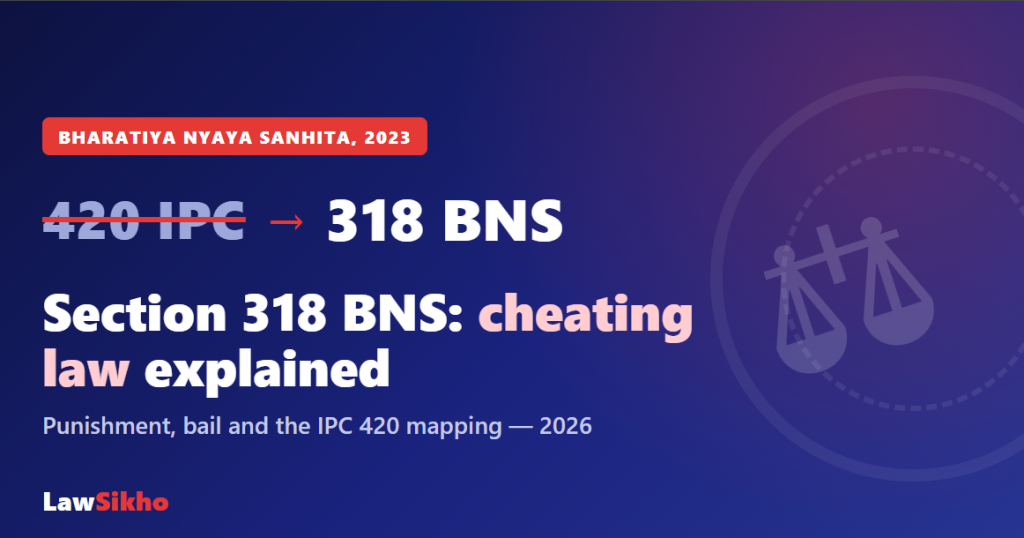
For more than 160 years, one number did the work of an entire dictionary. “420.” In Hindi cinema, in street slang, in the casual insult thrown across a tea stall, it meant exactly one thing: a cheat, a fraudster, a man whose word you could not trust. There was even a famous film character built around it. The number came straight from the law, from Section 420 of the Indian Penal Code, 1860, the provision that punished cheating and dishonestly inducing the delivery of property, the very offence now governed by Section 318 BNS cheating. People who had never read a statute in their lives knew what “chaar-sau-bees” meant.
Then, on 1 July 2024, it quietly left the statute book. The Indian Penal Code was repealed and replaced by the Bharatiya Nyaya Sanhita, 2023. Cheating, including the famous “cheating and delivery of property” offence once prosecuted under IPC 420, is now governed by Section 318 BNS cheating provisions. The number that everyone knew was gone from the operative law overnight.
And here is the strange part. The offence itself barely changed.
The conduct that made you a “420” still makes you a criminal. A shopkeeper who sells a fake product as genuine, an online seller who takes payment and ships nothing, a fraudster who deceives a buyer into parting with money: all of them still commit cheating, just under a renumbered section. The deception is the same. The dishonest intent is the same. The punishment ceiling, despite a myth you will read on half the pages that come up when you search, is the same too.
What changed was the label and a little of the procedure. “420” became Section 318(4). The scattered cheating provisions of the old Code were folded into a single section with four sub-sections. Cheating by personation was carved out into its own provision. A few classification details shifted. That is the honest summary, and it is the summary most explainers get wrong.
Think about the practitioner who can hold all of this cleanly in their head right now, in 2026. While other advocates fumble between the old number and the new one, mixing up IPC 420 with BNS 318 in front of a magistrate, this is the lawyer who walks into the bail hearing and cites the correct sub-section, the correct seven-year ceiling, and the 2024 Supreme Court ruling that decides whether a commercial dispute is even a crime at all. That fluency is not academic. It wins bail, it gets false cases quashed, and it builds a reputation in a profession that is busy re-skilling for the new code.
That is what this guide is built to give you. The full picture of cheating under the BNS, sub-section by sub-section, with the punishment ladder corrected, the IPC mapping laid out, the bail position made clear, and the practical steps for filing or defending a case.
Here is the quick answer searchers want, then the full picture, sub-section by sub-section.
Section 318 of the Bharatiya Nyaya Sanhita, 2023 defines cheating and replaces the old IPC cheating cluster, including the famous Section 420 IPC. It punishes general cheating with up to 3 years under 318(2), and cheating with dishonest delivery of property under 318(4), the successor to 420, with up to 7 years and a fine.
That short answer hides a lot of detail, and most of the questions people actually ask sit in that detail. The sections below unpack each one: the ingredients of cheating, the four sub-sections and their punishments, the IPC-to-BNS map, the bail position, how to file or defend a case, and the case law that now governs all of it.
Table of Contents
What is Section 318 BNS cheating?
Essential ingredients of cheating under Section 318 BNS
Sub-sections 318(1) to 318(4) and the punishment ladder
IPC 420 to BNS 318: the full cheating-cluster mapping
Is Section 318 BNS bailable, cognizable and compoundable?
Cheating (318) vs criminal breach of trust (316) vs cheating by personation (319)
How to file a cheating FIR under Section 318 BNS
Cheating under 318(4) in the digital economy: UPI, online and investment fraud
Defending a Section 318 BNS case and quashing false cheating cases
Landmark case law on cheating under Section 318 BNS
Common mistakes and misconceptions about Section 318 BNS
Frequently asked questions
References
What is Section 318 BNS cheating?
Most people arrive at this topic mid-problem. Either someone has cheated them and they want to know what the law calls it, or an FIR has landed and they need to understand what they are accused of. The first thing to fix is the definition, because almost everyone uses “cheating” loosely, as though any broken deal or unpaid bill counts.
It does not. Cheating is a specific offence with specific ingredients, and getting it right at the start saves a great deal of confusion later.
Cheating under Section 318 of the Bharatiya Nyaya Sanhita, 2023 is committed when a person, by deceiving another, fraudulently or dishonestly induces the deceived person to deliver property to someone, or to consent to someone retaining property, or intentionally induces them to do or omit something they would not have done but for the deception, where that act or omission causes or is likely to cause damage or harm to that person in body, mind, reputation or property. The deception sits at the centre. The dishonest or fraudulent inducement is what turns the deception into a crime.
There is an important rider in the section itself. The Explanation to 318(1) makes clear that a dishonest concealment of facts is also a deception. So cheating is not limited to active lies; staying silent about something you were bound to disclose, in order to trick the other side, counts too. That matters in cases where the fraud is built on what was hidden rather than what was said.
What does “dishonestly induces” actually mean here? In plain terms, the accused must have set out to gain something they were not entitled to, or to cause the other person a loss they should not have suffered, and used deception to bring it about. A genuine misunderstanding is not cheating. A deliberate trick that makes you part with your money is.
Now, a single point that trips up almost everyone. Cheating does not require that you actually lost money. The harm limb is broader than that. We will come back to this in the ingredients section, because it is one of the most misunderstood features of the offence.
Section 318 also does something the old Code did not do neatly. It consolidates the entire IPC cheating family into one provision with four sub-sections, and the last of those, 318(4), is the direct successor to the famous IPC 420. The introduced authority on dishonest intent, the A.M. Mohan v. The State, 2024 SCC OnLine SC 339 ruling, sits underneath this whole structure, and we develop it fully in the ingredients and case-law sections.
A common question is simply when all of this started. Section 318 BNS came into force on 1 July 2024, the day the Bharatiya Nyaya Sanhita replaced the Indian Penal Code. Any cheating committed on or after that date is charged under Section 318; the transition for older conduct is covered later in this guide.
The pitfall to avoid here is treating every disappointment as cheating. A deal that went bad, a service that underwhelmed, a borrower who could not repay: none of these is automatically a crime. Without deception and dishonest inducement, there is no Section 318 offence, only a civil grievance.
Essential ingredients of cheating under Section 318 BNS
Why does the ingredient list matter so much? Because the prosecution does not get to win by showing that the accused behaved badly. It must prove each ingredient of cheating, in sequence, and if even one is missing, the case fails however unsympathetic the accused looks. For the defence, that same list is a map of where to attack.
Here are the essential ingredients of cheating under Section 318 BNS, in the order a court tests them:
There was a deception of some person by the accused.
By that deception, the accused fraudulently or dishonestly induced the deceived person to deliver property, or to consent to its retention, or intentionally induced an act or omission.
That delivery, act, or omission caused or was likely to cause damage or harm to that person in body, mind, reputation, or property.
The dishonest or fraudulent intention existed at the time of the inducement, that is, at inception.
Map those onto a familiar scene and the structure becomes obvious. A seller tells a buyer a phone is brand-new and sealed (deception), the buyer pays and takes it on the strength of that claim (dishonest inducement to deliver property), the phone turns out to be a used handset repackaged (harm to property), and the seller knew it was used all along (dishonest intent at inception). All four boxes tick. Remove the last one, and the picture changes completely.
The expert point worth holding onto is that the harm limb is wider than money. Cheating reaches damage or harm to body, mind, reputation, or property, which is why the offence can exist even where the victim recovered every rupee. So a question practitioners hear constantly is whether cheating requires actual financial loss to the victim. It does not. The risk of harm, or harm to reputation or mind, can be enough, provided the deception and dishonest inducement are made out.
The pitfall is assuming that because no money changed hands, no cheating occurred. That is not the test. The test is deception plus dishonest inducement plus the likelihood of harm, with the intent fixed at the moment of inducement.
Deception and dishonest or fraudulent inducement
So what is the chain that has to be proved? It runs in a line: deception, then dishonest or fraudulent inducement, then either delivery of property or an act or omission that causes or is likely to cause harm. Break the chain at any link and the offence is incomplete.
Deception is the first link, and the Explanation to the section extends it to dishonest concealment of facts, not just positive lies. Picture a builder who knows the land has no clear title and says nothing while collecting booking amounts. The silence, where there was a duty to disclose, is itself the deception. The inducement is the booking payment; the harm is the buyer’s exposure to a defective title.
Does the victim have to suffer an actual financial loss for this chain to close? No, and this is the point most explainers skip. The section is satisfied by harm or the likelihood of harm to body, mind, reputation, or property. The harm limb exists precisely so that cheating is not narrowed to cases of completed monetary loss.
The pitfall here is confusing a hard bargain with a deception. Puffery, optimism, or a salesperson’s enthusiasm is not cheating. The line is crossed only when there is a real deception, made dishonestly, to induce the other side to act to their detriment.
Dishonest intention must exist at inception
Here is the single most important ingredient, and the one that decides most contested cases. The dishonest or fraudulent intention must exist at the time the inducement is made. Not later. The accused must have meant to deceive when they made the promise or the representation that drew the victim in.
This is exactly what the Supreme Court fixed in the A.M. Mohan v. The State, 2024 SCC OnLine SC 339 ruling, which held that to attract cheating the dishonest intention has to be present at the time of the inducement, and that the focus is on the intent to deceive rather than the loss actually caused. The complementary authority is the S.W. Palanitkar v. State of Bihar, (2002) 1 SCC 241 line, which holds that a mere subsequent failure to keep a promise does not, by itself, amount to cheating. Something must have gone wrong at the start, not merely afterwards.
Think of it this way. A businessman who borrows money meaning to repay it, and later cannot because his venture collapses, has not cheated anyone; he has defaulted. The same businessman who borrows knowing from the outset that he will never repay, using a false project to extract the loan, has cheated. The conduct looks identical from the outside. The intent at inception is what separates a civil default from a criminal offence.
We develop the defence side of this in the section on defending a 318 case, because inception intent is the hinge on which both quashing petitions and acquittals turn. For now, the point to carry forward is that timing of intent is everything.
Sub-sections 318(1) to 318(4) and the punishment ladder
Here is where many readers go wrong. They look up “punishment for cheating under BNS”, find a single number, and stop. But Section 318 does not have one punishment. It has a ladder, and the rung you land on depends on what kind of cheating it was and who the victim was.
The same word, “cheating”, covers a shopkeeper who short-changes a customer and a fraudster who tricks a buyer out of lakhs through a fake property deal. The law grades them differently.
The table below maps each sub-section of Section 318 BNS to what it covers, the maximum punishment, and the old IPC provision it replaced.
Sub-section
What it covers
Maximum punishment
IPC equivalent
Section 318(1)
Definition of cheating (no punishment)
Definition only
IPC 415
Section 318(2)
General cheating
Up to 3 years, fine, or both
IPC 417
Section 318(3)
Cheating by a person bound to protect the victim’s interest
Up to 5 years, fine, or both
IPC 418
Section 318(4)
Cheating and dishonestly inducing delivery of property
Up to 7 years, and fine
IPC 420
There is a clear logic running through this ladder. The graver the breach and the more the victim was entitled to expect protection, the heavier the punishment. A stranger’s con is bad; a betrayal by someone who was supposed to be guarding your interest is worse; and cheating that strips you of actual property carries the heaviest ordinary ceiling.
A practical warning before the detail. The most expensive error in this whole area is citing the wrong sub-section and the wrong punishment, and the most common version of that error is the “10 years” myth attached to 318(4). We deal with it head-on below, because getting it right is both an accuracy point and, frankly, a credibility test.
General cheating: 318(2) and 318(3)
Start with the lower rungs. General cheating under Section 318 of the Bharatiya Nyaya Sanhita, 2023 sub-section (2) is punishable with imprisonment of either description up to three years, or fine, or both. This is the everyday cheating provision, the successor to the old IPC 417, and it covers cheating that does not involve dishonestly inducing the delivery of property.
Sub-section (3) sits one rung higher. Where the person who cheats was bound, by law or by a legal contract, to protect the interest of the person cheated, the maximum rises to five years, or fine, or both. This is the successor to IPC 418, and the enhancement reflects the breach of a protective duty. A trustee, a guardian, or a professional acting for a client who cheats the very person they were duty-bound to safeguard falls here.
What is the practical difference between the three-year and five-year tiers? It comes down to the relationship. Ordinary cheating between strangers, or between parties at arm’s length, sits at three years under 318(2). Cheating by someone who occupied a position of protective obligation jumps to five years under 318(3). The conduct may be similar; the breach of trust attached to the role is what lifts the ceiling.
The pitfall is defaulting everything to the general tier. An advocate who charges a fiduciary’s cheating under 318(2) when 318(3) applies has under-framed the offence. The relationship between the parties is not a detail; it can change the maximum sentence.
Cheating and delivery of property: 318(4), the old 420
This is the rung everyone has heard of, even if they call it by its old number. Section 318(4) BNS punishes cheating coupled with dishonestly inducing the deceived person to deliver property, or to make, alter, or destroy a valuable security. The maximum is imprisonment of either description up to seven years, and the offender is also liable to a fine. This is the direct successor to IPC 420, the famous “420”.
Notice the structure carefully. 318(4) is not just any cheating; it is cheating where the deception actually produces the delivery of property or a valuable security. That extra element, the parting with property, is what makes it the gravest ordinary cheating offence and what attaches the mandatory fine.
What does “delivery of property or valuable security” look like in the real world? A buyer pays for a branded product and is handed a counterfeit. A seller takes an advance for goods he never intends to ship. A fraudster persuades someone to sign over a cheque or a promissory note through a false story. In each case, property or a valuable security changes hands because of the deception, and that is what brings 318(4) into play. The digital versions of exactly this, from UPI fraud to fake investment schemes, get their own section later in this guide.
Is the fine optional under 318(4)? No. Unlike 318(2) and 318(3), where the court may impose imprisonment or fine or both, sub-section (4) provides that the offender shall also be liable to a fine. The fine accompanies the custodial exposure rather than substituting for it, which matters in commercial cases where the amount cheated was large.
The “10 years” myth: it is 7 years
Now to the correction that this guide exists to make. Search “318(4) punishment” and you will find page after page claiming the maximum is ten years. That is wrong. The bare act says seven years, and the maximum was not increased when IPC 420 became Section 318(4).
Let us be precise about what actually changed. The BNS consolidated the scattered cheating provisions and adjusted the procedural classification. It did not raise the ceiling for cheating-and-delivery-of-property. IPC 420 carried a seven-year maximum, and Section 318(4) carries the same seven-year maximum. The “10 years” figure appears to have spread from a handful of low-quality pages that simply got the number wrong, and it then propagated across copycat content and even into some AI-generated summaries.
Did the BNS increase the maximum sentence for this offence? No. The change is consolidation plus classification, not a longer ceiling. Anyone telling you 318(4) now carries ten years is repeating an error, and in a courtroom that error costs credibility.
Section 318 BNS punishment ladder
Three rungs of cheating: 3, 5 and 7 years (it is 7, not 10)
3 Years max
Section 318(2)
General cheating — up to 3 years, fine, or both.
Successor to IPC 417
5 Years max
Section 318(3)
Cheating by a person bound to protect the victim’s interest — up to 5 years, fine, or both.
Successor to IPC 418
7 Years max
Section 318(4)
Cheating and dishonestly inducing delivery of property (the old 420) — up to 7 years, and fine.
Successor to IPC 420; fine is mandatory
10 7 years, NOT 10
IPC 420 to BNS 318: the full cheating-cluster mapping
Why does the mapping matter so much in 2026? Because charge-sheets, FIRs, news reports, and clients all still speak in the old numbers. Someone walks in saying “I have a 420 case” and the advocate has to translate that into the BNS provision that actually governs it. Getting the crosswalk right is the everyday skill of practising under the new code.
The transition happened on a single date. On 1 July 2024, the Indian Penal Code, 1860 was repealed and the Bharatiya Nyaya Sanhita, 2023 came into force, and the entire cheating family was reorganised. The table below sets out the full conversion for the cheating cluster.
Old IPC section
What it covered
BNS section
Punishment
Section 415
Definition of cheating
Section 318(1)
Definition only
Section 417
Punishment for general cheating
Section 318(2)
Up to 3 years, fine, or both
Section 418
Cheating a person whose interest the offender was bound to protect
Section 318(3)
Up to 5 years, fine, or both
Section 420
Cheating and dishonestly inducing delivery of property
Section 318(4)
Up to 7 years, and fine
Sections 416 / 419
Cheating by personation
Section 319
Up to 5 years (personation offence)
Sections 405 / 406
Criminal breach of trust
Section 316
Up to 5 years (separate offence)
Read the map carefully and two things stand out. First, the definition of cheating moved from IPC 415 to 318(1), the general punishment from IPC 417 to 318(2), the protective-duty cheating from IPC 418 to 318(3), and the famous IPC 420 to 318(4). Second, two offences that people constantly muddle with cheating, personation and criminal breach of trust, were given their own homes in Section 319 and Section 316 respectively.
So is 420 IPC the same as 318 BNS? Not quite, and the nuance matters. IPC 420 corresponds specifically to Section 318(4), the cheating-and-delivery-of-property sub-section, not to the whole of Section 318. When someone says “420 is now 318”, the accurate version is “420 is now 318(4)”. The rest of Section 318 covers the other forms of cheating that lived in IPC 415, 417, and 418.
What about the question of what genuinely changed versus what stayed the same? The honest answer is that the substance of the offence is largely intact. The ingredients of cheating, the punishment ceilings, and the basic structure carried over. What changed is consolidation (five provisions becoming one section with sub-sections) and some procedural classification under the new criminal procedure code. To grasp how cheating sits alongside its closest cousin, it helps to read this together with criminal breach of trust under Section 316 BNS , which the “cannot co-exist” doctrine pairs it against.
Will “420” still be used after the BNS?
Here is a question that is half legal and half cultural. If the section is now 318(4), will people stop saying “420”? Almost certainly not, and that tells you something about how language and law part ways.
The number “420” entered Indian idiom over a century and a half, long enough that it stopped being a statutory reference and became a word in its own right. People who call someone a “420” are not citing the Penal Code; they are using a slang term for a cheat. That usage will survive the repeal exactly as plenty of dead-law phrases survive in everyday speech.
In practice, though, there is a clean line to draw. Colloquially, “420” lives on as the word for a fraudster. Statutorily, the operative provision is Section 318(4) BNS, and that is what an FIR, a charge-sheet, or a judgment will cite for offences committed on or after 1 July 2024. Knowing which register you are in, the slang or the statute, is part of speaking about this offence accurately.
IPC 420 to Section 318 BNS: the cheating-cluster mapping
How the old IPC cheating sections fold into Section 318 BNS
Old IPC section
What it covered
BNS section
Punishment
Section 415
Definition of cheating
Section 318(1)
Definition only
Section 417
Punishment for general cheating
Section 318(2)
Up to 3 years, fine, or both
Section 418
Cheating a person whose interest the offender was bound to protect
Section 318(3)
Up to 5 years, fine, or both
Section 420
Cheating and dishonestly inducing delivery of propertyThe old 420
Section 318(4)
Up to 7 years, and fine
Sections 416 / 419
Cheating by personation
Section 319
Up to 5 years
Sections 405 / 406
Criminal breach of trust
Section 316
Up to 5 years
⚠
IPC 420 is now Section 318(4) BNS , not the whole of Section 318. The seven-year maximum was NOT increased.
Is Section 318 BNS bailable, cognizable and compoundable?
This is the cluster of questions that anxious searchers ask most: is it bailable, can the police arrest, which court hears it, and can it be settled? The answers are not the same across the sub-sections, which is why a single blanket answer (the kind most pages give) is misleading. Classification depends on which sub-section you are charged under.
The table below sets out the classification sub-section by sub-section, read off the First Schedule to the BNSS. Compoundability is treated separately below, because the sources on it genuinely conflict and it should be confirmed against the Schedule before anyone relies on it.
Sub-section
Cognizable?
Bailable?
Triable by
Section 318(2)
Non-cognizable
Bailable
Any Magistrate
Section 318(3)
Non-cognizable
Bailable
Any Magistrate
Section 318(4)
Cognizable
Non-bailable
Magistrate of the First Class
Start with the practical consequence, because that is what the classification actually controls. For 318(2) and 318(3), being non-cognizable means the police cannot register an FIR and investigate on their own; the complainant generally needs a magistrate’s direction or has to go the private-complaint route. For 318(4), being cognizable means the police can register an FIR and investigate directly, and they can arrest without a warrant, subject to the arrest safeguards built into the criminal procedure code.
Can the police arrest you without a warrant under 318(4)? Because 318(4) is a cognizable offence, yes, the police can arrest without a prior warrant, though the BNSS arrest safeguards (notice before arrest in appropriate cases, recording of reasons, and the procedural protections around custody) still apply. That power to arrest directly is precisely why anticipatory bail becomes such a live concern for anyone facing a 318(4) allegation.
Which court tries a 318(4) case? It is triable by a Magistrate of the First Class. The lower-tier cheating offences under 318(2) and 318(3) can be tried by any Magistrate. The triable court is part of the same classification scheme that fixes cognizability and bailability.
What about compounding, the question of whether the parties can settle and close the case? Unlike cognizability and bailability, which the First Schedule fixes clearly, the compoundability of cheating is the one cell where published sources genuinely conflict. Because settling a case on the wrong assumption can be costly, whether cheating under Section 318 is compoundable, and on what conditions, is best confirmed with counsel against the Table of compoundable offences before anyone relies on it, rather than stated as settled here.
Classification sub-section by sub-section
Why restate the table in prose? Because the practical takeaway is easy to lose in a grid. The single most important distinction is between the property-delivery offence and the rest.
Section 318(4), the old 420, is the serious one for procedural purposes: cognizable, non-bailable, and triable by a Magistrate of the First Class. That combination is what lets a victim walk into a police station and have an FIR registered directly, and what exposes the accused to arrest without warrant. The reason 318(4) carries this weight is that it is a cognizable offence, and understanding why cognizable offences let the police act without prior sanction explains the whole procedural posture.
For 318(2) and 318(3), the picture is gentler: non-cognizable, bailable, triable by any Magistrate. The trade-off is that registering a case is harder, because the police will not usually act on their own; the complainant has to drive the process through the magistrate. A common question is therefore which route to take, and the answer depends almost entirely on whether the facts support a 318(4) charge with its property-delivery element, or only a general cheating charge under 318(2).
Cheating (318) vs criminal breach of trust (316) vs cheating by personation (319)
If there is one set of distinctions that decides cases in this area, it is this one. Police and complainants routinely lump cheating together with criminal breach of trust, and confuse both with personation. They are three different offences, and the Supreme Court has made the cheating-versus-breach-of-trust line very clear.
The table below compares the three offences across the features that actually distinguish them.
Aspect
Cheating (Section 318)
Criminal breach of trust (Section 316)
Cheating by personation (Section 319)
Core act
Deceiving someone into parting with property or acting to their detriment
Dishonestly misappropriating property that was lawfully entrusted
Cheating by pretending to be someone else (a real or fictitious person)
Entrustment vs inducement
The victim is induced by deception
The property was first entrusted, then misappropriated
The deception is as to identity
Key IPC origin
IPC 415, 417, 418, 420
IPC 405, 406
IPC 416, 419
Punishment
3, 5, or 7 years depending on sub-section
Up to 5 years (general)
Up to 5 years
Can they co-exist?
Cheating and breach of trust cannot co-exist on the same facts
Mutually exclusive with cheating
A distinct offence, charged on its own facts
The thread running through the table is the timing and nature of the dishonesty. In cheating, the dishonest intent exists at the inception and the victim is deceived into the transaction. In criminal breach of trust, the property was honestly handed over first and the dishonesty came later. In personation, the deception is specifically about who the accused is pretending to be.
The “cannot co-exist” doctrine
This is the doctrine that has reshaped how these cases are pleaded. In the Delhi Race Club (1940) Ltd. v. State of Uttar Pradesh, 2024 INSC 626 ruling of 2024, a two-judge bench of the Supreme Court held that cheating and criminal breach of trust are antithetical and cannot co-exist on the same set of facts, and that a mere non-payment in a sale is a civil matter, not cheating.
Run the logic and you see why. If the accused was dishonest from the very start, the property was procured by deception, which is cheating, and there was no genuine entrustment. If the property was genuinely entrusted and only later misappropriated, that is criminal breach of trust, and there was no inception-stage deception. You cannot have both on identical facts, because the dishonest intent sits at opposite ends of the timeline.
So can cheating and criminal breach of trust be charged together? Strictly, no, not on the same facts, because the two are mutually exclusive in the way the dishonest intent arises. The ruling has made courts increasingly impatient with the reflexive FIR that throws in both sections, and that scattergun pleading is now a frequent ground for quashing.
The practical lesson, and the one that decides bail and quashing applications, is that the timing of the dishonest intent is the fork in the road. We return to this in the defence section, because it is precisely where a civil dispute dressed up as cheating gets unpicked.
Cheating vs fraud, misrepresentation and cheque bounce
A cluster of related confusions sits around the edges of cheating, and clearing them up saves a lot of misdirected effort. Is cheating the same as fraud? Not exactly. “Fraud” is a broad concept that runs across civil and criminal law, while cheating is the specific criminal offence in Section 318, with its defined ingredients of deception and dishonest inducement. All cheating involves fraud in the loose sense; not all fraud is criminal cheating.
When is a misrepresentation civil and when is it criminal cheating? The dividing line is dishonest intent at inception. An innocent or negligent misrepresentation that induces a contract is a civil matter, giving rise to rescission or damages. A misrepresentation made dishonestly, intending to deceive from the outset, can cross into criminal cheating. The same false statement can be a civil wrong or a crime depending on the intent behind it.
What about cheating by personation, the Section 319 offence? The difference between Section 318 and Section 319 is the object of the deception. Ordinary cheating deceives someone about a fact or a promise; personation deceives them about identity, by the accused pretending to be some other person, real or fictitious. Identity theft scams and impersonation frauds fall under 319, even though they often overlap with the property-delivery harm of 318(4).
And the question almost everyone asks: is a bounced cheque cheating? Usually not on its own. A dishonoured cheque is ordinarily dealt with under Section 138 of the Negotiable Instruments Act, 1881 , which is a distinct statutory offence with its own notice and limitation framework. A cheque bounce becomes cheating only where there was dishonest intent at the inception of the transaction, for instance where the cheque was issued as part of a deception that was never meant to be honoured.
How to file a cheating FIR under Section 318 BNS
This is the transactional core of the guide, the part the victim and the accused both need. No competitor offers a clean walkthrough, which is exactly why so many people arrive here with the procedure half-understood. The process now runs through the Bharatiya Nagarik Suraksha Sanhita, 2023, which replaced the old criminal procedure code on 1 July 2024.
Here are the practical steps to set a cheating case in motion under the BNSS:
Gather your evidence first. Collect the agreement or communication that contains the false representation, the messages or emails, payment receipts, transaction records, and anything showing what you were promised versus what you got.
Draft the complaint clearly. Identify the deception, the dishonest inducement, and the harm or loss, mapping the facts onto the ingredients of cheating rather than just narrating a grievance.
Approach the police station with jurisdiction, normally where the offence or part of it occurred.
Understand the route by sub-section. For 318(4), a cognizable offence, the police are obliged to register an FIR. For 318(2) or 318(3), which are non-cognizable, you may need a magistrate’s direction or a private complaint.
File online where the state portal or e-FIR facility allows it, particularly for online and financial fraud.
Collect the FIR copy and note the FIR number, then track the investigation.
Escalate if the police refuse to register the FIR, using the route set out below.
What evidence do you actually need to prove cheating? The strongest cases combine three things: proof of the representation that was made (the contract, the advertisement, the chat), proof that it was false and known to be false, and proof that you acted on it to your detriment (the payment trail, the delivery records). Documentary evidence beats oral assertion every time, and a transaction trail that shows money moving on the strength of a false promise is the backbone of a 318(4) complaint.
Can you file a cheating complaint online? Increasingly, yes. Many states allow e-FIR or online complaint registration, and financial and cyber-enabled cheating can be reported through the national cybercrime portal, which then connects to a local FIR. The digital reporting path is covered in the online-fraud section below.
If the police refuse to register the FIR
What do you do when the station declines to act? The refusal is not the end of the road; the criminal procedure code builds in escalation precisely because police inaction is common.
The first step is a written complaint to the Superintendent of Police, setting out the cognizable offence and the refusal to register. Where the SP is satisfied that a cognizable offence is disclosed, registration can be directed. If that does not work, the next step is to approach the Magistrate, who has the power to direct registration and investigation, or to take a private complaint and proceed on it.
This connects directly to a question that decides whether a case should even be filed: can a cheating case be brought for non-payment of a loan? Usually not. Mere non-repayment is a civil matter unless there was dishonest intent at the inception of the loan, the kind of inception-stage deception the Delhi Race Club reasoning isolates. A loan taken honestly and not repaid is a recovery dispute; a loan taken through a false story, never meant to be repaid, can be cheating.
And what must the prosecution ultimately prove for a 318(4) conviction? Every ingredient: the deception, the dishonest inducement, the delivery of property or valuable security caused by it, and crucially the dishonest intent at inception. The whole structure of the offence is also the whole structure of the defence, which is why the next sections deal with bail and with dismantling a weak case.
Bail and anticipatory bail under the BNSS
Because 318(4) is non-bailable, bail is the first practical battle for anyone accused. Non-bailable does not mean bail is unavailable; it means bail is at the court’s discretion rather than a matter of right. That distinction is where good advocacy earns its keep.
The two routes are regular bail and anticipatory bail. Can you get anticipatory bail in a 318(4) case? Yes. Where arrest is genuinely apprehended, an accused can apply for anticipatory bail before arrest, under Section 482 of the Bharatiya Nagarik Suraksha Sanhita, 2023 , the anticipatory-bail provision that replaced Section 438 of the old Code of Criminal Procedure. A concrete illustration is the Calcutta High Court order in In Re: Siraj Lutfar Rahaman, C.R.M.(A) No. 4178 of 2024 , where anticipatory bail under Section 482 BNSS was granted in a 318(4)/316(2) BNS matter that the court found to be essentially a civil land-payment dispute.
Regular bail, by contrast, is sought after arrest or appearance, and the court weighs the gravity, the evidence, and the risk of flight or tampering.
How long does bail take in practice? There is no fixed answer, and it varies by court, by the seriousness of the allegation, and by how well the application is prepared. A well-documented anticipatory-bail application showing that the dispute is essentially civil can move quickly; a contested matter with a large alleged loss can take longer. For the broader mechanics, it is worth reading how the bail framework operates under the BNSS alongside this section.
Can a look-out circular be issued in a cheating case? It is possible, particularly in larger financial-fraud matters where the accused may leave the country, which is one more reason to move for anticipatory protection early rather than wait. The combination of cognizability, the power to arrest without warrant, and the possibility of a look-out circular is exactly why the accused in a serious 318(4) matter cannot afford to be passive.
Cheating under 318(4) in the digital economy: UPI, online and investment fraud
Where does the real-world volume of cheating cases actually sit today? Increasingly, not in the bazaar but on the phone. Section 318(4) has quietly become the default charge for the digital economy: UPI fraud, fake-payment-screenshot scams, online-shopping cheating, and investment Ponzi schemes. This is the old “420” reborn for the smartphone era, and it is the area most explainers ignore.
The fit is natural once you see it. Every one of these scams involves a deception that induces the victim to part with money or property, which is precisely the 318(4) structure. A fraudster sends a doctored screenshot showing a payment that never arrived, the seller releases the goods, and property has been delivered through deception. An online store takes payment and ships nothing. An “investment adviser” promises guaranteed returns on a scheme that is a pyramid from the start.
Is online shopping fraud covered under Section 318? Yes. Where a seller takes payment and dishonestly fails to deliver, or delivers something materially different from what was represented, with dishonest intent at the inception, the conduct fits 318(4). The medium is digital, but the offence is the same cheating-and-delivery-of-property the section has always covered.
Is investment or Ponzi fraud charged under 318(4)? Commonly, yes, often alongside other statutory offences. A scheme that induces investors to hand over money on a false promise of returns, where the operators knew from the start it could not pay, is cheating with delivery of property.
Is a fake payment screenshot scam cheating? Where the screenshot is the deception that induces delivery, it squarely is. Phishing that tricks a victim into transferring money fits the same mould.
Looking ahead, this is where the offence is heading. The digital-fraud caseload is likely to keep rising, and the BNS-era prosecution of online cheating will increasingly integrate with the Information Technology Act and the cybercrime reporting workflows, building a fresh layer of BNS-specific precedent over the next few years. For readers who work at the intersection of law and technology, this overlap is becoming a distinct practice area in its own right; LawSikho’s Diploma in Cyber Law, FinTech Regulations and Technology Contracts covers exactly that terrain.
How to report an online or UPI scam
So what do you actually do the moment you realise you have been scammed online? Speed matters, because frozen funds can sometimes be recovered if you act fast.
Report it on the national cybercrime portal at cybercrime.gov.in, and call the cyber-fraud helpline number 1930 as quickly as possible, ideally within the golden hours after the transaction, which improves the chance of the receiving account being frozen. Lodge the complaint with the transaction details, the counterparty’s identifiers, and any screenshots or chat records you have.
How does a cyber complaint connect to a Section 318(4) FIR? The cybercrime portal complaint and the FIR are linked parts of the same process. A complaint on the portal can be converted into or escalated to a formal FIR under 318(4) (often read with the relevant Information Technology Act provisions) at the local cyber police station. Keeping the acknowledgement number, the transaction trail, and all communications is what allows the cyber cell and the investigating officer to build the cheating case on solid evidence.
Defending a Section 318 BNS case and quashing false cheating cases
What if you are on the other side, accused of cheating in a case that should never have been criminal? A striking number of Section 318 FIRs are commercial disputes dressed up as crimes, filed to pressure the other side into paying. The good news for the accused is that the structure of the offence supplies the defence; each ingredient the prosecution must prove is a point of attack.
The central defence is the one we have built toward throughout this guide: no dishonest intent at inception. If the accused entered the transaction honestly and only later failed to perform, there is no cheating, because the dishonest intent did not exist when the inducement was made. This is the A.M. Mohan v. The State, 2024 SCC OnLine SC 339 and S.W. Palanitkar v. State of Bihar, (2002) 1 SCC 241 line in action, distinguishing a broken promise from a criminal deception.
How do you defend a 318 or 420 case in practice? The defence themes track the ingredients. Show that there was no deception, or that any representation was honestly made; show that the complainant was not actually induced by it; show that the dishonest intent was absent at inception; and where the facts are essentially civil, argue that the criminal court is the wrong forum altogether. Documentary proof that the dealing was a genuine commercial transaction is often the most powerful material.
How can a false 318 or 420 case be quashed? Through the High Court’s inherent powers, where the FIR or complaint, taken at face value, does not disclose the ingredients of cheating, or where the matter is purely civil. A false cheating FIR can be quashed using the High Court’s inherent powers when it is really a disguised civil claim, and the Delhi Race Club reasoning has given that argument fresh force. Quashing is often a faster and cleaner outcome than fighting a full trial on a case that should not exist.
When a civil dispute is wrongly charged as cheating
Here is the scenario that generates more wrongful cheating FIRs than any other: a purely contractual or commercial dispute repackaged as a crime. A supplier is not paid, a buyer is dissatisfied, a loan is not repaid, and instead of a civil suit the aggrieved party persuades the police to register a cheating case.
The law’s answer is increasingly firm. In the Delhi Race Club (1940) Ltd. v. State of Uttar Pradesh, 2024 INSC 626 reasoning, the Supreme Court held that mere non-payment in a sale is a civil matter and does not become cheating just because money is owed. Where the dispute is at bottom about performance of a contract, and there was no inception-stage deception, the criminal process is being abused, and the High Court can step in.
This tightening of the dishonest-intent test is producing a genuine second-order effect on practice. As courts scrutinise “civil dressed as criminal” cases more closely, the demand for quashing petitions and anticipatory-bail applications in commercial-dispute-as-cheating matters is growing, and a niche practice area is forming around it. The advocate who can quickly diagnose whether a 318 FIR discloses a real crime or a disguised civil claim, and act on it at the threshold, is doing work that is both valuable and increasingly sought after.
Landmark case law on cheating under Section 318 BNS
Why lead with case law in a statute explainer? Because the bare act tells you what cheating is, but the judgments tell you how courts actually apply it, and that is where cases are won and lost. The authorities below anchor the key ingredients and distinctions, and although several pre-date the BNS, IPC-era authority on cheating remains persuasive and courts increasingly cite the BNS sections directly.
The table below organises the leading authorities by the ingredient or distinction each one anchors.
The 2024 ruling is the headline authority for the transition era. Decided weeks after the BNS came into force, the Delhi Race Club judgment drew a firm line between criminal cheating and ordinary civil disputes, and rebuked the routine clubbing of cheating with criminal breach of trust. It is the case to cite whenever a commercial dispute has been criminalised.
The inception-intent authorities supply the doctrinal backbone. The A.M. Mohan ruling fixes the dishonest intention at the time of inducement, and the S.W. Palanitkar line confirms that a later broken promise is not, on its own, cheating. Together they are the most-cited propositions in both prosecution and defence, and they recur throughout this guide because almost every contested cheating case turns on them.
What does the future of this case law look like? The old IPC-420 jurisprudence remains persuasive, but a fresh body of BNS-era orders is accumulating, and early High Court bail and quashing orders under Section 318 are already building the new precedent layer. Over the next few years, expect courts to cite Section 318 directly rather than reaching back to IPC 420, even as the substance of the old rulings carries through.
Common mistakes and misconceptions about Section 318 BNS
Which errors actually cost people, in court and out of it? A handful recur so often that they are worth setting out plainly as misconception and correction, because each one has practical consequences.
The first is the punishment myth. The misconception is that 318(4) carries a maximum of ten years. The correction is that the maximum is seven years, unchanged from IPC 420, because the BNS consolidated and reclassified the offence without raising the ceiling. Repeating the wrong figure misjudges the risk and damages credibility.
The second is the broken-promise fallacy. The misconception is that every unkept promise or unpaid debt is cheating. The correction is that cheating requires dishonest intent at inception; a deal that honestly went wrong, or a loan honestly taken and not repaid, is a civil matter, not a crime. This is the single most common reason wrongful cheating FIRs collapse.
The third is the label confusion. The misconception is that “420” is still the operative section. The correction is that the operative provision for cheating-and-delivery-of-property is now Section 318(4); “420” survives only as slang. Citing the dead section in a current matter signals unfamiliarity with the new code.
Then there are the transition questions that genuinely puzzle people. Will old 420 cases be tried under the IPC or the BNS? Offences committed before 1 July 2024 are generally tried under the law in force when the offence was committed, which is the IPC, while offences on or after that date are charged under the BNS.
Does the BNS apply to cheating committed before 1 July 2024? As a rule, no; the savings and transition principle preserves the application of the old law to pre-commencement conduct, so a 2023 cheating offence is an IPC 420 case even if it comes to trial in 2026.
Frequently asked questions
1. What is Section 318 of the BNS?
Section 318 of the Bharatiya Nyaya Sanhita, 2023 is the provision that defines and punishes cheating. It contains four sub-sections: 318(1) defines the offence, while 318(2), 318(3), and 318(4) set out the punishment for general cheating, cheating by a person bound to protect the victim, and cheating with delivery of property respectively.
2. Which section replaced 420 IPC in the BNS?
Section 318(4) of the BNS replaced Section 420 of the IPC. It covers cheating coupled with dishonestly inducing the delivery of property or a valuable security, and carries up to seven years’ imprisonment and a fine. The wider Section 318 also absorbs the other old cheating provisions, IPC 415, 417, and 418.
3. Is 420 IPC the same as 318 BNS?
Not exactly. IPC 420 corresponds specifically to Section 318(4), the cheating-and-delivery-of-property sub-section, not to the whole of Section 318. The rest of Section 318 covers the general cheating offences that previously sat in IPC 415, 417, and 418. So “420 is now 318(4)” is the accurate statement.
4. What is the new section for 420 in BNS 2023?
The new section for the old IPC 420 is Section 318(4) of the Bharatiya Nyaya Sanhita, 2023, which came into force on 1 July 2024. It retains the seven-year maximum and the mandatory fine that IPC 420 carried. Charge-sheets often still note the old IPC 420 in parentheses for continuity.
5. What is the punishment under Section 318(4) BNS?
Section 318(4) is punishable with imprisonment of either description up to seven years, and the offender is also liable to a fine. It is the gravest ordinary cheating offence under the section because it involves the actual delivery of property or a valuable security obtained through deception. The fine is mandatory, not optional.
6. Is the punishment for 318(4) seven years or ten years?
It is seven years, not ten. Several pages wrongly state ten years, but the bare act fixes the maximum at seven, exactly as the old IPC 420 did. The BNS consolidated and reclassified the cheating offences without increasing the ceiling for cheating with delivery of property.
7. Is Section 318 BNS bailable or non-bailable?
It depends on the sub-section. Under the First Schedule to the BNSS, general cheating under 318(2) and 318(3) is non-cognizable and bailable, while cheating with delivery of property under 318(4) is cognizable and non-bailable. The compoundability position is less settled and is best confirmed with counsel before any settlement is relied on.
8. Can I get anticipatory bail in a 318(4) case?
Yes. Because 318(4) is non-bailable and the police can arrest without a warrant, anticipatory bail is an important protection where arrest is apprehended. The accused can apply before arrest under Section 482 of the BNSS, the anticipatory-bail provision that replaced Section 438 CrPC, and a strong application often shows that the dispute is essentially civil.
9. How do I file a cheating case under Section 318 BNS?
Gather your evidence (the false representation, the payment trail, the communications), draft a complaint identifying the deception, inducement, and harm, and approach the police station with jurisdiction. For 318(4), a cognizable offence, the police must register an FIR; for 318(2) or 318(3), you may need a magistrate’s direction or a private complaint.
10. What is the difference between cheating (318) and criminal breach of trust (316)?
The difference is the timing of the dishonest intent. In cheating, the accused was dishonest at inception and induced the victim by deception. In criminal breach of trust, the property was lawfully entrusted first and the dishonesty came later. The Supreme Court has held the two offences cannot co-exist on the same facts.
11. Section 318 BNS vs Section 420 IPC: what actually changed?
The substance of the offence is largely the same. The change is consolidation (the scattered cheating provisions became one Section 318 with four sub-sections) and some procedural reclassification under the BNSS. The maximum punishment for cheating with delivery of property stayed at seven years, and the core ingredients of the offence carried over intact.
12. When did Section 318 BNS come into force?
Section 318 came into force on 1 July 2024, the date the Bharatiya Nyaya Sanhita, 2023 replaced the Indian Penal Code, 1860. Cheating committed on or after that date is charged under Section 318. Offences committed before that date are generally tried under the old IPC provisions.
References
Case Law
A.M. Mohan v. The State, 2024 SCC OnLine SC 339 (Supreme Court of India): indiankanoon.org/doc/180229683 : dishonest intention must exist at the time of the inducement to attract cheating.
Delhi Race Club (1940) Ltd. v. State of Uttar Pradesh, 2024 INSC 626 (Supreme Court of India): indiankanoon.org/doc/65832318 : cheating and criminal breach of trust cannot co-exist on the same facts; mere non-payment in a sale is a civil matter.
In Re: Siraj Lutfar Rahaman, C.R.M.(A) No. 4178 of 2024 (Calcutta High Court): indiankanoon.org/doc/127958843 : anticipatory bail under Section 482 BNSS granted in a 318(4)/316(2) BNS matter found to be essentially a civil land-payment dispute.
S.W. Palanitkar v. State of Bihar, (2002) 1 SCC 241 (Supreme Court of India): indiankanoon.org/doc/891864 : a mere subsequent failure to keep a promise does not, by itself, amount to cheating.
Statutes
Indian Penal Code, 1860: Sections 415, 417, 418 and 420 for the IPC-to-BNS cheating mapping: indiacode.nic.in .
Negotiable Instruments Act, 1881, Section 138: cheque dishonour offence, distinguished from cheating under Section 318: indiacode.nic.in .
Information Technology Act, 2000: read with Section 318(4) BNS for cyber-enabled cheating: indiacode.nic.in .
Bharatiya Nyaya Sanhita, 2023, Section 318 (cheating), sub-sections 318(1) to 318(4); also Section 319 (cheating by personation) and Section 316 (criminal breach of trust): indiacode.nic.in .
Bharatiya Nagarik Suraksha Sanhita, 2023, Section 482 (anticipatory bail, successor to CrPC Section 438) and the First Schedule classification of Section 318 offences: indiacode.nic.in .
cybercrime.gov.in: national cybercrime reporting portal (and the 1930 cyber-fraud helpline) for online and UPI fraud.
This article is for informational purposes only and does not constitute legal advice. For specific legal guidance, consult a qualified legal professional.





 Allow notifications