
Last verified: July 2026
A single slap. A shove in a parking lot. A fistful of pulled hair that leaves nothing behind but a red mark and a moment of pain. Most people assume none of that is serious enough to reach a criminal court. They’re wrong. Under Section 115 BNS, that exact conduct, voluntarily causing hurt, is enough to sustain a conviction, because Indian criminal law fixes on what the person intended, not on how bad the injury looks afterwards.
That principle has decided real cases at the highest level. The Supreme Court once dealt with an accused whose kick did not directly kill the victim. Death followed days later, from an untreated infection that turned gangrenous. The Court held that the proven act “only amounted to” voluntarily causing hurt, converted the conviction, and sentenced the accused to seven months’ imprisonment (Pirthi v. State of Haryana, 1994 AIR 1582). In an older Andhra Pradesh High Court matter, dragging a woman by her hair was itself held to be hurt (Kosana Ranganayakamma v. Pasupulati Subbamma, AIR 1967 AP 208).
So the instinctive question, “is a slap really a crime?”, is the wrong one to ask. The right question is narrower and far more useful: did the person intend, or know they were likely, to cause bodily pain? That single idea, mens rea over injury size, runs through the entire provision. It cuts both ways too: in the Supreme Court matter above, even a death did not push the charge above hurt, because the proven intention reached only that far. Get it, and everything else about Sec. 115 (BNS), the punishment, the bail, the compounding, the defence, starts to make sense.

Here’s why this matters right now. On 1 July 2024, the Bharatiya Nyaya Sanhita replaced the Indian Penal Code that had governed this offence since 1860. The section number changed. So did one number inside it: the maximum fine jumped tenfold. But the definition, and the reason a slap can still land you in front of a Magistrate, did not move an inch. Police stations, older filings and half the internet still say “323”. The law now says “115”. Both refer to the same thing.
Whether you’re a law student learning the hurt provisions for the judiciary exam, a young advocate handling your first 115/323 brief, or someone who has just been named in (or wants to file) a simple-hurt complaint, the next few minutes give you the fast answer first, then the depth. And the depth is where most pages give up.
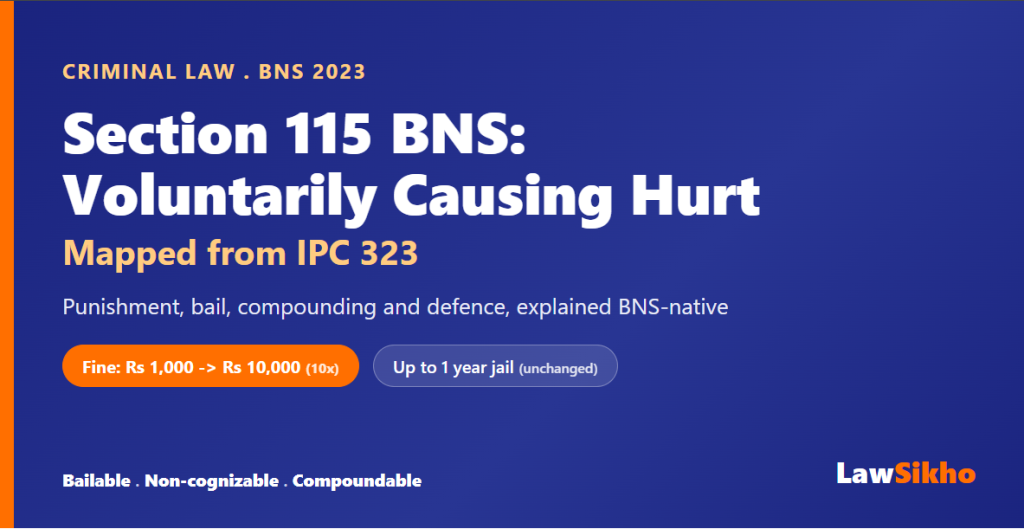
Section 115 BNS punishes voluntarily causing hurt, intentionally or knowingly causing bodily pain, disease or infirmity, with imprisonment up to one year, or a fine up to ₹10,000, or both. It replaces IPC Section 323; the fine rose tenfold from ₹1,000, while the one-year jail term is unchanged. The offence is bailable, non-cognizable and compoundable.
The detail, the ingredients, bail, compounding, defence and the case law, is below. Use the table of contents to jump to whatever you came for, or read it end to end for the full picture.
What is voluntarily causing hurt under Sec. 115 BNS?
Start with the situation that brings people here. Someone was hit, pushed, scratched or grabbed, a complaint is in the air, and the first thing everyone wants to know is whether the law even treats this as an offence. It does, and the provision that treats it as one is Sec. 115 (BNS). This is the section that answers “what is section 115 bns” for the everyday physical scuffle.
In plain terms, Section 115 of the Bharatiya Nyaya Sanhita, 2023 defines and punishes voluntarily causing hurt. It has two parts that do two different jobs. Sub-section (1) tells you what the offence is. Sub-section (2) tells you what happens to the person who commits it. Keep those apart in your head and the rest of this guide reads cleanly.
Here’s the thing most quick summaries skip: “voluntarily causing hurt” is a stack of two definitions, not one. You need the meaning of “hurt” (found a section earlier, in Sec. 114) and then the meaning of doing it “voluntarily” (Sec. 115(1)). Miss either layer and you’ll misread half the case law. So we take them in that order.
What “hurt” means under Sec. 114 BNS
“Hurt” is not left to common sense. It’s defined. Under Section 114 of the Bharatiya Nyaya Sanhita, 2023, “whoever causes bodily pain, disease or infirmity to any person is said to cause hurt.” That’s the whole definition, and it carries over word for word from 319 (IPC). Three heads, and any one of them is enough.
Bodily pain is the obvious one: a blow, a slap, a kick that hurts. Disease is subtler, deliberately transmitting an infection, for instance, can be hurt. Infirmity is the head people forget: a temporary loss of function, like being drugged into a stupor or made unable to use a limb for a while, counts even when there’s no cut, no bruise and no blood.
Notice what’s missing from that list. There’s no requirement of a wound, a mark, or a doctor’s certificate. Bodily pain on its own satisfies the definition. That’s why a well-aimed slap that leaves only redness is squarely within Sec. 114 (BNS), and it’s the foundation the whole offence is built on.
Sec. 115(1): the intention-or-knowledge test
Now the “voluntarily” layer. Sec. 115(1) BNS (the re-enactment of 321 (IPC)) says a person “voluntarily” causes hurt when they do an act with the intention of causing hurt, or with the knowledge that they’re likely to cause hurt, and hurt actually results. That “or” is the entire game.
You don’t need both intention and knowledge. Either one, on its own, is enough. A person who swings a fist meaning to hurt has intention. A person who throws a heavy object into a crowd not caring who it hits has knowledge that hurt is likely. Both “voluntarily” cause hurt in the eyes of the law, even though only one of them actually wanted to injure anyone.
What experienced practitioners know is that this “or” is where prosecutions are won and lost. Can’t prove the accused intended to hurt? Fine, prove they knew hurt was likely. And that lower bar is exactly why so few accused escape on a pure “I didn’t mean it” defence. Intention is hard to prove; knowledge of likely consequences is often obvious from the act itself.
Sec. 115 BNS in Hindi and everyday illustrations
A common question readers raise is what Sec. 115 BNS says “in Hindi”, since the FIR and charge sheet often use Hindi phrasing. The Hindi legal term for voluntarily causing hurt is swechchha se chot pahunchana (स्वेच्छा से चोट पहुँचाना), and for hurt itself, upahati or chot. The substance is identical to the English text: intentional or knowing infliction of bodily pain, disease or infirmity.
Illustrations make it concrete. A slap that leaves the cheek red is hurt. Pulling someone by the hair is hurt: an Andhra Pradesh High Court held exactly that in Kosana Ranganayakamma v. Pasupulati Subbamma, AIR 1967 AP 208, where dragging a woman by the hair fell within voluntarily causing hurt. A shove that makes someone stumble and feel pain is hurt. None of these needs stitches, an X-ray or a scar. Bodily pain, caused on purpose or with knowledge it was likely, is the whole story.
IPC 323 to BNS 115: what actually changed
If you learned this offence as “323”, you’re not out of date, you’re just using the old vocabulary. IPC 323 is the section every practising lawyer, every police station and every law-school note referred to for 164 years. On 1 July 2024 it became Sec. 115(2) (BNS). The searches “ipc 323 in bns” and “bns equivalent of ipc 323” all point to this one mapping.
The reassuring news for anyone who studied the old code: almost nothing of substance moved. The definition of hurt, the definition of voluntary causing, the one-year jail ceiling, all re-enacted, largely verbatim. This is part of a broader BNS pattern, where colonial-era offences were renumbered and their fines modernised, but their core was left intact.
But one number did change, and it’s the number searchers actually care about. So let’s separate the mapping (which sections became which) from the single real change (the fine), because conflating them is where most explainer pages get muddled.
The mapping: 319, 321 and 323 to their BNS numbers
Three IPC sections collapse neatly into the new scheme. 319 (IPC), the definition of hurt, became Sec. 114 (BNS). 321 (IPC), the definition of voluntarily causing hurt, became Sec. 115(1). And 323 (IPC), the punishment for voluntarily causing hurt, became Sec. 115(2). The Indian Penal Code split definition and punishment across three sections; the BNS folds them into one section with two sub-sections.
That consolidation is the only structural change worth memorising. If someone asks you “what is section 321 IPC in BNS”, the answer is Sec. 115(1). If they ask which sub-section carries the punishment, it’s 115(2), not 115(1). Getting that sub-section right matters when you draft a charge or a bail application, because the punishment clause is where the sentence lives.
The headline change: the fine, not the jail term
Here’s the one fact worth the whole section. Under IPC 323, the maximum fine was ₹1,000. Under Sec. 115(2) BNS, it’s ₹10,000. That’s a tenfold increase. The maximum imprisonment, one year, did not change at all. So is Sec. 115(2) the same as IPC 323? Substantively yes, with exactly one difference: the fine ceiling.
The table below is the fast reference searchers keep looking for and rarely find in one clean place.
| Feature | IPC 323 (old) | Sec. 115(2) BNS (current) |
|---|---|---|
| Offence | Voluntarily causing hurt | Voluntarily causing hurt (unchanged) |
| Maximum imprisonment | Up to 1 year | Up to 1 year (unchanged) |
| Maximum fine | ₹1,000 | ₹10,000 (10x increase) |
| Definition of “hurt” | Section 319 IPC | Section 114 BNS |
| Definition of “voluntarily causing hurt” | Section 321 IPC | Section 115(1) BNS |
| In force from | 1860 | 1 July 2024 |
Why did the fine jump? The plain answer is time. A ₹1,000 ceiling set in colonial rupees and never revised had become almost meaningless by the 2020s, more a formality than a deterrent. The BNS reset it to ₹10,000, a figure with at least some bite for a first offence. We’ll come back to a non-obvious side effect of that reset when we talk about compounding.
When it changed
Precision on dates helps you spot a stale page instantly. The Bharatiya Nyaya Sanhita received assent on 25 December 2023 and commenced on 1 July 2024, replacing the Indian Penal Code along with the CrPC and the Evidence Act. Any offence committed on or after 1 July 2024 is charged under Sec. 115 (BNS); anything before that date is still tried under the old 323 (IPC). That transition line is why both numbers will live side by side in courtrooms for years.
Old provision (IPC, 1860)
New provision (BNS, 2023)
IPC 323 (punishment)
->
Sec. 115(2) BNS
IPC 321 (definition)
->
Sec. 115(1) BNS
IPC 319 (hurt defined)
->
Sec. 114 BNS
Fine: up to Rs 1,000
->
Up to Rs 10,000 10x increase
Jail term: up to 1 year
->
Up to 1 year UNCHANGED
Essential ingredients: when is hurt “voluntary”?
Prosecutors have to prove specific things, and defence lawyers attack exactly those things. So the ingredients aren’t academic, they’re the checklist a Magistrate mentally runs before convicting. Knowing them tells you both what the prosecution must establish and where a defence can bite.
Strip Sec. 115 (BNS) to its parts and four elements have to be present together. Miss any one and the offence isn’t made out.
The four elements
To convict for voluntarily causing hurt under Sec. 115 (BNS), the prosecution must establish all four of the following:
- An act by the accused (something the person did, not merely an accident or an act of God).
- Intention to cause hurt, or knowledge that hurt was likely (the mens rea, and either one suffices).
- A causal link between that act and the hurt (the act must have caused the hurt, not some unrelated event).
- Hurt actually caused, that is, bodily pain, disease or infirmity, subject to the grave-and-sudden-provocation exception in Sec. 122(1) (BNS).
That fourth point carries a built-in carve-out. If the hurt was caused on grave and sudden provocation, the offence shifts to the lighter provocation provision rather than plain Sec. 115(2). Hold that thought; the defence section returns to it in detail.
No minimum degree of hurt
This is the ingredient people refuse to believe. The law prescribes no minimum degree of hurt. There’s no threshold of blood, no minimum number of stitches, no “it has to leave a mark” rule. Momentary bodily pain is enough. Redness is enough. A scratch that stings for a minute is enough.
That’s why “is a slap really a crime?” answers itself once you know the ingredients. A slap is an act; it’s usually done with intention or at least knowledge that it’ll hurt; it causes bodily pain. All four elements, present. The absence of a lasting injury doesn’t rescue the accused; it only affects sentencing, not guilt.
Frankly, this gets overlooked even by people who should know better. Does bodily pain without any visible mark count? Yes. The definition in Sec. 114 (BNS) lists bodily pain as its own head of hurt, entirely separate from any wound. A punch that leaves no bruise but genuinely hurt still causes hurt in law.
Edge cases: disease, mental agony, transferred intent
Three edge cases come up constantly in queries and cross-examination. First, disease. Deliberately transmitting an infection, or administering something that makes a person ill, can be hurt, because “disease” is one of the three heads in Sec. 114 (BNS). The classic illustration is spiking food or drink to cause sickness.
Second, mental agony and threats. Does purely mental suffering, or a mere threat, count as hurt? Generally no. Hurt under Sec. 114 (BNS) is bodily: pain, disease or infirmity to the body. A threat with no physical effect is usually dealt with under other provisions (criminal intimidation), not the hurt sections. The line the courts watch is whether the body, not just the mind, was affected.
Third, transferred intent. What if the accused meant to hit person A but struck person B? The intention transfers. Because Sec. 115(1) turns on intending or knowing hurt to “any person”, aiming at one and hitting another still satisfies the mens rea. This is the “second-order” trap that inflates charges: a borderline injury, an aggressive complaint, and suddenly a simple push is being written up as something graver so that arrest powers kick in. Watch for that pressure, and hold the line at what the injury actually was.
Punishment for voluntarily causing hurt under Sec. 115 BNS
The reason punishment gets its own section is that the maximum on paper and the sentence in practice are two very different numbers. Knowing both stops a first-time accused from panicking, and stops a complainant from expecting a jail term that rarely comes for a simple slap.
Under Section 115 of the Bharatiya Nyaya Sanhita, 2023, sub-section (2) sets the ceiling. What actually gets handed down is usually far below it.
The statutory maximum
The maximum punishment for voluntarily causing hurt under Sec. 115(2) (BNS) is imprisonment of either description for up to one year, or a fine up to ₹10,000, or both. “Either description” means the imprisonment can be simple or rigorous. That’s the whole ceiling, and it’s the answer to “what is the punishment under section 115 bns” and “maximum jail term for voluntarily causing hurt”.
Read the structure carefully, because the “or” matters as much as it did in the definition. A court can impose jail or a fine or both. It’s not obliged to send anyone to prison. For a minor, one-off injury with no aggravating features, a fine alone is a perfectly lawful outcome, and often the realistic one.
Fine-only outcomes and what first-time offenders get
Can you get only a fine and no jail? Yes. Nothing in Sec. 115(2) (BNS) forces custody, and for a first-time offender on a minor injury, a fine-only disposition is common. Courts reserve the one-year ceiling for cases with genuine aggravation: repeated conduct, a vulnerable victim, or an injury at the serious end of “simple”.
What do first-time offenders usually get, in practice? For a genuinely minor scuffle, expect the matter to end in one of three ways: a compromise and acquittal (more on that soon), a fine, or, where the accused qualifies, release on probation without a conviction being recorded against them. Actual imprisonment for a clean first offence of simple hurt is the exception, not the rule.
Probation instead of jail
Here’s a route many accused don’t know exists. Even where guilt is proved, the court can decline to send a first-time or young offender to jail and release them on probation of good conduct under Section 4 of the Probation of Offenders Act, 1958. The Supreme Court has confirmed that on a 323 conviction the court may extend this benefit (Sitaram Paswan v. State of Bihar, (2005) 13 SCC 110).
The catch? Probation isn’t automatic. The discretion turns on the nature of the offence and the character of the offender, so a person with prior convictions or an ugly fact pattern won’t get it. But for the clean-record, minor-injury first offender, this is often the single most useful thing a defence lawyer can ask for, because it avoids the collateral damage a recorded conviction causes to jobs and travel.
Is Sec. 115 BNS bailable, cognizable and compoundable?
Yes: Sec. 115 (BNS) is bailable, non-cognizable and compoundable, and it’s triable by any Magistrate. That single line answers the three questions searchers ask most, and it’s worth stating up front because a surprising number of pages get one of them wrong.
Why does the classification matter so much? Because it controls what actually happens after a complaint: whether the police can arrest you on the spot, whether you’ll get bail as of right, and whether the two sides can settle the case and walk away. Get the classification wrong and you’ll give (or receive) badly wrong advice at the worst possible moment.
The full procedural profile, drawn from the BNSS First Schedule, is set out below.
| Attribute | Classification for Sec. 115 BNS |
|---|---|
| Cognizable or non-cognizable | Non-cognizable |
| Bailable or non-bailable | Bailable |
| Compoundable | Compoundable, by the person to whom the hurt is caused |
| Triable by | Any Magistrate |
Non-cognizable: no automatic FIR, no automatic arrest
Non-cognizable is the classification competitors most often botch, so read this twice. Because Sec. 115 (BNS) is non-cognizable, the police cannot register a regular FIR and cannot arrest without a warrant on their own initiative. They record the information, enter it in the station diary, and refer the complainant to a Magistrate, who then orders investigation if satisfied there’s a case.
So can police arrest without a warrant under Sec. 115? No, not for simple hurt standing alone. Can they register an FIR directly and start investigating on their own? Also no, they need the Magistrate’s order first. This is the exact opposite of what a couple of widely-copied pages claim, and it’s a difference that changes how you counsel a worried client on day one.
Bailable: bail as a matter of right
Because the offence is bailable, bail is a matter of right, not discretion. Under Section 478 of the Bharatiya Nagarik Suraksha Sanhita, 2023, a person accused of a bailable offence is entitled to be released on bail; the police officer or the court “shall” release them on furnishing bail. There’s no need to establish exceptional grounds the way you would for a non-bailable offence.
How does bail actually work in a 115/323 matter? In most simple-hurt cases the person is released on a personal bond with or without sureties, often at the police station stage itself or on first appearance before the Magistrate. Because arrest isn’t automatic in the first place (non-cognizable, remember), full-blown bail hearings for a standalone Sec. 115 (BNS) charge are far less common than nervous clients fear.
Compoundable by the person hurt
Compoundable means the two sides can lawfully settle. For simple hurt, the person entitled to compound is the person to whom the hurt was caused, the victim, not a random third party and not the State. The next section walks through exactly how that’s done, because “compoundable” on its own tells you nothing about the mechanics, and the mechanics are where cases actually end.
A recurring worry is what happens when the complainant’s account is shaky. Even where the offence is proved as a category, a conviction still needs cogent evidence. The Supreme Court set aside a 323 conviction for want of positive, corroborative proof linking the accused to the assault (Boini Mahipal v. State of Telangana, 2023 INSC 629). Classification tells you the offence is minor; it doesn’t lower the standard of proof.
How to compound or settle a Sec. 115 / 323 case correctly
Most simple-hurt matters don’t end in a contested trial. They end in a compromise recorded before the Magistrate. That’s not a loophole, it’s the design of the system for petty offences between people who often know each other, and knowing the procedure is worth more to a real client than any amount of theory.
“Compoundable” is where competitor pages stop. We keep going, because the reader who searched “how to compound 323 case” or “bnss section for compounding simple hurt” wants the steps, not the label.
Who can compound, and is court leave needed?
The right to compound belongs to the person to whom the hurt was caused. For simple hurt under Sec. 115 (BNS), the offence sits in the category that the victim can compound without needing the court’s prior permission, unlike the more serious offences where a Magistrate’s leave is a precondition. That distinction, permission needed versus not needed, tracks the seriousness of the offence.
Do you need court permission to compound a simple-hurt case? For standalone simple hurt, no separate leave of the court is required, the victim’s willingness to compound is the operative fact. That said, the compromise still has to be placed before and accepted by the court so it can pass the consequential order. So “no permission needed” doesn’t mean “do it privately and forget the court”; it means the court records the settlement rather than gatekeeping whether you’re allowed to reach one.
The BNSS compounding procedure
Here’s what it actually looks like. The person hurt and the accused arrive at a compromise, they file (or state on record) a joint petition or memo of compromise before the Magistrate trying the case, the court satisfies itself the compromise is voluntary and genuine, and it records the composition under Section 359 of the Bharatiya Nagarik Suraksha Sanhita, 2023. The First Table to Sec. 359 lists voluntarily causing hurt under Sec. 115(2) as compoundable by the person to whom the hurt is caused, so the legal effect is decisive: composition of the offence operates as an acquittal of the accused.
That acquittal-on-composition is the whole point. Once the compounding is accepted and recorded, the accused stands acquitted, not merely discharged, of that offence. It’s a clean exit, which is exactly why so many 115/323 matters resolve this way rather than dragging through evidence.
Why the ₹10,000 ceiling nudges an earlier compromise
Now the non-obvious downstream effect promised earlier. When the maximum fine was ₹1,000, the financial stakes of losing at trial were almost trivial, so there was little economic pressure to settle. Raise that ceiling to ₹10,000 and the calculus shifts, even a fine-only conviction now stings more, which subtly increases the accused’s incentive to compound early rather than gamble on the sentence.
The practical reality is that most petty-hurt matters were always going to compromise; the higher fine simply pulls that compromise a little earlier in the timeline. Multiply that across the enormous volume of simple-hurt cases in magistrate courts and you get a system that leans, gently, toward faster settlement, which is precisely what an overloaded docket needs.
How to defend a Sec. 115 / 323 charge: a practitioner playbook
This is the section the internet doesn’t have. “How do I defend a false 323 case?” gets asked constantly on forums and answered in scraps, never as a structured playbook. So here’s the actual toolkit, the same lines of defence a criminal lawyer runs through when a simple-hurt brief lands on the desk.
A defence to a Sec. 115 / 323 charge is usually built from one or more of these:
- Right of private defence (self-defence): the force was lawful protection of person or property, not an offence at all.
- No intention and no knowledge: the mens rea is missing, so the act wasn’t “voluntary” in the legal sense.
- A negative or absent medico-legal certificate (MLC): no medical proof that hurt was caused.
- False or counter-case indicators: delay, contradictions, or an obvious tit-for-tat complaint.
- Grave-and-sudden-provocation downgrade: the hurt, if any, was on provocation, shifting it to the lighter provision.
- Delay or discrepancy in the complaint: an unexplained gap or a shifting story that undermines credibility.
Each deserves a closer look, because knowing that a defence exists is useless without knowing how it’s run.
Self-defence and the private-defence exceptions
Self-defence is the strongest answer when the facts support it, because it doesn’t just reduce the offence, it negates it. If the accused used reasonable force to protect their own body or property (or another’s) from an imminent threat, the law treats that force as lawful, and no offence of voluntarily causing hurt is made out at all. The right of private defence is a complete answer, not a mitigating plea.
The limits matter, though. The force must be proportionate to the threat and used while the threat was live, not as retaliation after it had passed. Is self-defence a valid defence to voluntarily causing hurt? Absolutely, provided the response was reasonable and the danger real. Push it past proportion, and the defence collapses into the very offence it was meant to answer.
Attacking mens rea
Remember the “intention OR knowledge” test. The defence’s job is to show the prosecution can prove neither. If the contact was a genuine accident, a stumble in a crowd, an involuntary reflex, then there was no intention to hurt and no knowledge that hurt was likely, and the “voluntarily” element fails. No mens rea, no Sec. 115 (BNS) offence.
This is harder than it sounds, because knowledge is often inferred from the act itself. But it’s live in the right facts: a jostle on a crowded train, contact during a fall, an act done to avoid a greater harm. The better approach, in our view, is to pair the no-mens-rea argument with the physical evidence, showing the injury pattern is consistent with an accident rather than a deliberate blow.
The medico-legal certificate
The MLC is where many simple-hurt prosecutions live or die. It’s the doctor’s record of the injuries, and it’s the prosecution’s main independent proof that hurt was actually caused. What if the MLC is negative, showing no injury, or was never prepared at all? Then the prosecution is left leaning almost entirely on the complainant’s word, which is far weaker.
The grave-and-sudden-provocation downgrade
Where hurt was caused in the heat of grave and sudden provocation, the offence isn’t plain Sec. 115(2) (BNS) at all, it drops to the lighter provocation provision, Sec. 122(1) (BNS), which punishes simple hurt on provocation with imprisonment up to one month, or a fine up to ₹5,000, or both. That is exactly why the punishment clause opens with the words “except in the case provided for by sub-section (1) of section 122”. This is the exception written into the punishment clause itself, and it’s a genuine downgrade, not merely a sentencing plea.
The elements are specific: the provocation must be both grave and sudden, and the reaction must follow before there’s time to cool off. A slap returned instantly in the face of a serious insult may qualify; a calculated blow delivered an hour later, after the anger had time to settle, will not. Does grave and sudden provocation reduce the offence? Yes, where the facts genuinely fit, it moves the charge to the mitigated cousin discussed later in this guide.
Will a 323 case affect a job, passport or career?
This is the question that actually keeps clients awake, and it deserves a straight answer. A pending or past simple-hurt case can surface in police verification for a passport or a government job, and an outstanding case can complicate clearance. But context matters, this is a bailable, non-cognizable, compoundable minor offence, and how it’s disclosed and resolved makes a real difference.
The community insight here is practical: an acquittal on compounding, or a probation order without a recorded conviction, is far cleaner on a verification form than a pending, unresolved matter dragging on for years. That’s another reason early, lawful resolution beats letting a petty case linger. A resolved 115/323 matter is a very different thing on paper from an open one.
Sec. 115 vs its neighbours: 117, 118, 121 and 122 BNS
Sec. 115 (BNS) doesn’t live alone. It sits at the bottom of a family of hurt offences, and which one you’re actually facing decides everything: whether the police can arrest, whether bail is a right, how serious the sentence is. Confuse the siblings and you’ll misjudge the whole case, which is exactly what happens when a borderline injury gets pushed up the ladder.
The real question is where the boundary sits. This table draws the lines in one place, one row per sibling.
| Section | Offence | Approx. IPC equivalent | Key feature |
|---|---|---|---|
| Sec. 115 | Simple / voluntarily causing hurt | 323 | The base offence (this page); bailable, non-cognizable |
| Sec. 117 | Voluntarily causing grievous hurt | 322 / 325 | Serious, lasting injury; far heavier and often cognizable |
| Sec. 118 | Hurt by dangerous weapons or means | 324 / 326 | Weapon or dangerous means upgrades the charge |
| Sec. 121 | Hurt to a public servant on duty | 332 / 333 | Aggravated by the victim’s official status |
| Sec. 122 | Hurt on grave and sudden provocation | 334 / 335 | Mitigated; the exception carved out of 115(2) |
Simple hurt (115) vs grievous hurt (117)
The 115-versus-117 line is the one that decides arrest powers, so it’s the boundary complainants and investigating officers push hardest. Grievous hurt covers the serious, lasting categories, things like fracture, loss of a body part or sight, or an injury that endangers life or lays the victim up for a long period. Simple hurt is everything below that threshold.
We won’t re-explain grievous hurt here, because it has its own dedicated guide. If you’re trying to work out whether an injury crosses into the serious category, read voluntarily causing grievous hurt under Sec. 117 BNS, which sets out the specific heads of grievous hurt and how courts draw the line. The short version for our purposes: if the injury isn’t grievous, it stays at Sec. 115 (BNS), and the difference matters because grievous hurt triggers arrest powers that simple hurt does not.
When it’s charged under 118 instead
The presence of a weapon changes the section. Sec. 118 (BNS) covers hurt caused by dangerous weapons or means, a knife, an acid, fire, a heavy instrument, and it’s the modern home of the old “323 versus 324” question. So when is a case charged under 118 rather than 115? When the instrument used was capable of causing death or grievous hurt, even if the actual injury was minor.
This is where charge-inflation shows up in the real world. A push with bare hands is Sec. 115; the same push with a bottle in hand invites Sec. 118. As with other BNS offences such as theft under Sec. 303 BNS, the exact section chosen at the charging stage shapes the entire trajectory of the case, so scrutinise the charge sheet closely for whether the “dangerous weapon” tag is genuinely made out or merely tacked on.
The aggravated cousin (121) and the mitigated cousin (122)
Two siblings sit either side of Sec. 115 (BNS) in seriousness. Sec. 121 (BNS) is the aggravated cousin: voluntarily causing hurt to a public servant in the discharge of duty (or to deter or punish them), the rough equivalent of the old 332/333 (IPC). Because the victim’s official function is being protected, the punishment is heavier than for ordinary simple hurt. So what is Sec. 121 BNS? It’s the section that protects public servants doing their job.
Sec. 122 (BNS) is the mitigated cousin, and it’s the one that matters most for defence: voluntarily causing hurt on grave and sudden provocation, roughly the old 334/335 (IPC). What is Sec. 122 BNS? It’s the lighter offence for hurt caused in the heat of genuine provocation, and it’s the very exception carved out of Sec. 115(2). What’s the difference between 323 and 334 (IPC), then? In BNS terms, it’s the difference between hurt caused coolly (115) and hurt caused on grave and sudden provocation (122), the latter carrying a much smaller punishment.
Section
What it covers
Sec. 115
Simple hurt (voluntarily causing hurt) THIS PAGE
Sec. 117
Grievous hurt (see the Sec. 117 guide)
Sec. 118
Hurt by dangerous weapons or means
Sec. 121
Hurt to a public servant (aggravated)
Sec. 122
Hurt on grave and sudden provocation (mitigated)
Voluntarily causing hurt in the courts: key case law
Statute tells you the rule; case law tells you how courts actually apply it. For an offence this common, the precedents, most of them IPC-323 rulings that carry straight over to Sec. 115 (BNS), are what turn the black-letter law into something you can argue. Four themes matter, and each has an anchor case.
Because Sec. 115 reproduces the old provisions almost verbatim, the entire body of 323 (IPC) precedent remains good law and citable under the new number.
Intention over injury: the fatal-outcome downgrade
The single most important principle is that intention, not the size of the injury, controls the offence. The clearest illustration is the Supreme Court matter where a kick did not directly cause death, death followed from an untreated infection that turned gangrenous, and the Court held the proven act “only amounted to” voluntarily causing hurt rather than a homicide offence (Pirthi v. State of Haryana, 1994 AIR 1582). The conviction settled at 323 (IPC), with seven months’ rigorous imprisonment.
That ruling is the anchor for every downgrade argument. A serious-looking or even fatal outcome does not automatically mean a serious charge, if the proven intention and knowledge only reached “hurt”, the offence stays at hurt. It’s a principle defence lawyers lean on hard, and prosecutors have to work around.
What counts as hurt: everyday physical acts
On the other side of the line is how little it takes to be hurt. The Andhra Pradesh High Court held that dragging a person by the hair and fisting them fell squarely within voluntarily causing hurt (Kosana Ranganayakamma v. Pasupulati Subbamma, AIR 1967 AP 208). No weapon, no lasting injury, just an everyday physical act done with intention.
This is the case to cite whenever someone insists a minor act is “too small” to be an offence. Paired with the fatal-outcome downgrade, it brackets the offence neatly: injury size doesn’t make a minor act serious, and it doesn’t make it trivial either. What matters is the intentional or knowing infliction of bodily pain.
The evidentiary bar: cogent corroboration
A minor offence still demands proper proof. The Supreme Court set aside a conviction under 323 read with 34 (IPC) because the evidence lacked cogent, positive corroboration tying the accused to the assault (Boini Mahipal v. State of Telangana, 2023 INSC 629). Suspicion and a bare complaint aren’t enough; the prosecution has to actually connect this accused to this injury.
This is a defence lawyer’s evidentiary anchor. It says out loud what the defence section argued: contradictions, gaps and uncorroborated allegations are fatal, even for an offence as ordinary as simple hurt. The “minor offence” label never lowers the standard of proof.
Edge cases: later death and group liability
Two edge cases round this out. First, does Sec. 115 (BNS) still apply if the person hurt later dies of an unrelated cause? A prosecution for voluntarily causing hurt does not abate merely because the victim later dies; the offence, once committed, stands on its own facts (Muhammad Ibrahim Sahib v. Shaik Dawood, AIR 1921 Madras 278).
Second, group liability. When several people act together with a common intention, each can be held liable for the hurt under Sec. 115 (BNS) read with the common-intention provision, Sec. 3(5) (BNS) (the successor to 34 (IPC)). Can a group be charged jointly? Yes, where the shared intention is proved, the act of one is treated as the act of all. This is distinct from, though sometimes confused with, criminal conspiracy under Sec. 61 BNS, where several persons agree to commit an offence, common intention is about the shared purpose at the moment of the act, not a prior agreement.
Recent changes and what’s next for Sec. 115 BNS
So what actually counts as “recent” for an offence this old? For an evergreen offence, “recent changes” sounds like a contradiction, but the shift from IPC to BNS is the most significant thing to happen to simple hurt in a century and a half. Understanding what moved (and what didn’t) is how you avoid citing a stale figure or a dead section number in a live matter.
Two time horizons are worth a look: how we got here, and where this is heading.
1860 to 2024: the fine frozen for a century and a half
For 164 years, from 1860 to 2024, simple hurt was governed by IPC sections 319 to 323, and the fine ceiling under 323 (IPC) sat at ₹1,000 the entire time. Think about that: a monetary penalty set in colonial rupees, never once revised, until it had effectively no deterrent value left. The single substantive reform in the move to Sec. 115(2) (BNS) was to lift that ceiling tenfold to ₹10,000, while re-enacting the offence and the one-year jail term unchanged.
That “modernise the fine, keep the offence” pattern runs across the BNS. The definition of hurt, the intention-or-knowledge test, the procedural classification, all carried over. Only the rupee figure moved, which is why the old case law survives intact.
BNS case-law maturation
Looking forward, the interesting shift is in citation. Early signals suggest that over 2025 to 2028, appellate courts will increasingly cite the offence by its BNS number, building a native Sec. 115 (BNS) precedent stack rather than always reaching back to 323 (IPC). Practitioners expect that pages citing BNS-numbered decisions will steadily out-rank those frozen on the old IPC framing.
The procedural side is likely to evolve too. BNSS is pushing e-FIR, zero-FIR and time-bound investigation, and for a non-cognizable offence like Sec. 115, that sharpens rather than softens the “you need a Magistrate’s order” reality. How a simple-hurt complaint actually starts, and how quickly it moves, will look a little different by 2028 than it does today.
The section-number literacy gap
Here’s a second-order effect that will linger for years: the vocabulary gap. Police FIRs, older practitioners and the general public will keep saying “323” long after the section became 115, so both numbers will live side by side in filings, arguments and searches through the late 2020s. That dual vocabulary isn’t a nuisance, it’s a signal.
It means anyone dealing with these matters, or writing about them, has to own both numbers at once. A charge sheet may say one and a client may say the other, and treating them as the same offence (which they are) is the mark of someone who actually understands the transition rather than just the new code.
Common mistakes and misconceptions about Sec. 115 BNS
A handful of confident-sounding errors circulate about this offence, and each one can lead a real person to the wrong decision at the wrong time. So it’s worth naming the three biggest and correcting them cleanly. Why do these persist? Because each contains a grain of intuition that happens to be wrong in law.
“It’s cognizable, police can arrest”
This is the most damaging error, and it’s on several widely-copied pages. Simple hurt under Sec. 115 (BNS) is non-cognizable per the BNSS First Schedule, which means the police cannot register a regular FIR or arrest on their own for a standalone charge, they need a Magistrate’s order first. Anyone telling a client “the police will arrest them immediately” for a plain slap is simply wrong on the classification.
“A slap is too minor to be a crime”
The opposite error, equally common. There is no minimum degree of hurt, redness, momentary pain or a scratch is enough, because Sec. 114 (BNS) counts bodily pain on its own as hurt. A slap that leaves nothing behind can still sustain a conviction, as the case law in this guide shows. Minor injury affects the sentence, not whether an offence was committed.
“Compoundable means the case just disappears”
Compoundable doesn’t mean automatic. The two sides still have to record their compromise before the Magistrate, and the court records the composition under the BNSS procedure before the accused stands acquitted. A settlement reached on paper but never placed before the court doesn’t end the prosecution, the case ends when the court accepts the composition, not a moment before.
Frequently asked questions
1. What is Sec. 115 BNS? Sec. 115 (BNS) defines and punishes voluntarily causing hurt. Sub-section (1) says a person voluntarily causes hurt when they act with the intention, or the knowledge, of causing bodily pain, disease or infirmity, and hurt results. Sub-section (2) sets the punishment: up to one year’s imprisonment, or a fine up to ₹10,000, or both. It replaces IPC 323.
2. What is IPC 323 in BNS? IPC 323 (voluntarily causing hurt) is now Sec. 115(2) (BNS). The offence and the one-year jail term are the same; the only substantive change is the maximum fine, which rose from ₹1,000 to ₹10,000. The definition sections also moved: 319 (IPC) became Sec. 114 and 321 (IPC) became Sec. 115(1).
3. When did IPC 323 become BNS 115? On 1 July 2024, when the Bharatiya Nyaya Sanhita, 2023 commenced and replaced the Indian Penal Code, 1860. Offences committed on or after that date are charged under Sec. 115 (BNS); offences before it are still tried under 323 (IPC).
4. Has the punishment changed from IPC 323 to BNS 115? Only the fine. The maximum imprisonment stays at one year. The maximum fine increased tenfold, from ₹1,000 under IPC 323 to ₹10,000 under Sec. 115(2) (BNS). The definition of the offence is otherwise re-enacted almost word for word.
5. What is the punishment under Sec. 115 BNS? Imprisonment of either description for a term up to one year, or a fine up to ₹10,000, or both. The court can choose jail, a fine, or both; it isn’t obliged to impose custody, and for a minor first offence a fine alone (or probation) is common.
6. What is the maximum fine under Sec. 115(2) BNS? ₹10,000. This is a tenfold increase over the ₹1,000 ceiling that applied under IPC 323, and it’s the single substantive change the BNS made to this offence.
7. Is Sec. 115 BNS bailable or non-bailable? Bailable. Bail is a matter of right, not discretion. A person accused of simple hurt is entitled to be released on bail, usually on a personal bond with or without sureties, without having to establish the exceptional grounds a non-bailable offence would require.
8. Is Sec. 115 BNS cognizable or non-cognizable? Non-cognizable, per the BNSS First Schedule. The police cannot register a regular FIR or arrest without a warrant for a standalone Sec. 115 charge; they must obtain a Magistrate’s order before investigating. Some competitor pages wrongly call it cognizable, they’re incorrect.
9. Is Sec. 115 BNS compoundable? Yes. Simple hurt is a compoundable offence, meaning the two sides can lawfully settle. The person entitled to compound is the person to whom the hurt was caused, and for simple hurt this can be done without the court’s prior permission, though the compromise is still recorded before the court.
10. Who can compound a voluntarily-causing-hurt case? The person to whom the hurt was caused, the victim. Not the State, not a bystander, and not a relative acting independently. The victim’s genuine, voluntary willingness to compound is the operative fact the Magistrate confirms before recording the composition.
11. How do I settle or withdraw a 323 / 115 case? Reach a genuine compromise with the other side, then place a joint memo of compromise before the Magistrate trying the case. The court checks the settlement is voluntary and records the composition under the BNSS compounding procedure, which operates as an acquittal. You cannot simply “withdraw” it privately, it has to go through the court.
12. Which court tries a Sec. 115 BNS offence? Any Magistrate. Simple hurt is triable by any Magistrate, so these matters are handled at the magistrate-court level rather than by a Sessions Court.
13. What is the best defence to a Sec. 115 / 323 charge? There’s no single best defence, it depends on the facts. The strongest, where available, is the right of private defence (self-defence), which negates the offence entirely. Others include attacking the mens rea (no intention or knowledge), a negative or absent MLC, grave-and-sudden-provocation downgrade, and exposing a false or delayed complaint.
14. Does grave and sudden provocation reduce the offence? Yes, where the facts genuinely fit. Hurt caused on grave and sudden provocation is a separate, lighter offence carrying a much smaller punishment, and it’s the exception written into Sec. 115(2) itself. The provocation must be both grave and sudden, and the reaction must follow before there’s time to cool off.
15. What is the difference between Sec. 115 and Sec. 117 BNS (simple vs grievous hurt)? Sec. 115 covers simple hurt, ordinary bodily pain with no serious or lasting injury. Sec. 117 covers grievous hurt, the serious categories such as fracture, loss of a body part or sight, or an injury that endangers life. Grievous hurt is far more serious, carries heavier punishment, and often triggers arrest powers that simple hurt does not.
16. What is the difference between hurt and grievous hurt? “Hurt” (Sec. 114) is any bodily pain, disease or infirmity. “Grievous hurt” (Sec. 117 family) is a defined set of serious injuries, such as fractures, permanent disfigurement, or injuries that endanger life or cause prolonged incapacity. Every grievous hurt is a hurt, but only the serious, listed categories qualify as grievous.
17. Is voluntarily causing hurt a serious offence? It’s at the lower end of the seriousness scale. Simple hurt under Sec. 115 (BNS) is bailable, non-cognizable and compoundable, with a maximum of one year’s jail. It’s treated as a minor offence, but “minor” doesn’t mean “no consequences”, a conviction can still affect police verification for jobs and passports.
18. Is a slap enough for a Sec. 115 conviction? Yes. There’s no minimum degree of hurt, so a slap that causes bodily pain, even with no lasting mark, can sustain a conviction, because the law fixes on the intention or knowledge behind the act, not the severity of the injury. Indian courts have repeatedly confirmed that everyday physical acts count as hurt.
References
Case Law
- Boini Mahipal v. State of Telangana, 2023 INSC 629; Supreme Court of India, 19 July 2023.
- Kosana Ranganayakamma v. Pasupulati Subbamma, AIR 1967 AP 208; Andhra Pradesh High Court, 1966.
- Muhammad Ibrahim Sahib v. Shaik Dawood, AIR 1921 Madras 278; (1921) 40 MLJ 351; Madras High Court, 20 December 1920.
- Pirthi v. State of Haryana, 1994 AIR 1582; Supreme Court of India, 8 October 1993.
- Sitaram Paswan v. State of Bihar, (2005) 13 SCC 110; Supreme Court of India, 19 September 2005.
Statutes
- Indian Penal Code, 1860; sections cited (for mapping): 319, 321, 323, 34.
- Probation of Offenders Act, 1958; section cited: 4.
- Bharatiya Nyaya Sanhita, 2023; sections cited: 114, 115, 117, 118, 121, 122, 3(5).
- Bharatiya Nagarik Suraksha Sanhita, 2023; sections cited: 359, 478, First Schedule.
This article is for informational purposes only and does not constitute legal advice. For specific legal guidance, consult a qualified legal professional.



 Allow notifications