
Last verified: 2026-07-09
A qualified advocate in Bengaluru made a decision in the first week of June 2026: this was the year to sit the SQE and qualify as a solicitor of England and Wales. The plan was sensible, the motivation real. Then came the first wall. If you are searching for SQE exam dates and booking for 2026, the first thing to understand is that the calendar rewards planners and quietly punishes latecomers. The July 2026 SQE1 booking had already slammed shut on 28 May 2026, weeks before this candidate had even created an SQE account.
That is the trap. The exam sits 13 to 24 July 2026, so from the outside it looks bookable well into the summer. It isn’t. Booking closes roughly five weeks before the assessment window opens, and once it closes, no amount of readiness gets you a seat.
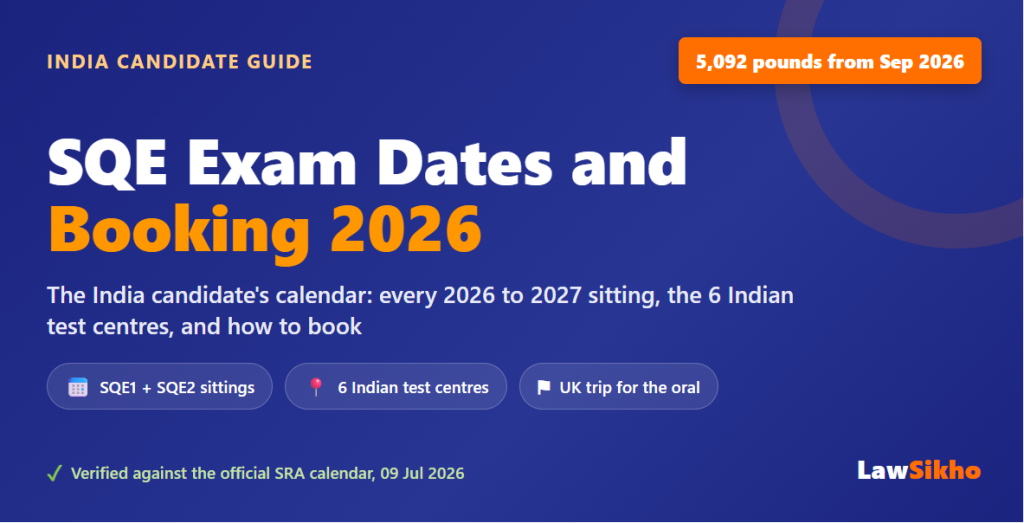
Now add money to the pressure. From September 2026 the combined cost of sitting both stages crosses £5,092: SQE1 rises to £2,006 and SQE2 to £3,086 after the latest SRA fee increase. And here’s the wrinkle most candidates miss. The October 2026 SQE2 is the very first sitting to charge the higher fee. So the two forces you’re actually fighting are a moving booking deadline and a rising price, and they don’t move in your favour.

Widen the lens and the stakes get more interesting, not less. In its first four years the SQE was sat by more than 30,000 candidates across 50 countries. You can now book it from six Indian cities: Bangalore, Chennai, Gurugram, Hyderabad, Mumbai and New Delhi. That is a genuinely international route to qualification, and an Indian lawyer can start it without leaving home.
But one component refuses to travel. The SQE2 oral assessment is still tethered to England and Wales. So an Indian candidate can sit SQE1 and the SQE2 written assessment from a Pearson VUE centre down the road, then must physically fly to the UK for the final oral stage. That single fact reframes the entire booking exercise, because it turns a date-picking task into a visa, travel and budget plan.
Here’s the good news for the advocate in Bengaluru, and for you. The July window closing wasn’t the end of the road. The October 2026 SQE2 was still open, the January 2027 SQE1 dates were already published, and a clear-eyed booking plan turned a missed deadline into a well-sequenced two-year run at qualification. That’s the difference a real calendar makes.
This guide consolidates every verified 2026 to 2027 SQE sitting, tells you which one you can still book, walks you through booking from India, names the six Indian test centres, and flags the money-and-visa traps. Everything is cross-checked against the official SRA calendar as of 09 July 2026. Before the full calendar, the one question every Indian candidate asks first.
Can you take the SQE in India? Yes. You can sit SQE1 and the SQE2 written assessment at Pearson VUE test centres in six Indian cities: Bangalore, Chennai, Gurugram, Hyderabad, Mumbai and New Delhi. Only the SQE2 oral must be sat in England or Wales, so a short UK trip is required for that final stage.
So how do you turn that into an actual booking? The rest of this guide moves from the full dated calendar to which sitting to choose, how to book from India, where you sit each stage, what it costs, and how to protect your money if plans change.
SQE 2026 to 2027 exam dates at a glance (the calendar you can actually book from)
The single biggest problem with SQE dates isn’t finding them. It’s that the official information is scattered across six different SRA pages: booking windows on one, written locations on another, oral locations on a third, cost on a fourth. A planner has to stitch them together and hope nothing has moved. So here is the whole thing in one place, cross-checked against sqe.sra.org.uk and status-tagged as of today.
Before you read a single date, know what you’re actually booking. SQE1 is two multiple-choice papers, FLK1 and FLK2, testing functioning legal knowledge. SQE2 is a skills assessment split into a written part and an oral part. If those labels are new to you, it’s worth a two-minute detour to understand what the FLK1, FLK2, written and oral stages actually involve before you commit money to a sitting.
The consolidated SQE1 and SQE2 calendar (2026 to 2027), status-tagged
| Sitting | Exam dates | Booking closes | Results | Status (09 Jul 2026) |
|---|---|---|---|---|
| SQE1, July 2026 | FLK1 13 to 17 Jul, FLK2 20 to 24 Jul | 28 May 2026 | 8 Sep 2026 | CLOSED (exam imminent) |
| SQE2, July 2026 | Written 28 to 30 Jul; Oral 4 to 7 Aug | 10 Jun 2026 | 17 Nov 2026 | CLOSED |
| SQE2, Oct 2026 | Written 27 to 29 Oct; Oral 3 to 11 Nov | 18 Sep 2026 | 23 Feb 2027 | OPEN, book this |
| SQE1, Jan 2027 | FLK1 11 to 15 Jan, FLK2 18 to 22 Jan | TBC (aggregators say 20 Nov 2026, unconfirmed) | TBC (aggregators say 8 Mar 2027) | Dates published; booking TBC |
| SQE2, Jan 2027 | Oral 26 to 29 Jan; Written 2 to 4 Feb 2027 | TBC (not yet published by SRA) | TBC | Dates published |
| SQE2, Apr 2027 | Written 20 to 22 Apr and 4 to 6 May; Oral 26 to 29 Apr and 11 to 14 May | TBC (not yet published by SRA) | TBC | Dates published; ~4-week extended window |
| SQE1, Jul 2027 | FLK1 12 to 16 Jul, FLK2 19 to 23 Jul | TBC (not yet published by SRA) | TBC | Dates published |
| SQE2, Jul 2027 | Oral 27 to 30 Jul; Written 3 to 5 Aug 2027 | TBC (not yet published by SRA) | TBC | Dates published |
Read the status column first, then the dates. That’s the order that actually helps you make a decision, because a perfect date you can no longer book is just trivia.
SQE1 runs twice a year, January and July only
This is the fact aggregators get wrong most often, so let’s be precise. The SRA runs SQE1 twice a year: once in January, once in July. That’s it. There is no standard October SQE1 and no standard April SQE1, whatever a coaching site’s date table tells you.
The SRA has said it “will continue to monitor demand for introducing additional SQE1 sittings (e.g. April and October) when appropriate.” Read that carefully. It is a statement about possible future capacity, not a confirmed extra sitting. Treat SQE1 as a two-window-a-year exam and plan around January and July, and you’ll never build a study calendar around a date that doesn’t exist.
SQE2 runs four times a year, January, April, July and October
SQE2 is the more flexible of the two, with four windows a year: January, April, July and October. That flexibility matters for Indian candidates, because it gives you more chances to slot the assessment around a UK trip and a visa. From 2027 the April SQE2 window expands to roughly four weeks, making it the largest delivery of the year (more on why that matters for slot competition later).
Why does the cadence difference exist? SQE2 tests skills through more assessor-intensive oral and written stations, and the SRA spreads that load across more windows. For you, the practical takeaway is simple: SQE1 forces a January-or-July decision, while SQE2 gives you room to manoeuvre.
What you can still book as of today (09 July 2026)
Here’s where the status tags earn their keep. As of 09 July 2026, both July 2026 sittings are closed. The next thing you can actually book is the October 2026 SQE2, with booking closing 18 September 2026. After that, the January 2027 SQE1 dates are published (FLK1 11 to 15 January, FLK2 18 to 22 January 2027), but its booking-close date has not yet been officially confirmed by the SRA.
In practice, dates publish about 12 months ahead and booking closes roughly five weeks before the window. What most people miss is that “published” and “bookable” are two different states. A 2027 date can be on the SRA calendar for months before its booking window opens, so seeing the date is not the same as being able to reserve a seat. Check the booking-window page, not just the date list.
Which SQE sitting should you book next?
Picking a sitting is really a scheduling problem dressed up as a date question. The right window isn’t the soonest one; it’s the one that gives you enough prep runway, sits at a fee tier you’re comfortable with, and still has a seat in your city. Get those three inputs right and the choice makes itself.
SQE1 January versus July, the Indian candidate’s trade-off
The cleanest way to choose is to work backwards. Take the exam date, subtract a realistic preparation period, and see whether the start date is sane. Most serious candidates give themselves around six months, and there’s a six-month SQE1 study plan you can work backwards from if you want a concrete runway to test against.
For a January SQE1, that means booking by roughly November and prepping through the Indian winter, Diwali and year-end included. For a July SQE1, you’d typically commit early in the year and study through spring and the monsoon. Neither is objectively better. But the question that actually decides it is which season your work and life leave room for sustained study. The practical reality is that most candidates who fail do so on preparation runway, not on the exam itself.
October versus January SQE2, cost and timeline
The October 2026 SQE2 has one thing the January 2027 SQE2 does not: it’s open right now. But it also carries the higher post-September fee of £3,086, because October is the first sitting charged at the new rate. So the trade-off is book-now-at-the-higher-fee versus wait-for-January-with-unconfirmed-booking-dates.
Our recommendation, for a candidate who is prep-ready, is not to wait purely to chase an uncertain date. A confirmed open window beats a published-but-unbookable one, and slot certainty is worth more than a small fee saving you may not even capture.
Should you book FLK1 and FLK2 in the same window or split them?
FLK1 and FLK2 sit on different days within the same SQE1 window (for July 2026, FLK1 ran 13 to 17 July and FLK2 20 to 24 July). You take both in the same sitting by default. Can you split them across two sittings? That’s a strategy some candidates use to reduce the load, but it doubles your exposure to booking deadlines and stretches your qualification timeline.
The second-order effect here is the one nobody flags. As Indian candidate volume rises, the binding constraint stops being “can I qualify?” and becomes “can I get a seat in my city on my date?” Slot scarcity, not eligibility, is the real limiter. And fee-rise timing makes it worse: when rational candidates rush to book a cheaper pre-October 2026 SQE2, they compress demand into specific windows, tightening exactly the slots you want. So the second-order lesson is to book early not because prep is done, but because the seat may not be there later.
How to book the SQE from India, step by step
Booking the SQE from India isn’t hard once you know the sequence, but the first attempt trips almost everyone up. The reason is a two-account system that isn’t obvious until you’re in it, plus a booking window that opens on UK time while you’re asleep. Before you start, it’s worth taking two minutes to confirm you meet the SQE eligibility and exemption requirements, because there’s no point booking a sitting you’re not yet cleared to take.
Here is the booking sequence, start to finish.
- Create a mySRA account and register your intention to take the SQE.
- Receive your unique SQE candidate number.
- Set up your separate SQE assessment account (run through Kaplan and Pearson VUE).
- Wait for the booking window to open (dates publish about 12 months ahead).
- Choose your assessment, sitting and Indian test centre, or complete the seat-reservation form if you’re required to.
- Pay the fee by card in GBP (see the payment-from-India note below).
- Confirm your reasonable-adjustments application before the booking deadline if you need adjustments.
- Save your confirmation and note the cancellation and reschedule deadlines.
mySRA account versus your separate SQE assessment account
This is the number-one source of confusion, so slow down here. The mySRA account is your record with the regulator: it’s where you register your intention and get your candidate number. The SQE assessment account is a separate thing, run through Kaplan and Pearson VUE, and it’s where you actually choose a sitting and pay. You need both, in that order, and they’re linked by your candidate number.
Skipping straight to the assessment account doesn’t work, because without a mySRA registration you have no candidate number to link. Set up mySRA first, always.
Getting your SQE candidate number
Your candidate number is the thread that ties the two accounts together. You get it after registering your intention to sit the SQE through mySRA, and you’ll need it to open and verify your assessment account. Treat it like an enrolment number: save it somewhere you won’t lose it, because you’ll reference it at every stage.
Seat-reservation form versus direct booking, which path you’re on
Most candidates book directly: window opens, you log in, you pick your assessment, sitting and centre. In some cases, though, you’ll be routed to a seat-reservation form instead of an instant booking, particularly around reasonable adjustments or specific location constraints. If that happens, the form is your booking path, and getting it in early matters just as much as a direct booking, because seats are still allocated on a first-come basis.
Booking on UK time (and why an Indian booker should be online early)
Booking windows open on UK time, which means a UK morning is your India afternoon. That’s actually convenient, if you know it’s coming. The candidates who get caught out are the ones who assume they can book “sometime this week” and log in on day three to find their preferred Mumbai or Delhi slot gone.
So what does this mean for you? Diarise the opening in IST, be logged in with your candidate number ready, and treat the first hour like it matters. Because for a popular city on a popular date, it does. Paying the fee is straightforward once you’re in: it’s a GBP card payment, so use a card enabled for international transactions and expect a forex conversion on your statement. For the full rupee budget rather than the GBP headline, we’ll point you to the deep-dive cost post in the fees section below.
The 6 Indian test centres and the SQE2-oral UK trip
Here’s the assumption that quietly derails Indian candidates: that the whole SQE can be done remotely, or at least entirely from India. It can’t. Where you physically sit each stage is the single most important logistics fact in this guide, and it splits neatly in two. SQE1 and the SQE2 written assessment are sit-able from India. The SQE2 oral is not.
The 6 Indian Pearson VUE cities
For SQE1 and the SQE2 written assessment, you have six Indian Pearson VUE test centres to choose from: Bangalore, Chennai, Gurugram, Hyderabad, Mumbai and New Delhi. That’s a real convenience, because it means the bulk of the SQE can be sat within a domestic train or flight of most candidates.
The catch? These six cities serve a growing candidate pool, and slots in the busiest centres go first. A candidate in Mumbai or Delhi competing for a popular date is in a different situation from one in a quieter city, and the difference shows up as availability. India is one of more than 50 countries with written test centres, so the global footprint is large, but your practical choice is these six.
The SQE2-oral England and Wales-only trap
Now the fact that changes everything. The SQE2 oral assessment is offered only in England and Wales, at four venues: London, Birmingham, Manchester and Cardiff. There is no Indian oral centre, no remote option, no workaround. To complete qualification, an Indian candidate must physically travel to the UK for the oral stage.
This isn’t a minor footnote. It converts the final stage of your SQE from a booking task into a travel-and-visa project, and it needs to be planned months ahead, not discovered late. A common question we hear is some version of “I assumed I could do it all from India, is that wrong?” Yes, for the oral, it is wrong, and finding that out early is a gift.
Sitting SQE2 Written in India versus on the same UK trip as the oral
Because the oral forces a UK trip anyway, you get a genuine choice for the SQE2 written. You can sit it at your Indian Pearson VUE centre, or you can sit it in the UK on the same visit as the oral. Batching both into one UK trip can save you a second flight and a second round of arrangements, if the written and oral fall in the same window.
In practice, experienced candidates weigh the cost of a longer UK stay against the cost of two separate trips. There’s no universal answer, but the option exists, and most first-timers don’t even realise it’s on the table. If you ask us, batching is usually the smarter call when your written and oral fall in the same window, purely because a second international trip rarely pays for itself.
Visa, travel and budget for the mandatory UK oral trip
Plan the UK trip as its own workstream. You’ll need to budget for flights, accommodation for the oral window, and the appropriate UK entry route (the gov.uk standard visitor route is the usual starting point for exam travel, though you should verify the exact category for your circumstances). Start early, because a visa slip doesn’t just cost you the trip.
And this is the pitfall that hurts most. The SQE2 oral cannot be rescheduled, so if your visa doesn’t come through in time, you can lose your slot and fall foul of the refund ladder (which, for a late SQE2 cancellation, can mean getting nothing back). We’ll break down that ladder shortly. For now, the rule is simple: begin the visa process before you book the oral, not after.
SQE fees in 2026 and the September fee rise
So how much does the SQE actually cost in 2026, and did the number just move? Cost is often the deciding factor in which sitting a candidate books, so it pays to know the numbers cold. The headline: the SQE got more expensive from September 2026, and the combined cost of both stages now crosses £5,000. Here is the fee picture, before and after the rise.
The 2026 fee table (before versus after September 2026)
| Fee | To Sep 2026 | From Sep 2026 |
|---|---|---|
| SQE1 (FLK1 + FLK2) | £1,934 | £2,006 |
| SQE2 (full) | £2,974 | £3,086 |
| Combined SQE1 + SQE2 | £4,908 | £5,092 |
The increase is roughly 3.7%, driven by inflation and a small uplift for Welsh translation. All SQE fees are VAT-exempt, so the figure you see is the figure you pay. For the full rupee picture rather than the GBP headline, see the full rupee cost of the SQE for Indian lawyers, which breaks down forex, travel and the total INR outlay so we don’t duplicate it here.
When the new fee bites, SQE2 bookings from October 2026
The timing rule is precise, and it’s the one that catches people. The new fees take effect from the September 2026 start of the academic year, and they apply to any candidate who books to take the SQE2 from October 2026 onwards. That makes the October 2026 SQE2 the very first sitting charged at the higher £3,086 rate.
So a candidate weighing July (now closed) against October should know that October is dearer, not cheaper. It’s a rare case where waiting costs you money rather than saving it.
Resit, appeal and other fees
Fail a part and you pay to sit it again. An SQE1 resit is £967 for one part or £1,934 for both; an SQE2 resit is £2,974 for the full assessment. There is no discounted “one part only” SQE2 resit, which is worth knowing before you book. Appeals cost £350 at the first stage and £850 at the final stage, and both are refunded if your appeal is upheld. Every one of these fees is VAT-exempt. And the reason we labour the resit numbers is simple: the mistake we see most often is candidates budgeting only for a clean first pass, then getting blindsided by a four-figure resit bill.
Reschedule, cancel, refunds and reasonable adjustments
Plans change, visas slip, and prep sometimes isn’t where you hoped. So if you have to walk away from a booked sitting, how much of your money actually comes back? The honest answer is: it depends entirely on when you pull the trigger. The SRA runs a sliding refund ladder, and it’s steeper than most candidates expect, so let’s map it precisely.
The SQE1 cancellation and refund ladder
| When you cancel | You get back |
|---|---|
| Within 14-day cooling-off period | 100% |
| Before 2 weeks prior to booking deadline | All but £30 |
| 4+ weeks before the window | 75% (25% charge) |
| 96+ hours before your slot | 25% (75% charge) |
| Within 96 hours or no-show | Nothing (100% charge) |
Read that bottom row twice. Cancel or fail to show within 96 hours of your SQE1 slot and you lose the entire fee. The ladder rewards early decisions and punishes late ones, exactly like the booking calendar does.
The SQE2 cancellation and refund ladder
| When you cancel | You get back |
|---|---|
| Within 14-day cooling-off period | 100% |
| Before 2 weeks prior to booking deadline | All but £250 |
| 4+ weeks before the window | 75% (25% charge) |
| 14+ days before the window | 25% (75% charge) |
| Within 14 days or no-show | Nothing (100% charge) |
The SQE2 ladder is harsher at the top: the flat charge for an early cancellation is £250, not £30, reflecting the higher fee and the assessor logistics. And the final cliff is wider too, at 14 days rather than 96 hours. For an Indian candidate, this is where a visa delay for the oral trip becomes a financial event, not just an inconvenience.
What you can reschedule (written yes, oral no) and venue changes
You can reschedule a written assessment while the booking window is still open, subject to availability. The oral cannot be rescheduled, full stop. That asymmetry is the single most important scheduling fact for anyone planning the UK trip, because it removes your safety net exactly where you most need one.
Venue-change requests are possible too, but they must reach the SRA no later than the booking deadline and are subject to availability. So if you want to move from, say, a Chennai centre to a Mumbai one, do it before the deadline or not at all.
Reasonable-adjustments deadline, apply before the booking deadline
If you need reasonable adjustments (extra time, specific equipment, accessibility support), the binding rule is that you must apply before the booking deadline for the relevant assessment. Some aggregators cite a “10 weeks prior” target; treat that as a best-practice guideline, not the legal cutoff. The official rule is the booking deadline.
Miss it, and you may be forced to sit without your adjustments or defer the whole sitting, which drops you back onto the refund ladder. What experienced candidates know is to file the adjustments application as early as possible, ideally before the booking window even opens, so it never becomes a deadline race. And if illness or an emergency hits on the day itself, that’s the mitigating-circumstances route, which is separate from cancellation and worth reading up on in advance.
When your results land, and how a pass flows into the next sitting
So once you have sat the exam, how long until you actually know? Results timing isn’t just trivia; it dictates whether you can book your next stage or have to wait a cycle. The two stages release results on very different clocks, and understanding the gap is what lets you sequence SQE1 into SQE2 without dead time. Here’s how the timing works.
SQE1 results, about 5 to 6 weeks after the assessment
SQE1 results land roughly five to six weeks after the assessment. For the July 2026 SQE1, that means results on 8 September 2026. Because SQE1 is machine-marked multiple choice, the turnaround is relatively quick and predictable, which is good news for planning your next move.
SQE2 results, about 14 to 18 weeks after the assessment
SQE2 takes far longer: roughly 14 to 18 weeks, because both the written and oral components are marked by assessors. For the October 2026 SQE2, results are scheduled for 23 February 2027. That’s a long wait, so factor it into any timeline that depends on being a qualified solicitor by a particular date.
How a January or July SQE1 pass flows into the next SQE2 window
Here’s the planning fact that ties it together. SQE1 results usually land while the next SQE2 booking window is still open. So a January or July SQE1 pass can flow straight into the following SQE2 sitting without a wasted cycle, if you’ve watched the overlap.
The mistake we see most often is candidates assuming their SQE1 results will already be out before they need to book SQE2, then discovering the booking deadline sits before the results date. Don’t book SQE2 blind, but do check the overlap, because in most cycles it works in your favour. One more clock to keep in view: you get three attempts at each stage within a six-year period that starts from your first assessment, so a resit still needs to fit inside that window.
Planning your sittings around QWE and the UK visa
Most candidates plan three things separately: their exam dates, their two years of Qualifying Work Experience, and their UK visa. Then those three collide. Sequencing them together from the start is what turns a stressful scramble into a controlled two-year run at qualification. So how should the pieces fit?
Sequencing SQE1 to SQE2 around 2 years of Qualifying Work Experience
The good news for Indian candidates is that Qualifying Work Experience can largely be completed in India and can run in parallel with your prep and your sittings. It doesn’t have to sit in a neat block before or after the exams. If you’re unsure what counts, it’s worth understanding how to complete your two years of Qualifying Work Experience before you lock your exam dates, because the QWE clock and the exam clock are easier to run together than to stack.
A sensible rule is to sequence the UK oral trip after your QWE has momentum, not mid-training. That way your travel and visa disruption lands when your work experience can absorb it, rather than when you’re trying to build it.
Timing the UK oral trip against your visa
The oral is the only stage that forces a UK visit, and it’s also the stage you cannot reschedule. Put those two facts together and the conclusion is unavoidable: start your visa process before you book the oral, and book the oral into a window that leaves a visa buffer. Working the other way round, booking first and hoping the visa keeps pace, is how candidates end up forfeiting a slot on the refund ladder.
Future outlook, extra SQE1 sittings and the expanding April 2027 window
Two forward signals are worth watching, because both could reshape India-candidate planning. First, the SRA has said it will monitor demand for introducing additional SQE1 sittings, potentially in April and October. If that happens, the rigid January-or-July choice loosens, which would help candidates who can’t make either current window. Early signals suggest this is on the SRA’s radar, but it is not confirmed, so plan around two SQE1 windows for now.
Second, and this one is confirmed: from 2027 the April SQE2 window expands to roughly four weeks, its largest delivery of the year. Practitioners expect that to relieve some pressure, but rising international demand may absorb the extra capacity quickly. Either way, the direction of travel is more candidates chasing seats, which is why booking early keeps getting more important each cycle. As a light comparison for anyone juggling both tracks, note that unlike the AIBE (which India’s Bar Council runs on its own annual cycle), the SQE’s fixed multi-window calendar is published a year ahead, so you can plan the two exams’ dates against each other well in advance.
Don’t trust “SQE 2026 dates” you see on coaching sites
Here’s a pattern worth naming, because it costs candidates real study time. Since the SQE launched in September 2021 (replacing the LPC route to qualification), a recurring problem has appeared every January: coaching and aggregator sites quietly relabel the previous completed cycle’s dates as “upcoming 2026” or “upcoming 2027.” A candidate then builds a six-month study plan around a date that has already passed.
Is that really so common? Yes, and you saw a live example earlier in this very guide. Recall the calendar’s flags: the “October SQE1” that some sites list doesn’t exist (they’ve confused SQE2’s four windows with SQE1’s two), and the Jan 2027 SQE1 booking date that aggregators cite as 20 November 2026 is unconfirmed by the SRA. Those aren’t hypothetical errors; they’re on live pages right now.
The fix is simple and non-negotiable. Verify every date against the official sqe.sra.org.uk booking-windows page before you plan around it. The regulator’s calendar is the only authoritative source, and a “date published” there still isn’t a “booking open” until the window actually opens. One more clarification, since it comes up: self-booking versus using a prep provider’s booking help makes no difference to the dates or the portal. Everyone books through the same official system, so a provider can guide you, but it can’t get you an earlier or different date than the SRA publishes.
Frequently asked questions about SQE dates and booking
What are the SQE exam dates for 2026? SQE1 sits in July 2026 (13 to 24 July), though its booking closed on 28 May 2026. SQE2 has July and October 2026 sittings; the October SQE2 (written 27 to 29 October, oral 3 to 11 November, booking closes 18 September 2026) is the one you can still book.
How many times a year is the SQE1 held? Twice, in January and July only. The SRA has said it is monitoring demand for possible additional sittings, but October and April SQE1 dates are not standard. Plan around the two fixed windows and treat any “extra” SQE1 date with caution until the SRA confirms it.
How many SQE2 sittings are there each year? Four, in January, April, July and October. From 2027 the April SQE2 window expands to about four weeks, making it the largest delivery of the year. That extra capacity is a response to rising demand, so book early even in the bigger window.
What are the SQE1 dates for January 2027? FLK1 sits 11 to 15 January 2027 and FLK2 sits 18 to 22 January 2027. The booking-close date has not yet been officially published by the SRA. Aggregators cite 20 November 2026, which is unconfirmed, so verify it on sqe.sra.org.uk before you plan around it.
What ID do I need on SQE assessment day? You need valid, government-issued photo ID whose name exactly matches your SQE booking. For Indian candidates that’s typically a passport. A name mismatch or an expired document can mean being turned away, so check the requirement on your confirmation well before the date and fix any discrepancy early.
How many attempts do I get at the SQE? You get up to three attempts at each of SQE1 and SQE2, within a six-year period that starts from your first assessment. Plan your sittings so that even a resit still fits inside that six-year window, because the clock does not pause between attempts.
How do I register for and book the SQE? Create a mySRA account and register your intention, receive your SQE candidate number, then set up your separate SQE assessment account. Once the window opens, book your assessment, sitting and test centre, pay the fee by card in GBP, and save your confirmation.
What is the difference between a mySRA account and an SQE assessment account? The mySRA account is your regulator record, where you register and get your candidate number. The SQE assessment account, run through Kaplan and Pearson VUE, is where you actually choose and pay for a sitting. You need both, set up in that order, linked by your candidate number.
How do I pay the SQE fee from India? Fees are charged in GBP and paid by card through the SQE assessment portal, so use a card enabled for international transactions and expect a forex conversion on your statement. For the full rupee cost picture, including travel and forex, see the dedicated SQE INR-cost guide linked in the fees section above.
Can I take the SQE in India? Yes, for SQE1 and the SQE2 written assessment, at Pearson VUE centres in Bangalore, Chennai, Gurugram, Hyderabad, Mumbai and New Delhi. The SQE2 oral is the exception: it’s held only in England or Wales, so that final stage always requires a short UK trip.
Do I have to travel to the UK for the SQE? Only for the SQE2 oral. SQE1 and the SQE2 written assessment can both be sat from India, but the oral component is offered only in London, Birmingham, Manchester or Cardiff. So budget for one UK visit, and start the visa process well before you book it.
Is there an October SQE1 sitting? No. SQE1 is held only in January and July. Some coaching sites list an “October” or “April” SQE1, but that appears to confuse SQE2’s four windows with SQE1’s two. Treat the official SRA calendar as the only reliable source for SQE1 dates.
Which Indian cities have SQE test centres? Six: Bangalore, Chennai, Gurugram, Hyderabad, Mumbai and New Delhi, all Pearson VUE centres for SQE1 and the SQE2 written assessment. Popular cities and dates fill quickly, so book as soon as your window opens to secure your preferred centre rather than settling for whatever remains.
How much does the SQE cost in 2026? Until September 2026, SQE1 is £1,934 and SQE2 is £2,974, so £4,908 combined. From September 2026 they rise to £2,006 and £3,086, so £5,092 combined. All fees are VAT-exempt, and resits and appeals cost extra on top of these figures.
Are SQE fees going up in 2026, and when does the rise take effect? Yes. The higher fees start from the September 2026 academic year and apply to any candidate booking the SQE2 from October 2026 onwards. That makes the October 2026 SQE2 the first sitting charged at the new £3,086 rate, so October is dearer than July, not cheaper.
When will I get my SQE1 results? About five to six weeks after the assessment, because SQE1 is machine-marked multiple choice. For the July 2026 SQE1, results are due on 8 September 2026. SQE1 results usually arrive while the next SQE2 booking window is still open, which helps sequencing.
When do SQE2 results come out? About fourteen to eighteen weeks after the assessment, longer than SQE1 because the oral and written components are marked by assessors. For the October 2026 SQE2, results are scheduled for 23 February 2027, so plan any qualification deadline around that wait.
Can I reschedule or cancel my SQE booking and get a refund? You can reschedule a written assessment while the booking window is open, but the oral cannot be rescheduled. Refunds follow a sliding scale, from a full refund in the 14-day cooling-off period down to nothing within 96 hours (SQE1) or 14 days (SQE2) of the assessment.
References (official sources)
- SRA SQE candidate hub
- Assessment dates and booking windows
- SQE1 and SQE2 written locations (Indian cities)
- SQE2 oral locations (UK only)
- SQE cost and fees
- How to book the SQE, step by step
- SQE assessment terms and conditions (Part D cancellation)
- Registering for the SQE
- 2027 assessment dates announcement
- SQE fees update and Annual Report 2024 to 2025
- Get a mySRA account
- gov.uk standard visitor route (for the SQE2 oral UK trip)
This article is for informational purposes only and does not constitute legal advice. For specific legal guidance, consult a qualified legal professional.



 Allow notifications